
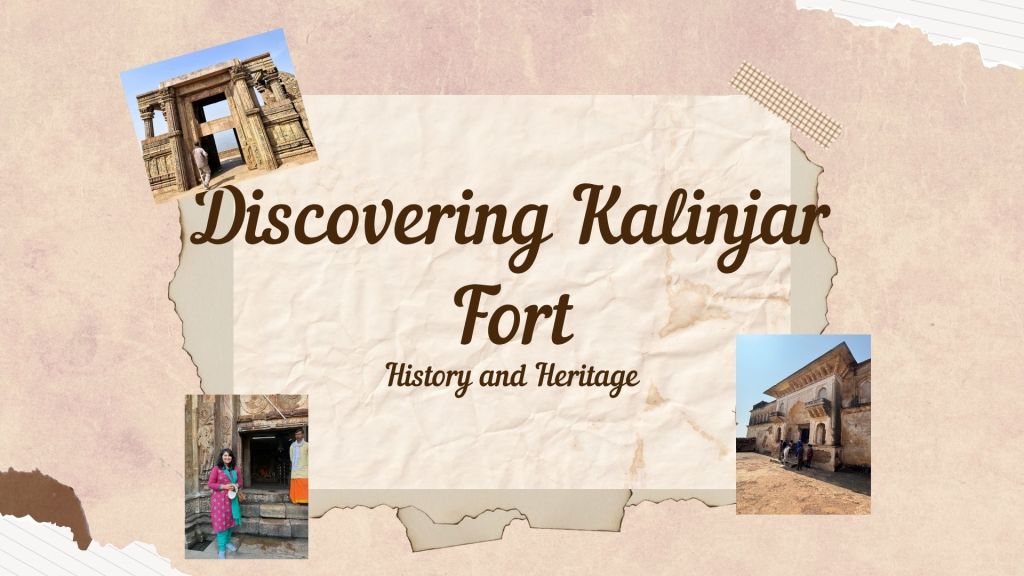
Did you read the Day Three of the Bundelkhand Trail blog post? If not, you can do so here. Experiences were overwhelming. A single post wouldn’t do justice to that whole road trip. So, I’m breaking down each day for you. Time for Day Four of the Trail – visiting Kalinjar!
Deep Dive India itinerary was delivering on its promise of adventure. Day Three had ended with Samir, Madhukar & I strolling in the Rahi Tourist Bungalow compound, me giving feedback and asking questions. Day Four began a cup of tea at the Tourist Bungalow.
No breakfast at the Rahi Tourist Bungalow as that was arranged at a local villager’s house enroute Kalinjar.
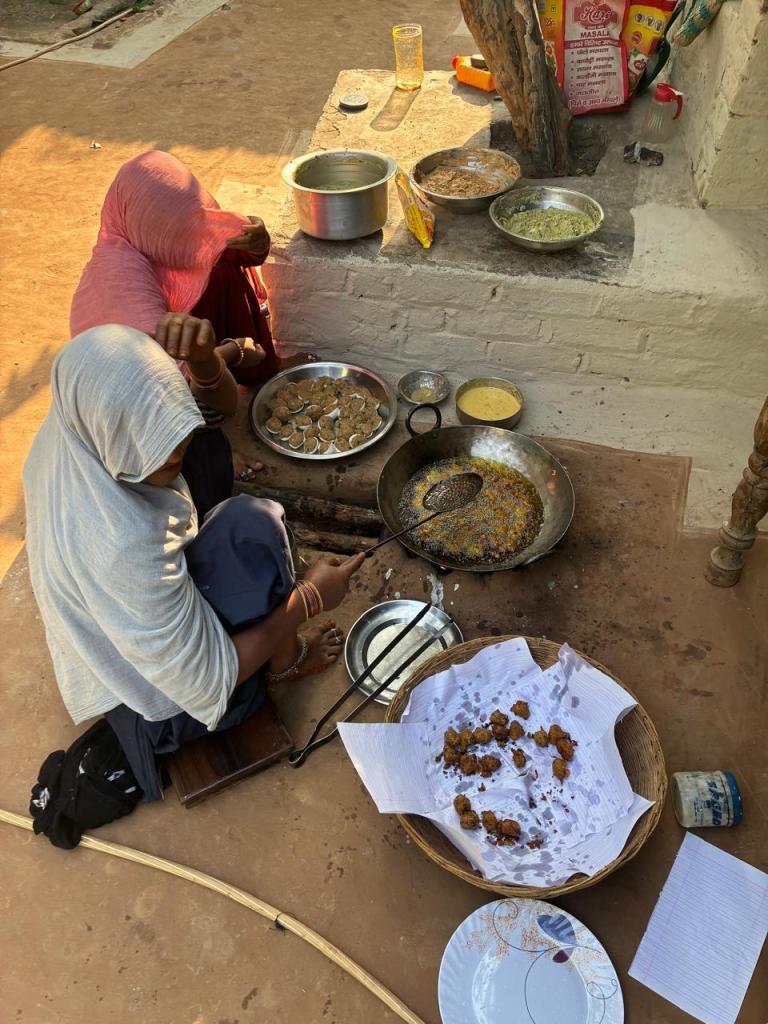
Breakfast Halt
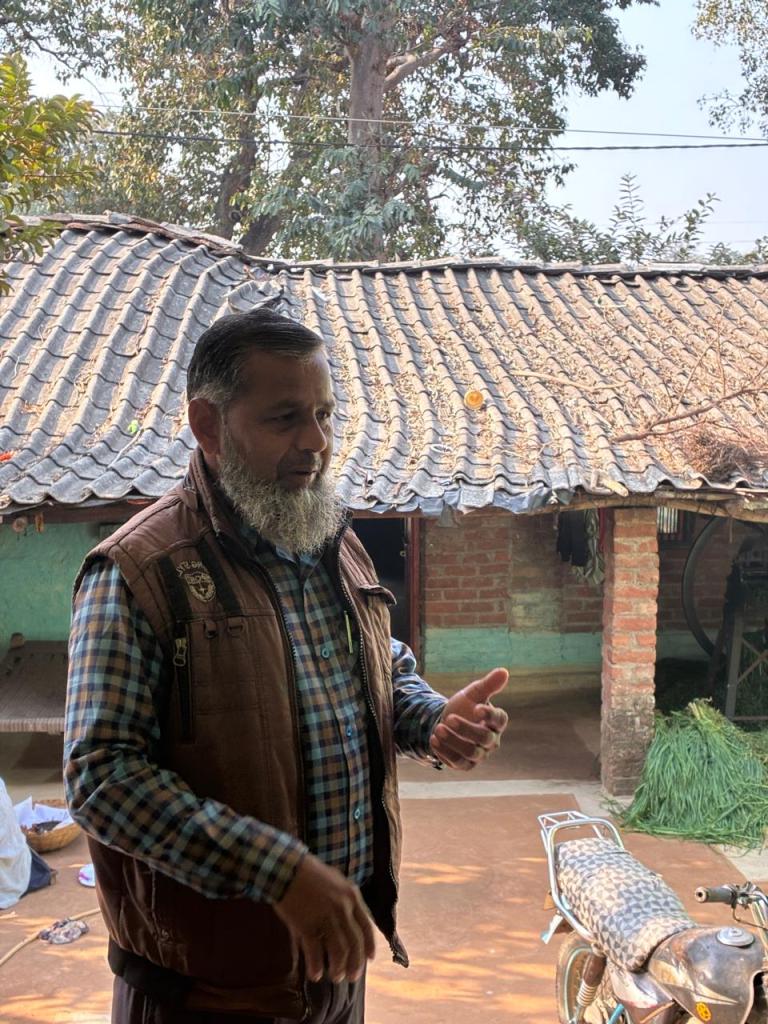
A short drive later, we were at the house of ‘Dr’ Umar Ali. His family is associated with Vanangana, a rural community-based women’s right collective. It creates platforms that allow women to come together. This enables them to identify common problems, confront them through collective action, and demonstrate the impact to the entire community.
The Ali family has volunteered to become a part of community – led tourism. Bundelkhand, despite its heritage and history, does not rank high on tourism. Through these community – led initiatives, it is hoped that the region can start interesting those who are keen on understanding cultural – economical – social aspects better.
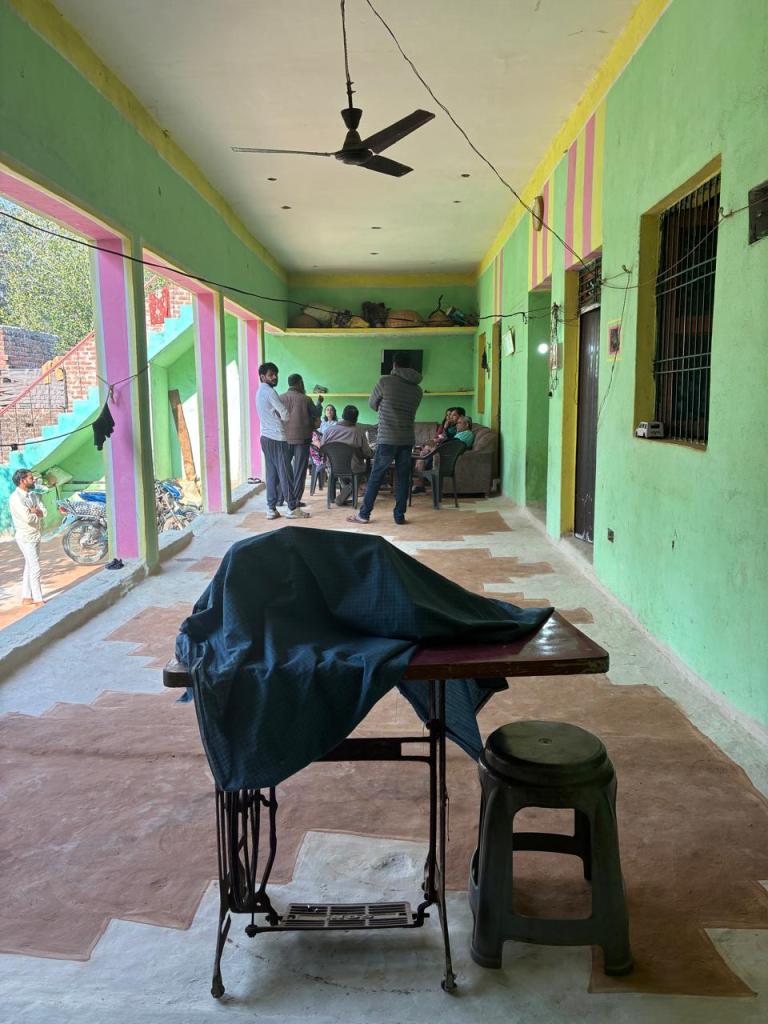
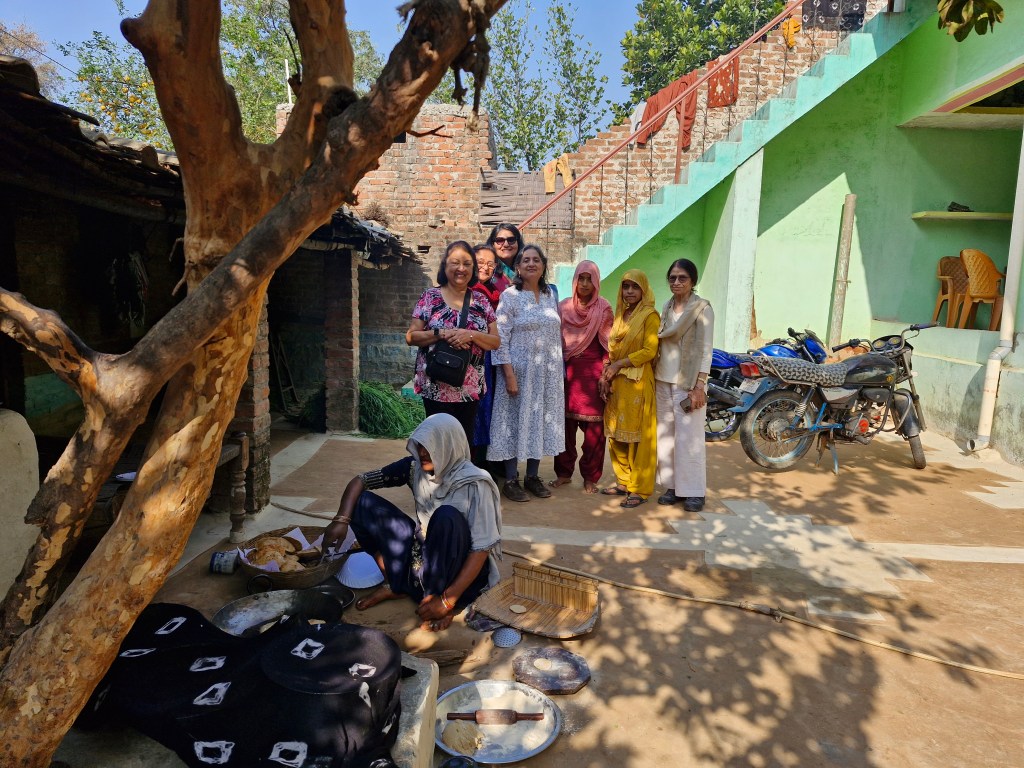
This was a traditional rural Indian dwelling. It had a vernacular architecture and use of natural, locally sourced materials. Such dwellings are climate-responsive. The heart was the open-air courtyard. It served as a social hub for family gatherings, rituals, and daily tasks like cooking and drying crops.
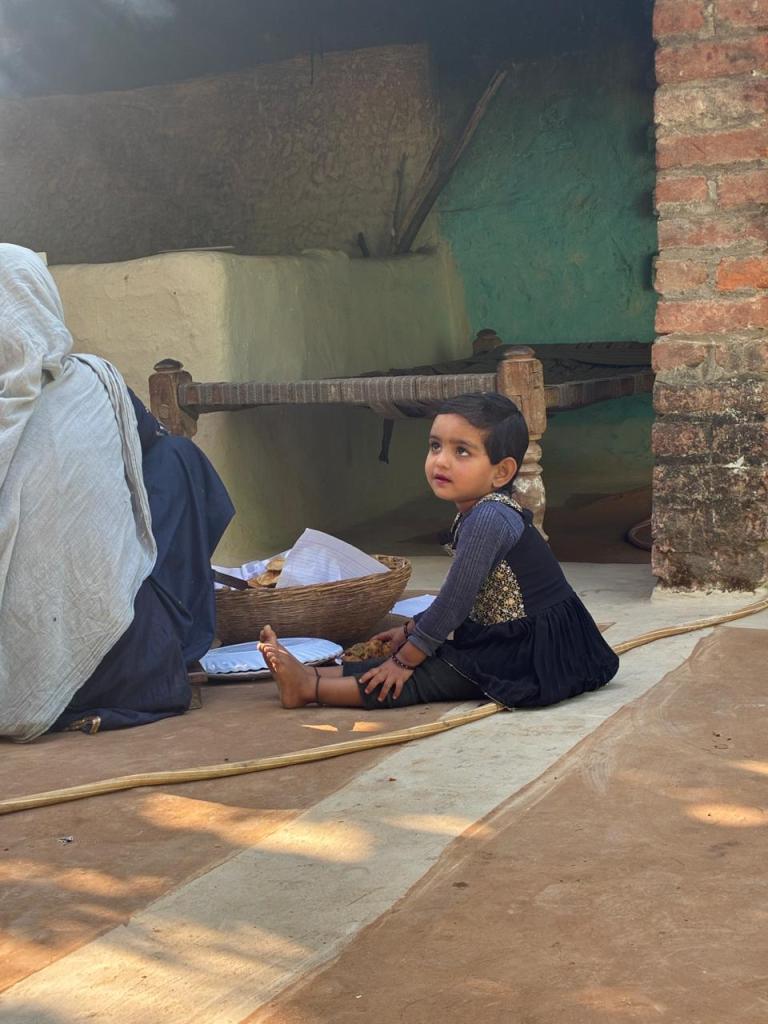
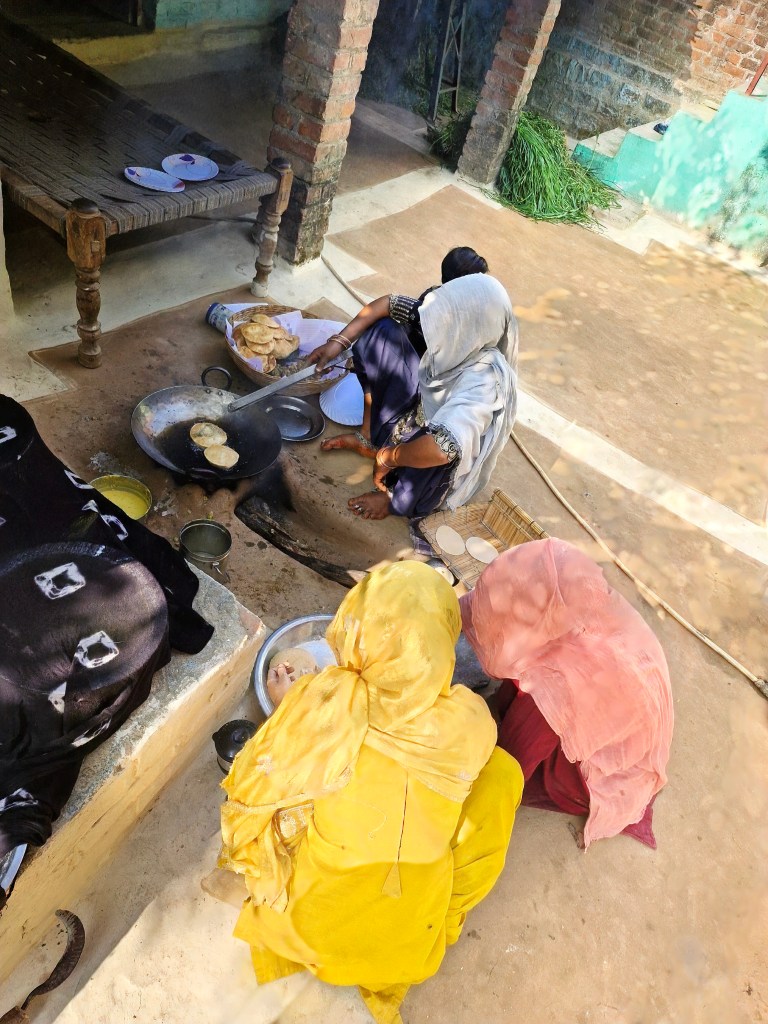
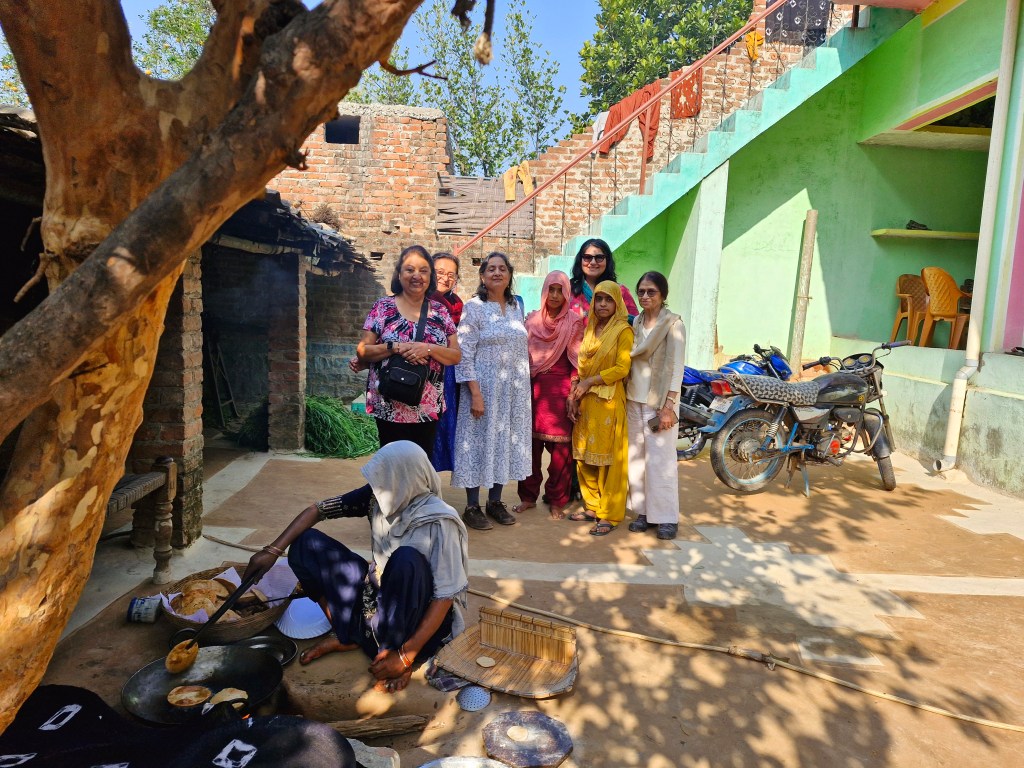
The dwelling demonstrated a transition between traditional and modern materials – earth & mud but also brick & mortar. The veranda allowed free-flowing ventilation. It provided a comfortable space for domestic activities sheltered from the sun.
And the veranda is where we were seated for our breakfast. In their humble abode, the family absolutely pampered us. The women cooked on a wood – fired chulha while the men of the house served us. As we waited for breakfast, Ali ji told us about their lives and their association with Vanangana.
Radhey bhaiya too chipped in with more details.
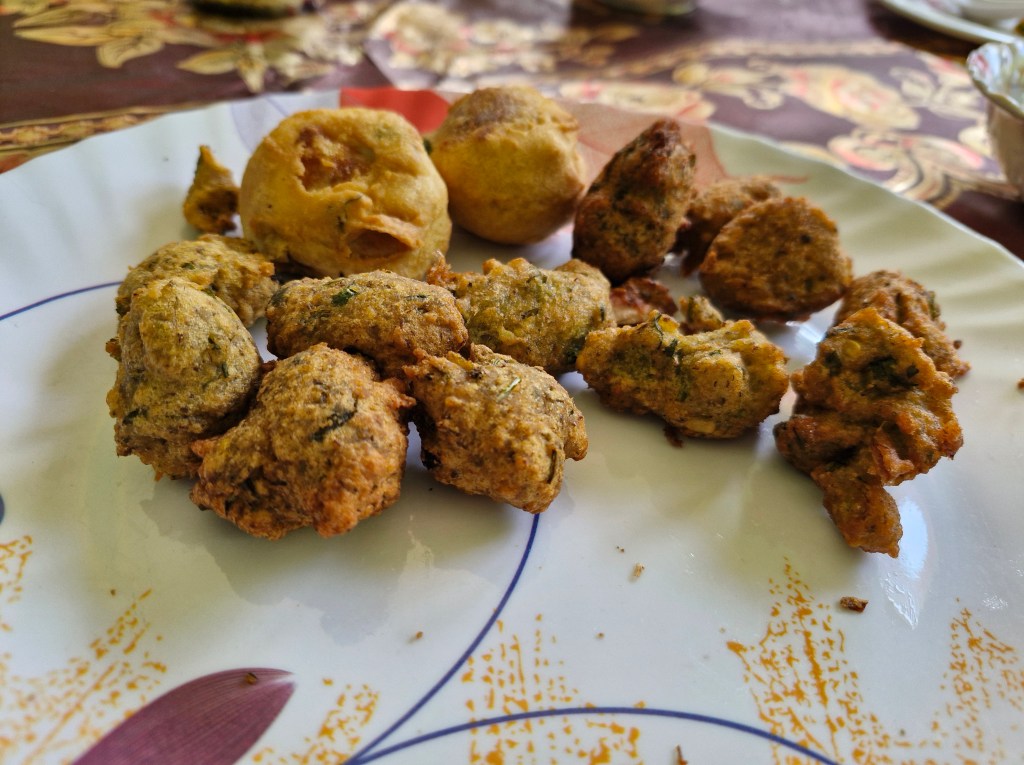
The breakfast spread was rooted in the local cuisine and oh – so – flavourful. We had pakodas of different kinds – moong, moong with vegetables and more. The pakodas were accompanied by one of the tastiest chutneys I’ve ever eaten! It seemed to be a potato & tomato chutney and now I am salivating just thinking of it!
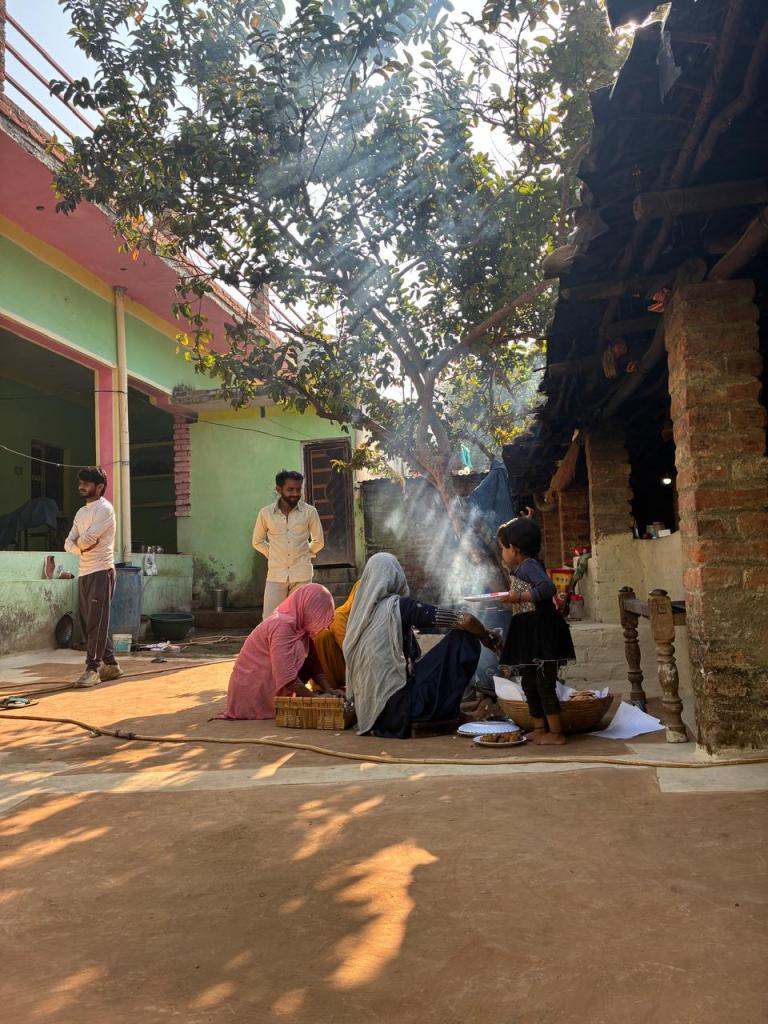
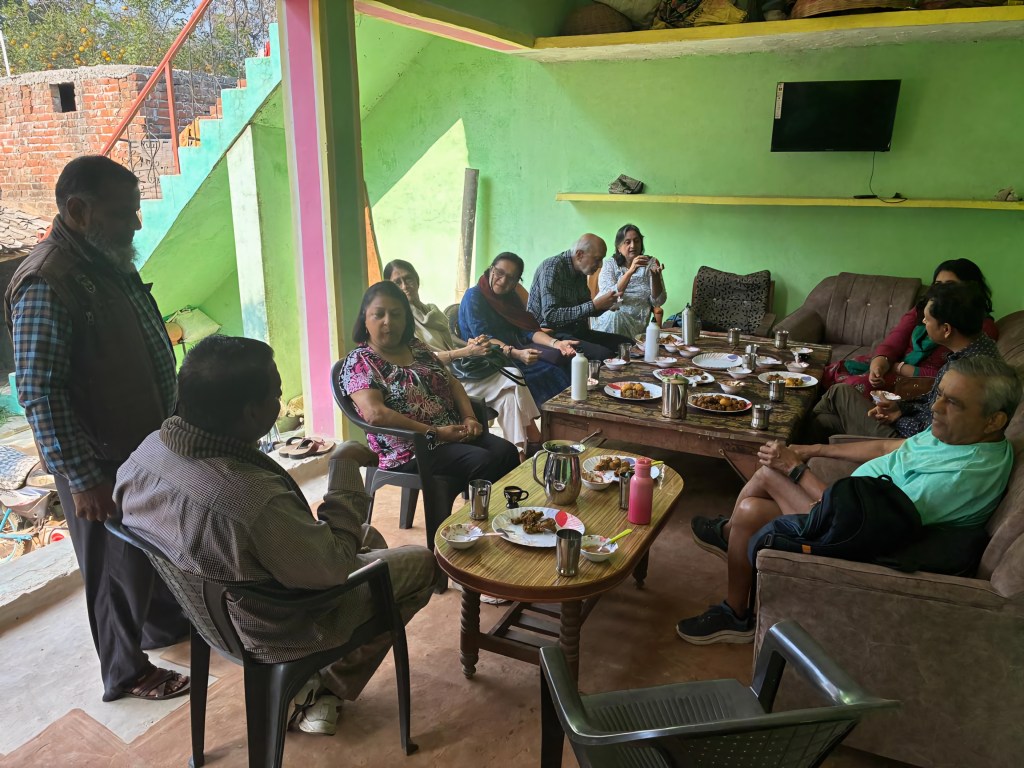
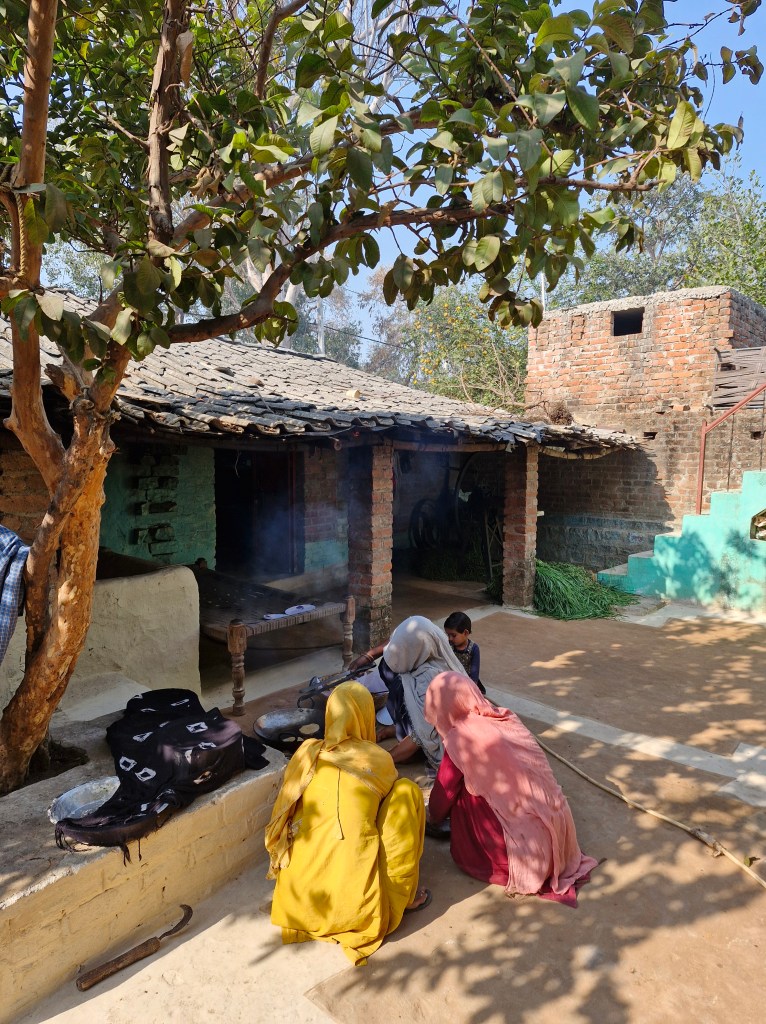
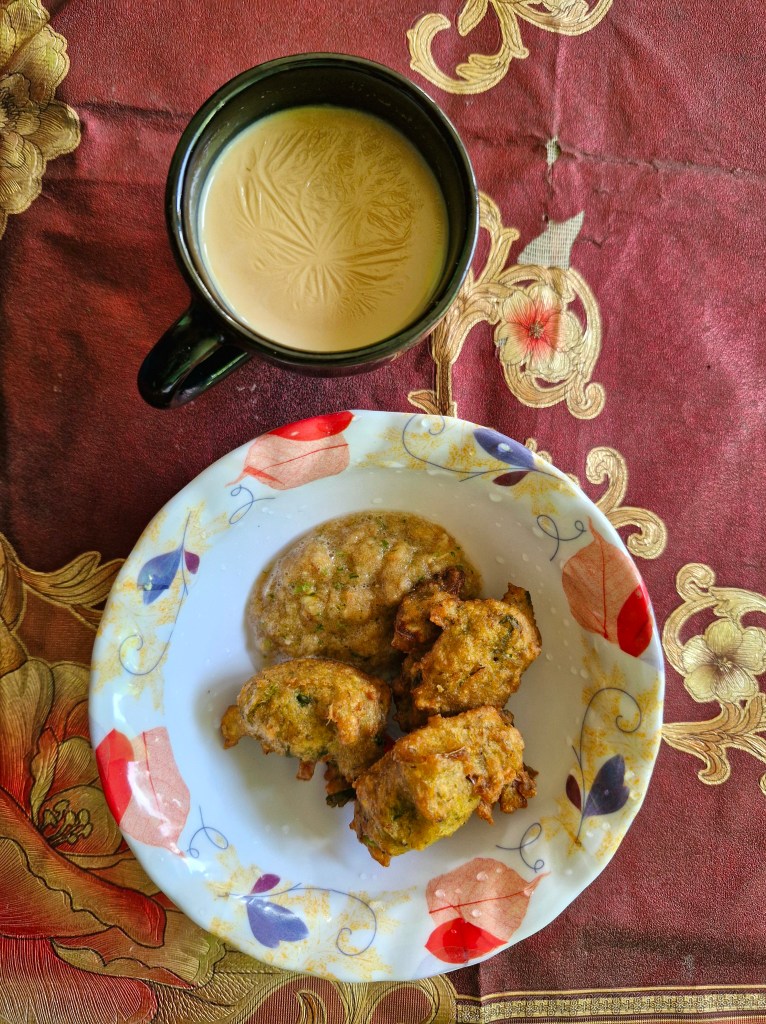
And then came a cup of tea that I greedily slurped down – it was made just to my liking! We thought pakodas were the sum total of the breakfast but we were wrong! That was followed by the ‘actual’ breakfast – pooris hot off the chulha and aloo ki sabzi.
Oh my God! I was in food heaven. The hosts were worried if we were liking the ‘simple’ meal or not. How do we tell them that it was one of the best meals we’d ever had? All of us thanked them profusely. The kindness of strangers is always overwhelming, isn’t it?
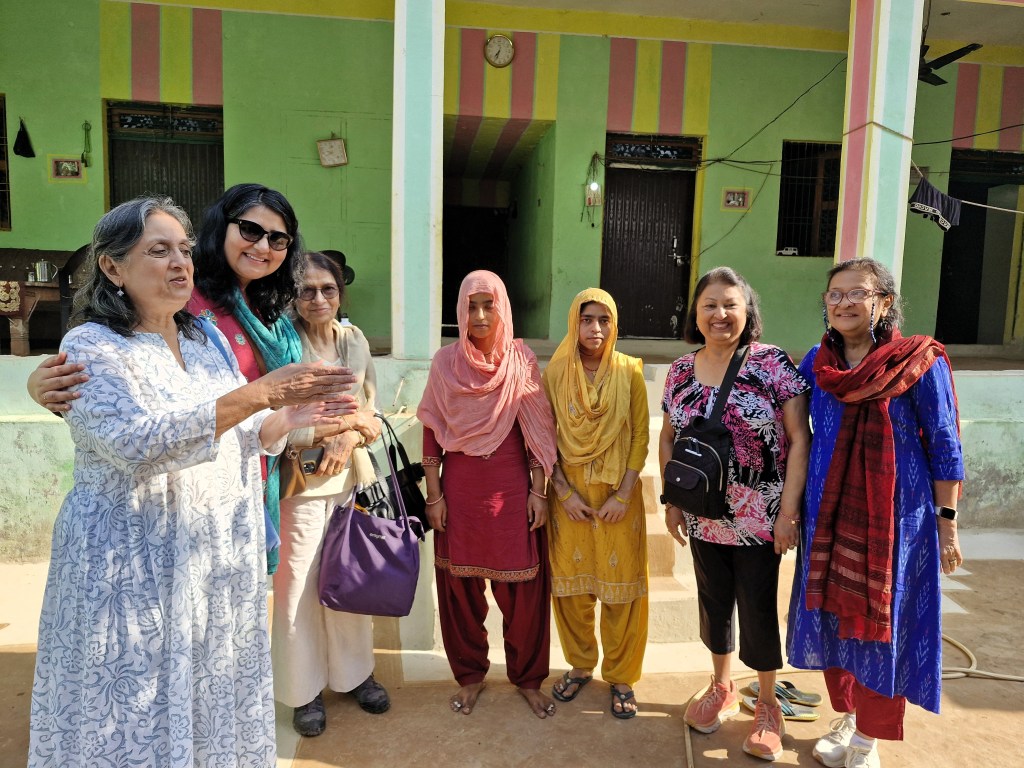
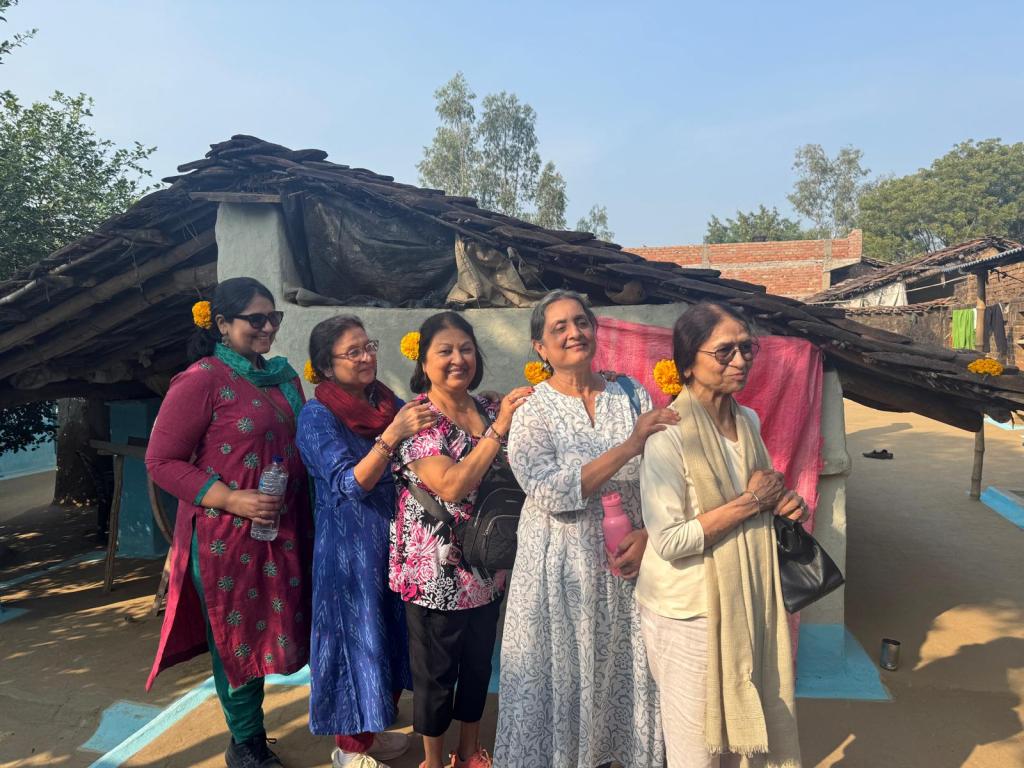
I’d loved the dwelling. It was sustainable compared to the concrete structures we inhabit. As we prepared to leave, I wanted a photo with the ladies of the house. But they were all in purdah and shy to come in front of the menfolk. So, we banished all the men outside the house.
The sweet ladies then giggled and obliged us with photographs. This made me so happy! And them too I feel. But, the littlest girl there, a child, disliked the fact that I was wearing sneakers with a suit! Ha ha! We pushed off after extended byes & thank yous.
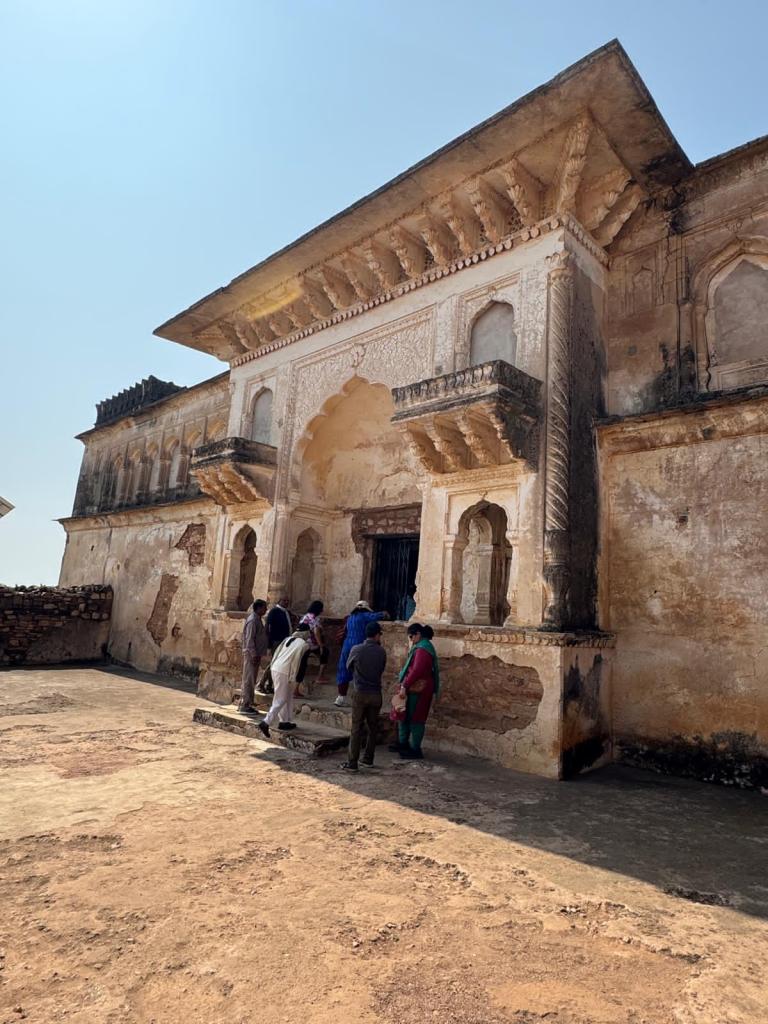
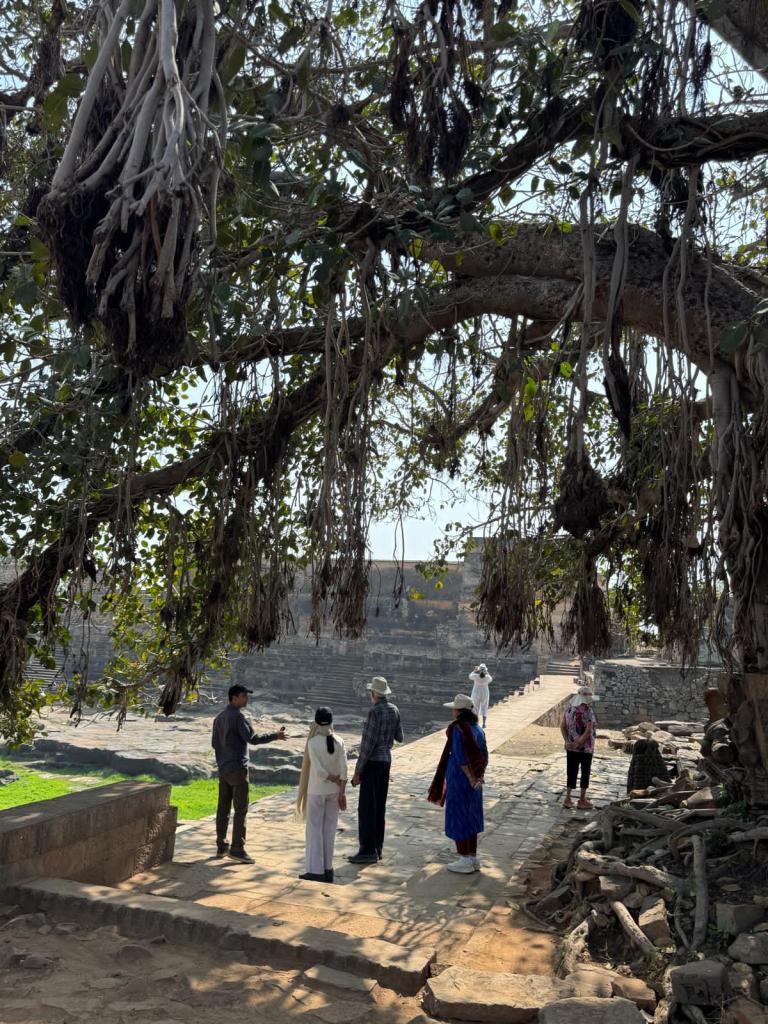
After an hour’s journey, we were at the Kalinjar Fort. It was hard to miss this magnificent construction even from kilometres away.
Kalinjar Fort
The name Kalinjar has its roots in Sanskrit where Kaal means death/ time & Jar means destruction/ subduing. Thus, it means ‘the destroyer of time’. This is because of its association with Lord Shiva. After the Samudra Manthan, He came to this area to consume the deadly poison halahala to save the earth.
The halahala turned Lord Shiva’s throat blue but He overcame its effects & achieved victory over death & time. This gave rise to this spot being called Kalinjar. The major attraction here is the Neelkanth (the one with the blue neck) Mahadev Temple about which I shall write shortly.
There is also a titanic statue of Kaal Bhairav carved in a sheer rock cliff.
The Kalinjar Fort is located in the Vindhyan region. This region is known for its ancient sedimentary rock formations. These formations date back hundreds of millions of years. Thus, the Kalinjar region contains evidence of the early Earth processes.
This makes it important for understanding the Earth’s geological evolution.
The Kalinjar Fort is the oldest and the strongest citadel in India. Within its premises are scattered temples from the Gupta period dating as far back as the third century BC, intricate friezes & statues carved in rock cliffs, numerous rock pools, palace ruins, courtyards, gateways, mosques & stepwells built over a millennium & a half.
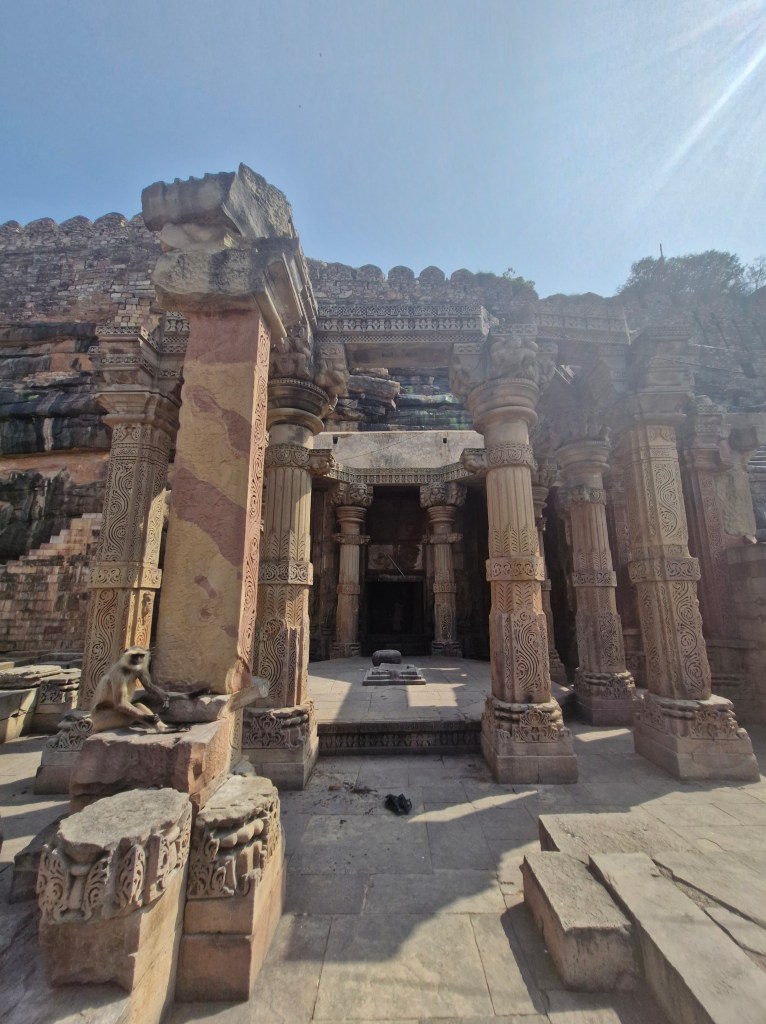
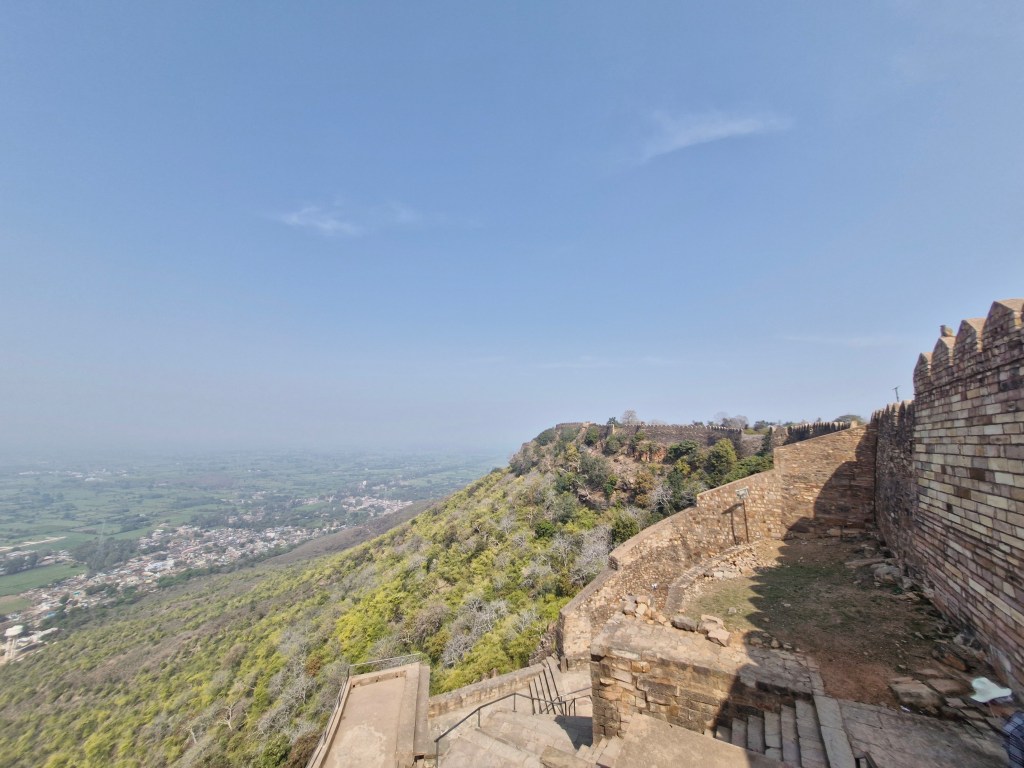
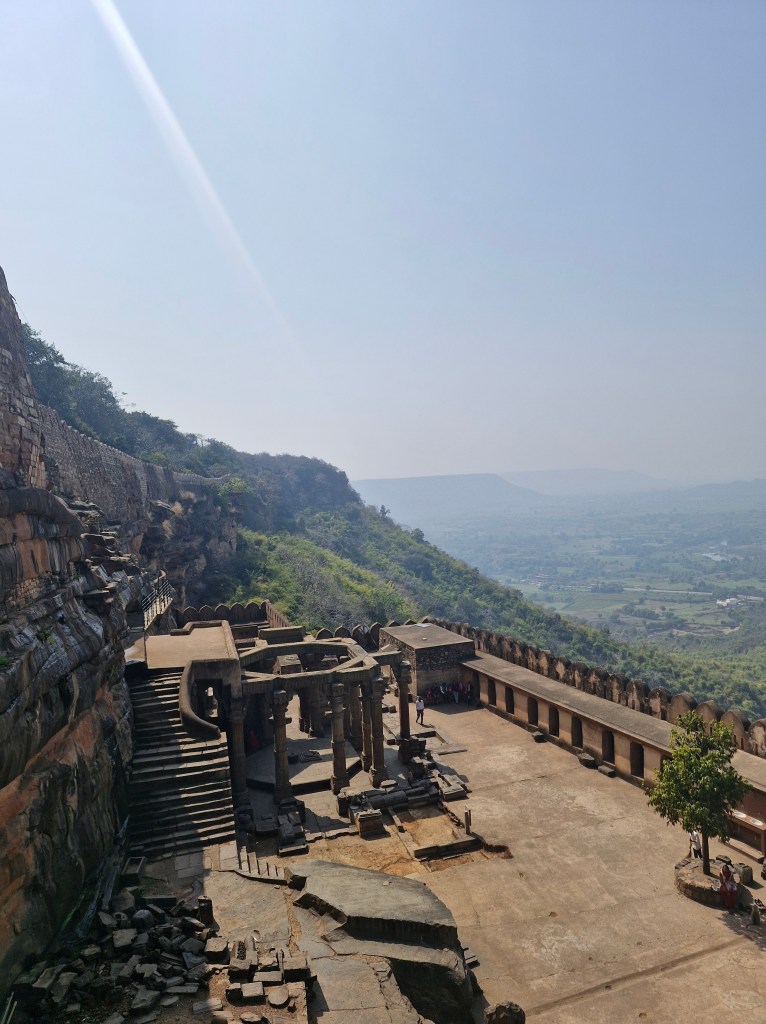
During the Mughal conquest, the Kalinjar Fort was captured by Akbar and granted to Birbal. Later, the British were not as generous to it as our ancestors had been. Today, in the tourism – deprived region of Bundelkhand, it encourages eco & heritage tourism.
The Kalinjar Fort also generates livelihood opportunities for the local communities.
You can visit the Kalinjar Fort anytime during the year. Winter, of course, is a great time for sightseeing because the weather is pleasant with a cool breeze blowing. Try to coincide your trip with MahaShivratri which is celebrated vigorously here.
I was there just three days short of the 2026 MahaShivratri.
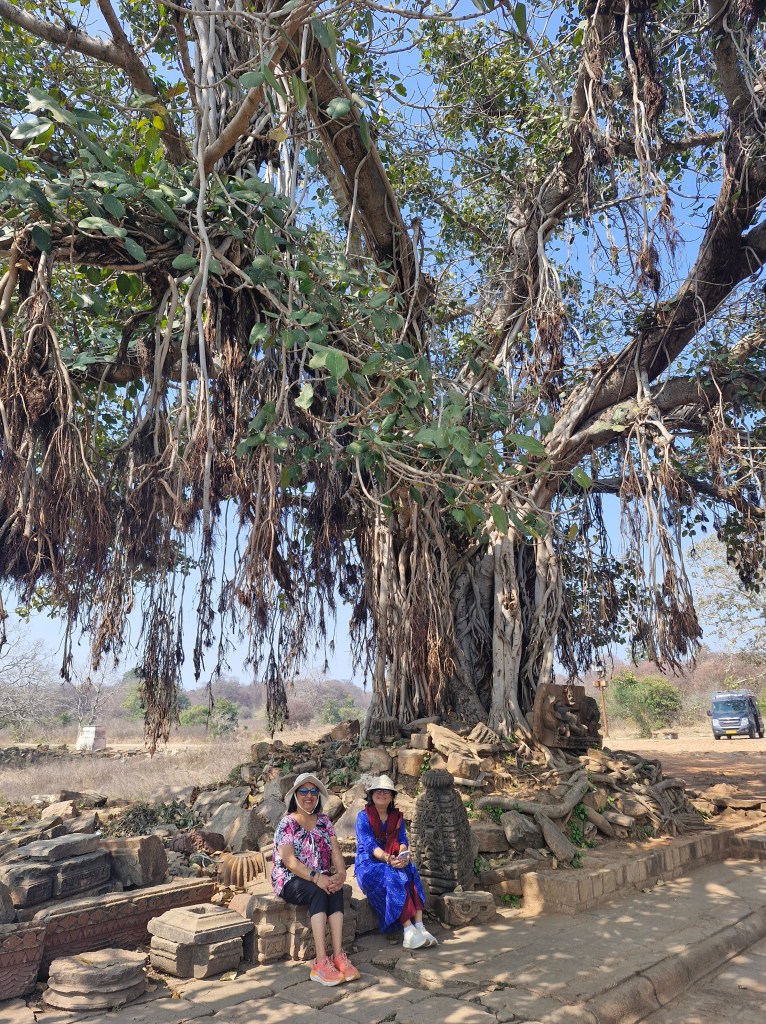
In summer, the greenery around the Kalinjar Fort and the entire compound looks brighter and glorious. In monsoon, the whole environment turns welcoming. The showers wash away the summer heat. The village receives moderate to heavy rainfall during the peak monsoon months.
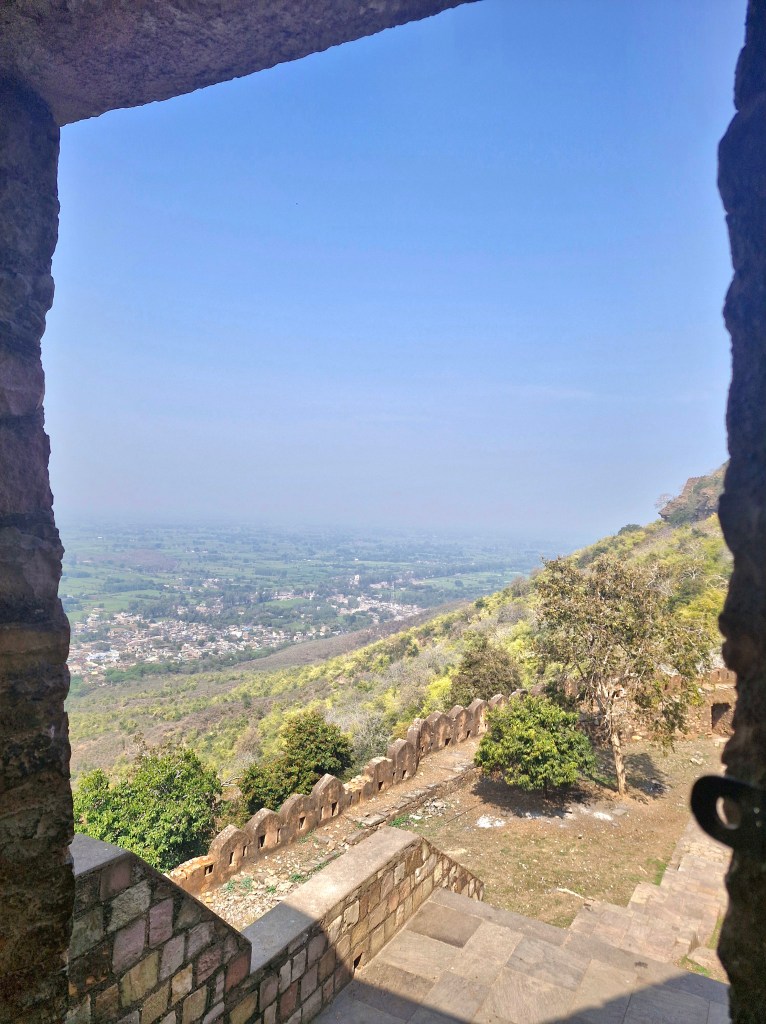
Our half a day was reserved for an exploration excursion inside the sprawling Kalinjar Fort. We entered through a beautifully – carved massive gate called the Paramardideva Darwaza. A bird’s eye view of the surrounding countryside greeted us.
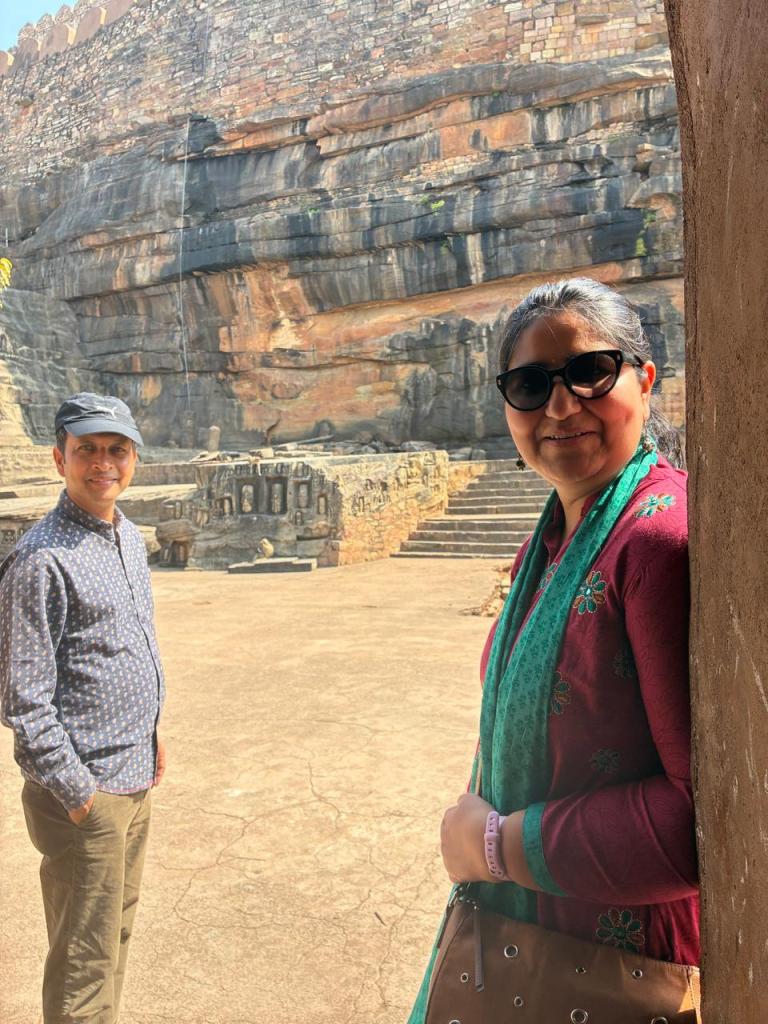
Breathtaking but also quite evident why this served as an important advantage for the ruling king’s soldiers. I could immediately see how formidable the Kalinjar Fort was. Samir gave us curated sessions on its geology, archaeology, architecture & history.
Neelkanth Mahadev Temple
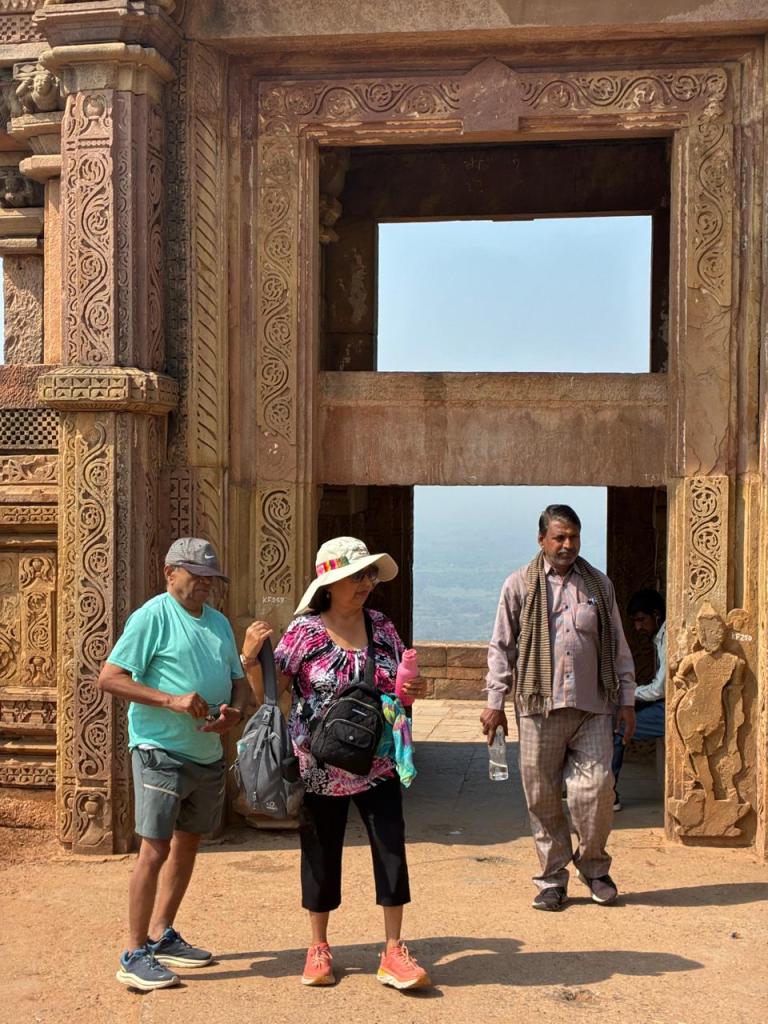
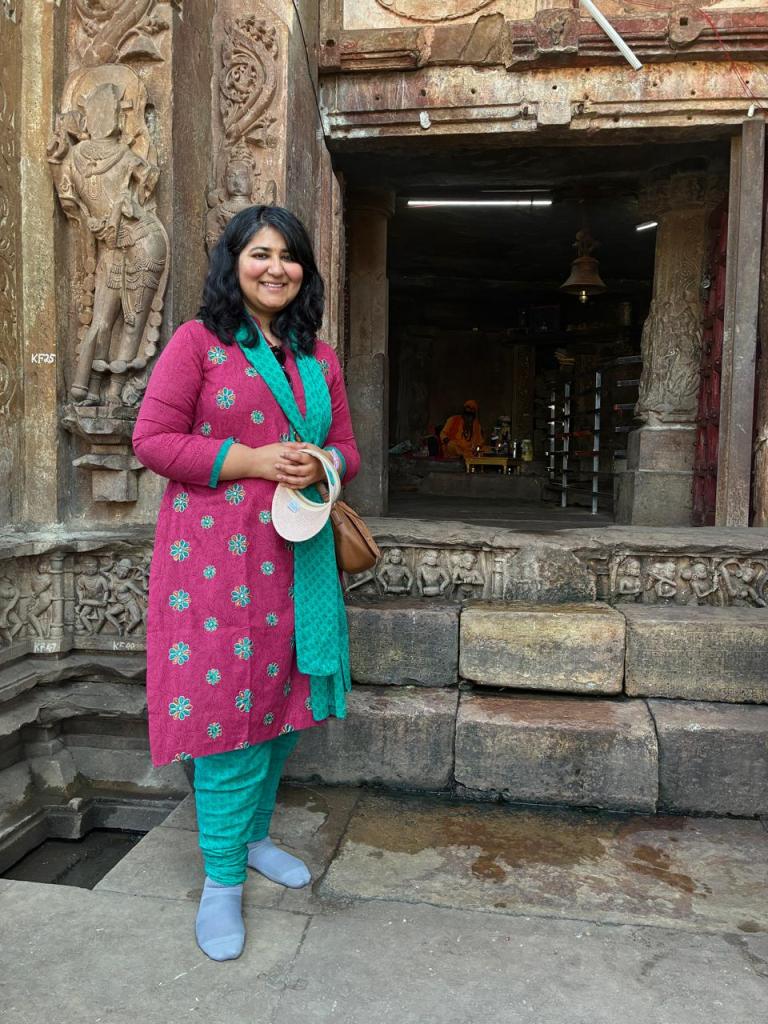
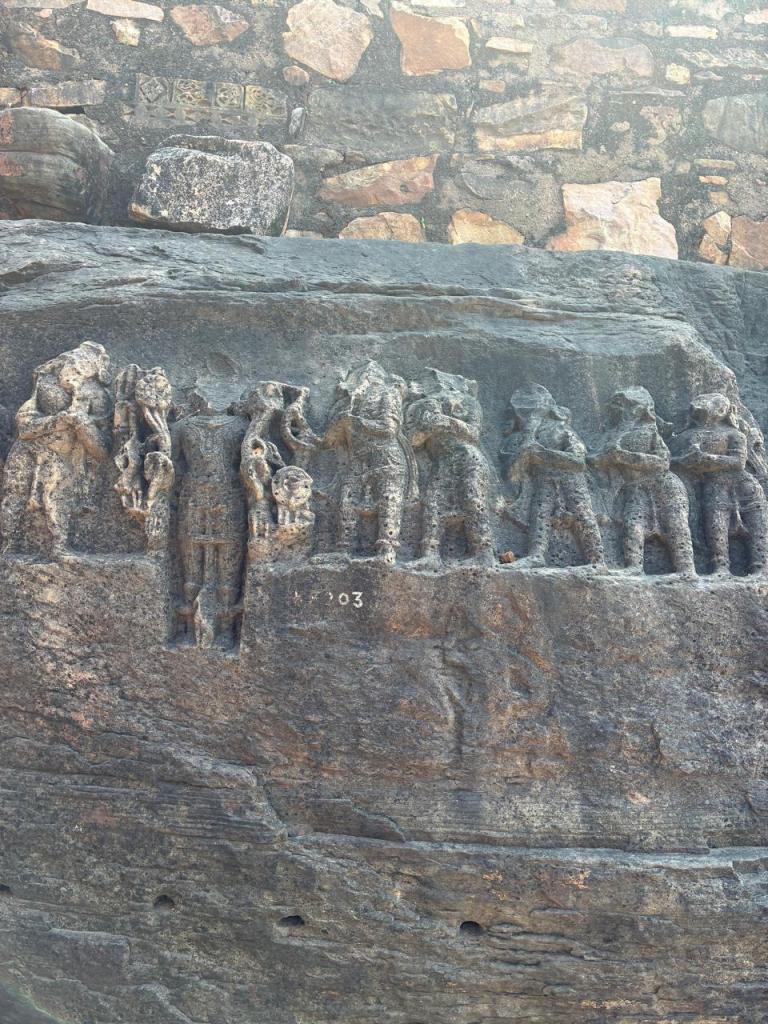
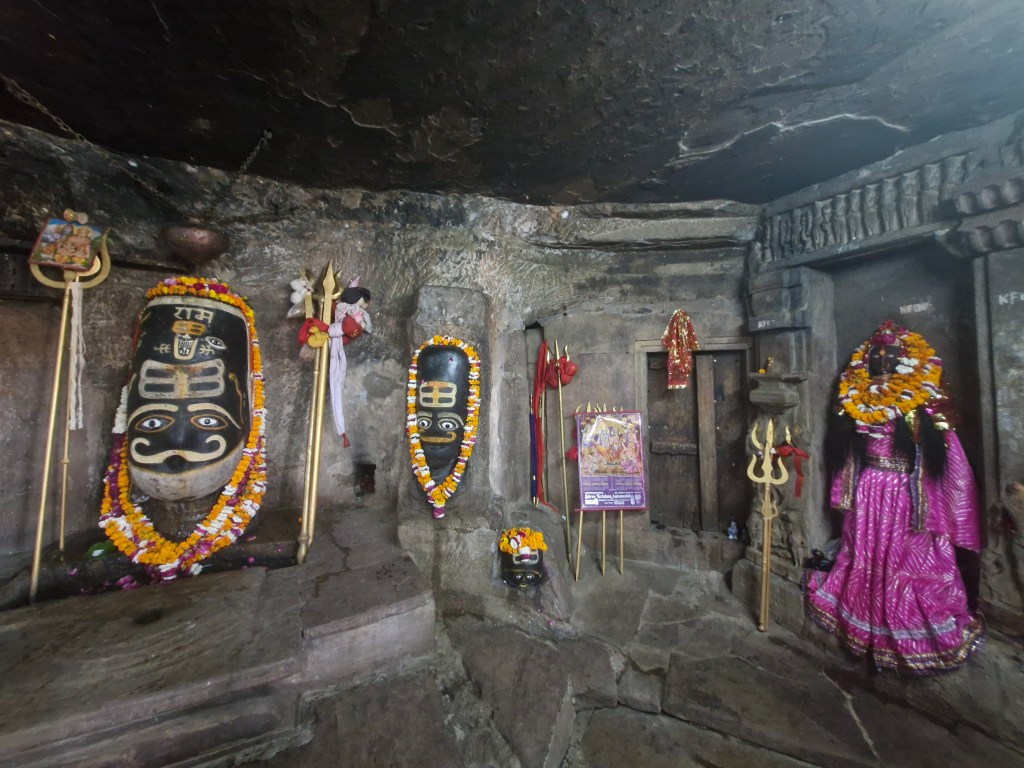
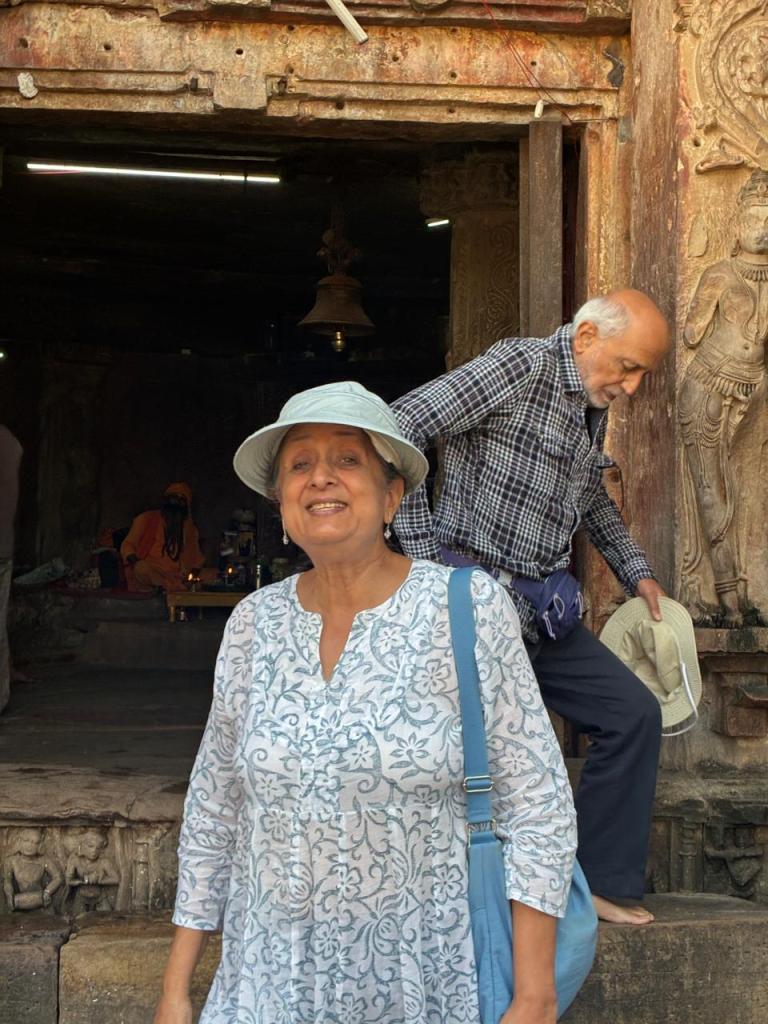
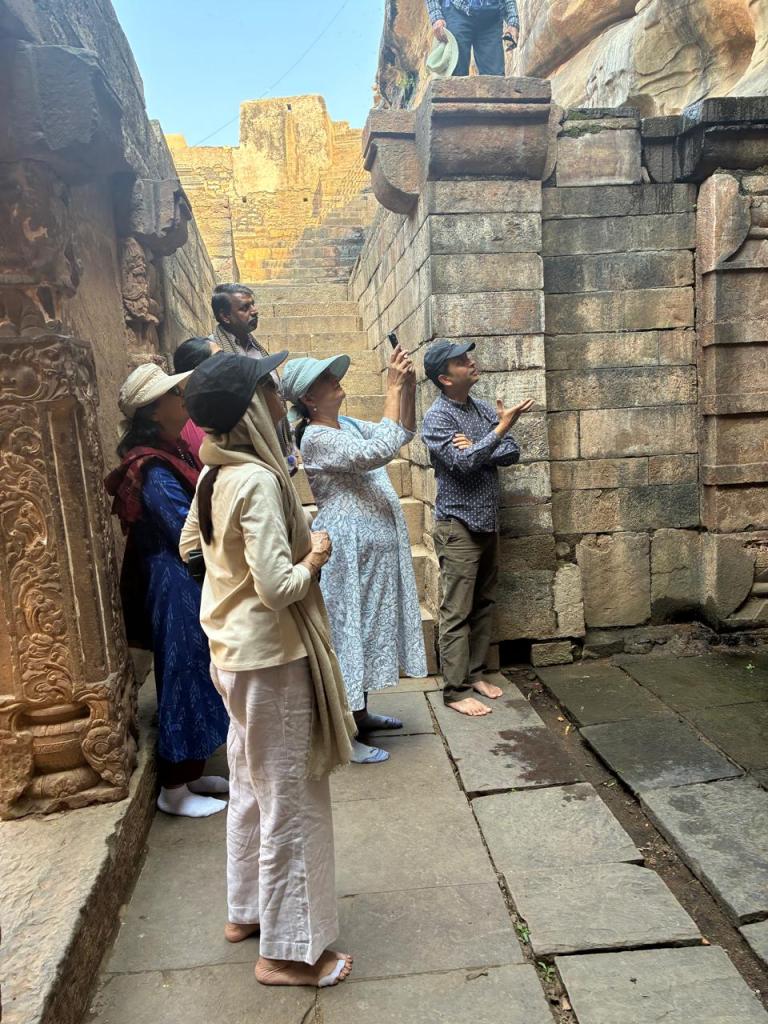
Our first major attraction at the Kalinjar Fort was the Neelkanth Mahadev Temple for which we descended almost 150 steep rock steps. As I descended, I was stunned with the architecture. It was built by the Chandela ruler Paramaditya Dev.
(Yup, the same Chandelas who built the Khajuraho Group of Temples.)
You can read my blog post about Khajuraho below.
KHAJURAHO – A PHOTO-LOG
Madhya Pradesh must be the most underrated tourist destination in India. The centrally-located state has nature, heritage, & art. Yet, we neither hear much about it nor see family & friends visiting MP. We ourselves were oblivious of all that…
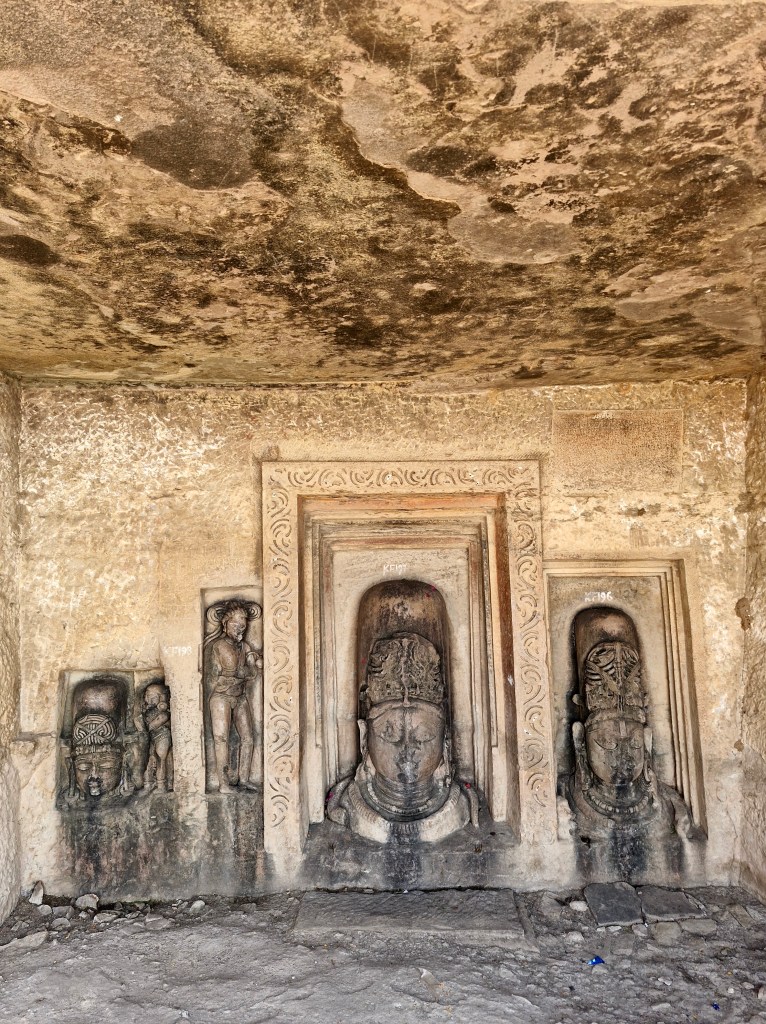
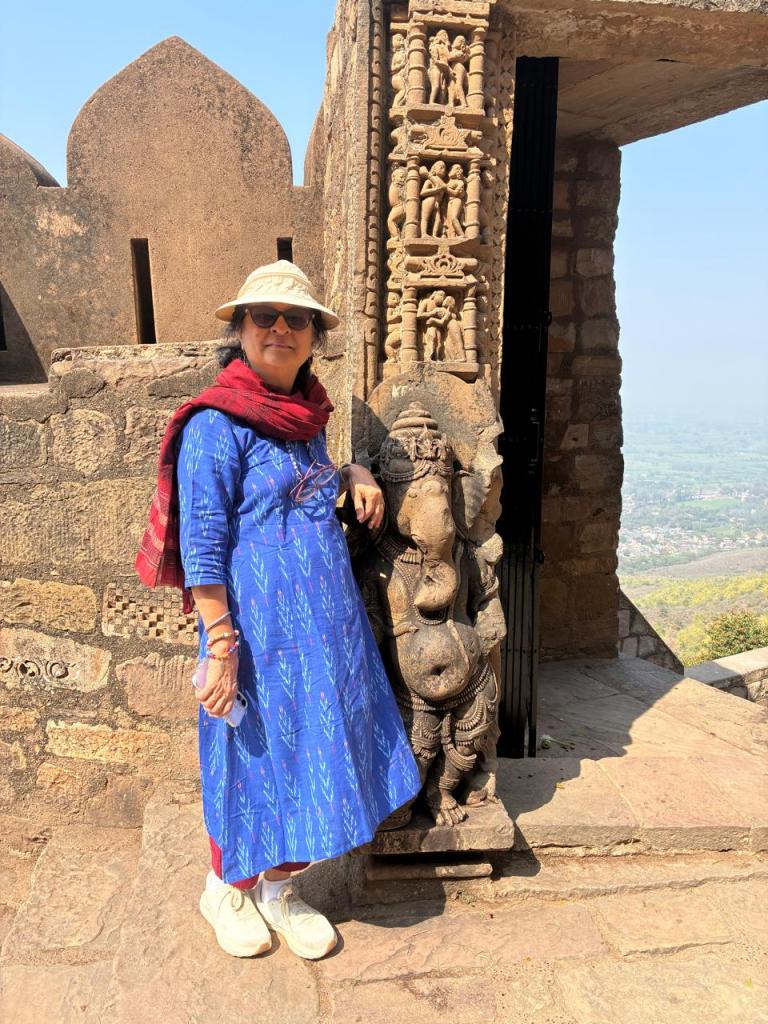
From the time we began descending the steps, the ancient ruins, the spectacular rock – cut sculptures and the stone statues scattered everywhere took my breath away. There was a life – size dancing Ganesha, Hanuman figures and the Varaha avatar of Lord Vishnu.
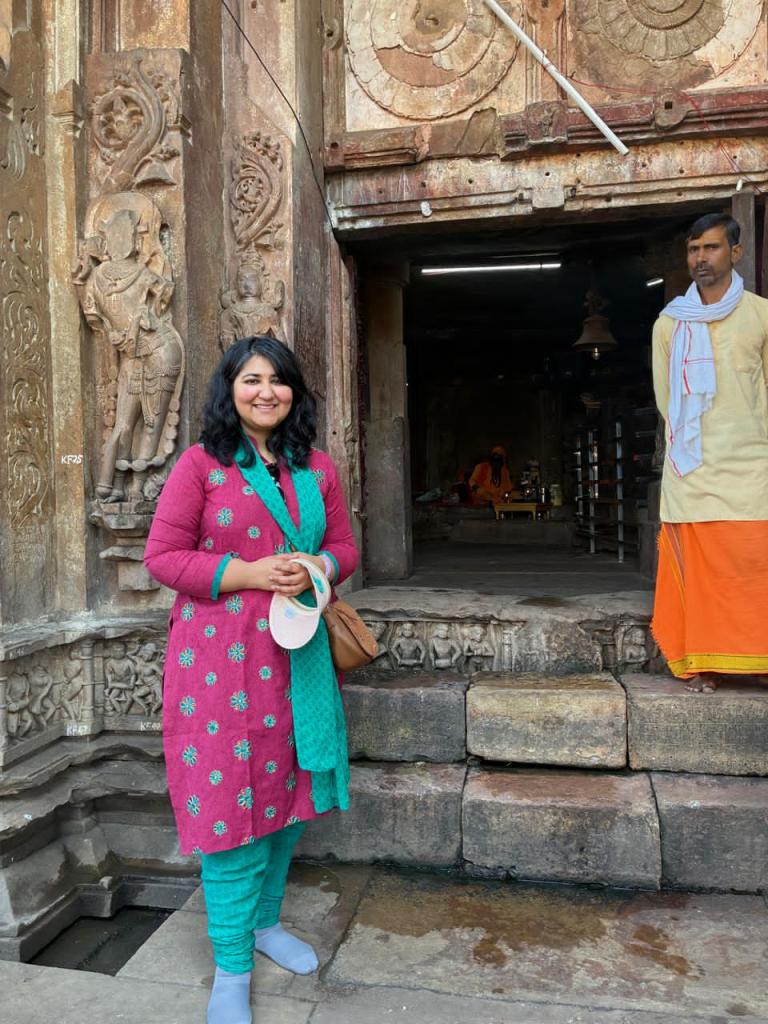
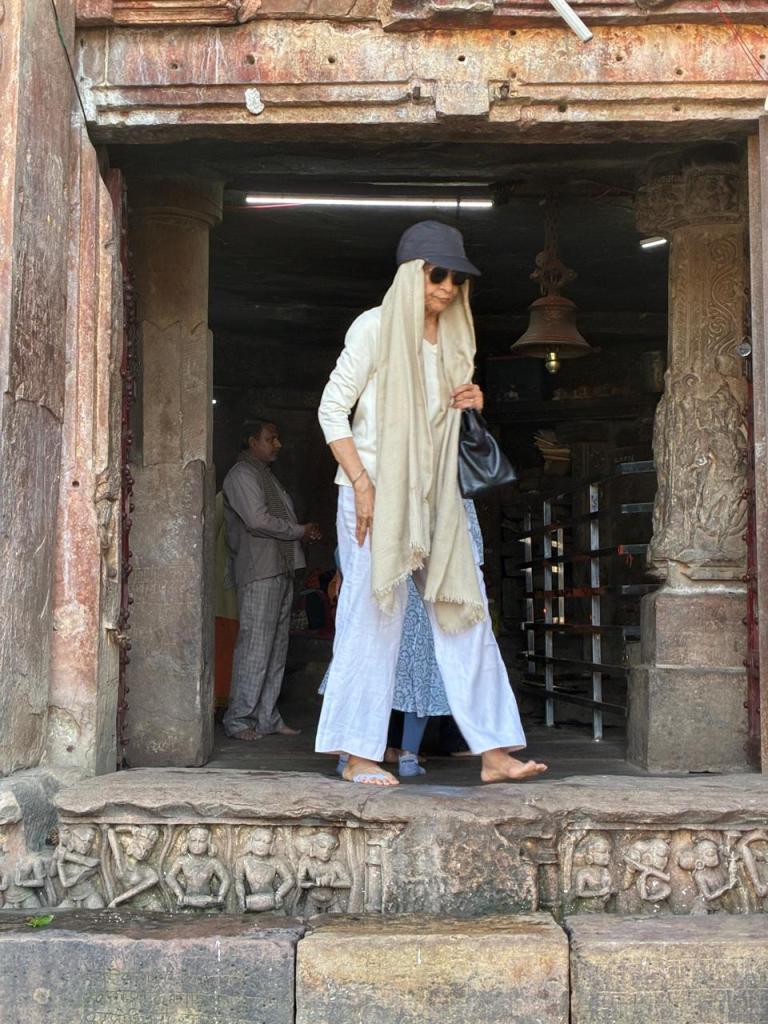
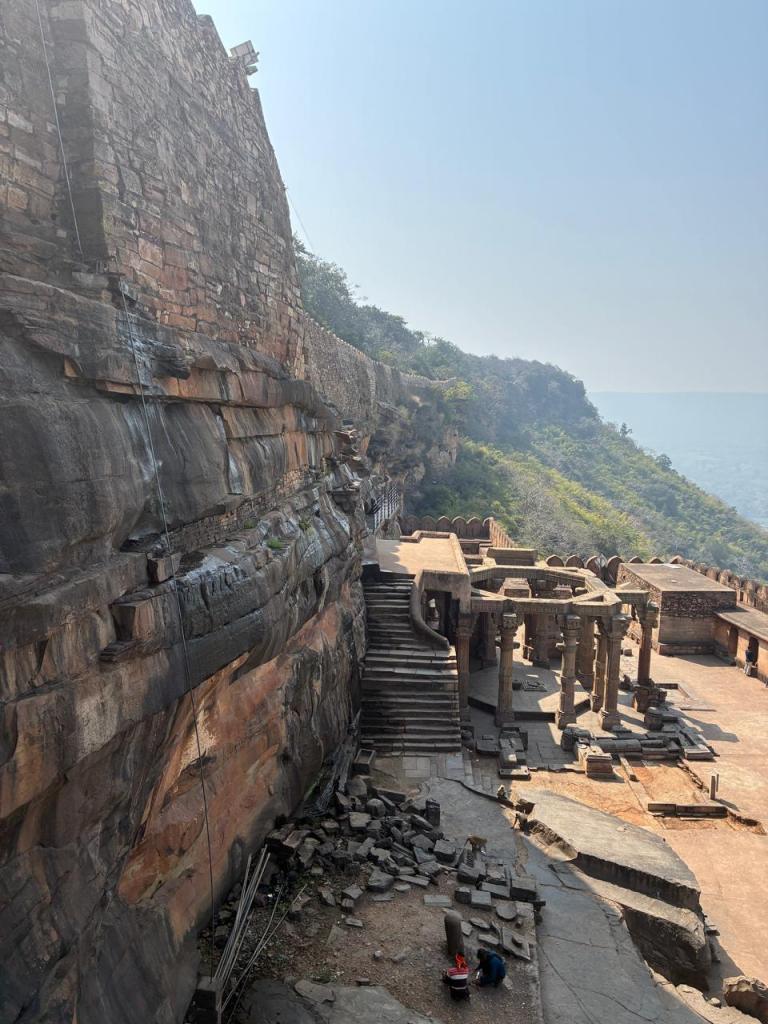
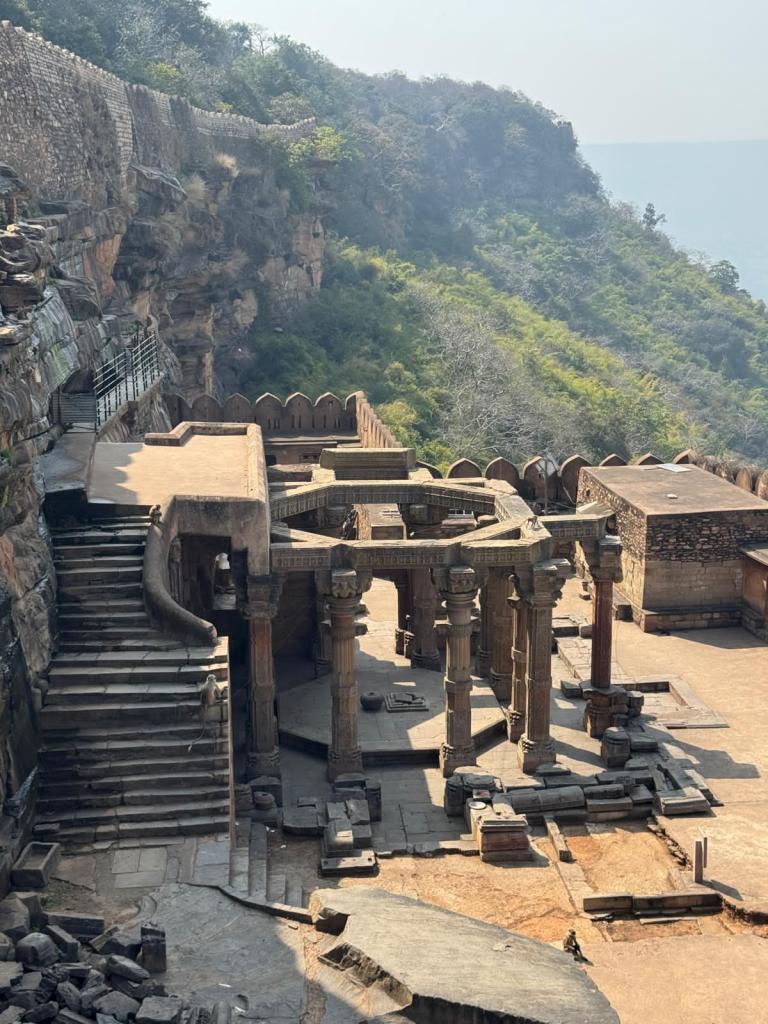
The Neelkanth Mahadev Temple is flanked by the remains of a hexagonal, magnificent, multi – pillared mandap designed in the traditional Chandela style. It is located in a small cave. Its façade was originally elaborately carved. Shiva, Parvati and the river goddesses Ganga and Yamuna sculptures on either side of the entrance are still in good condition.
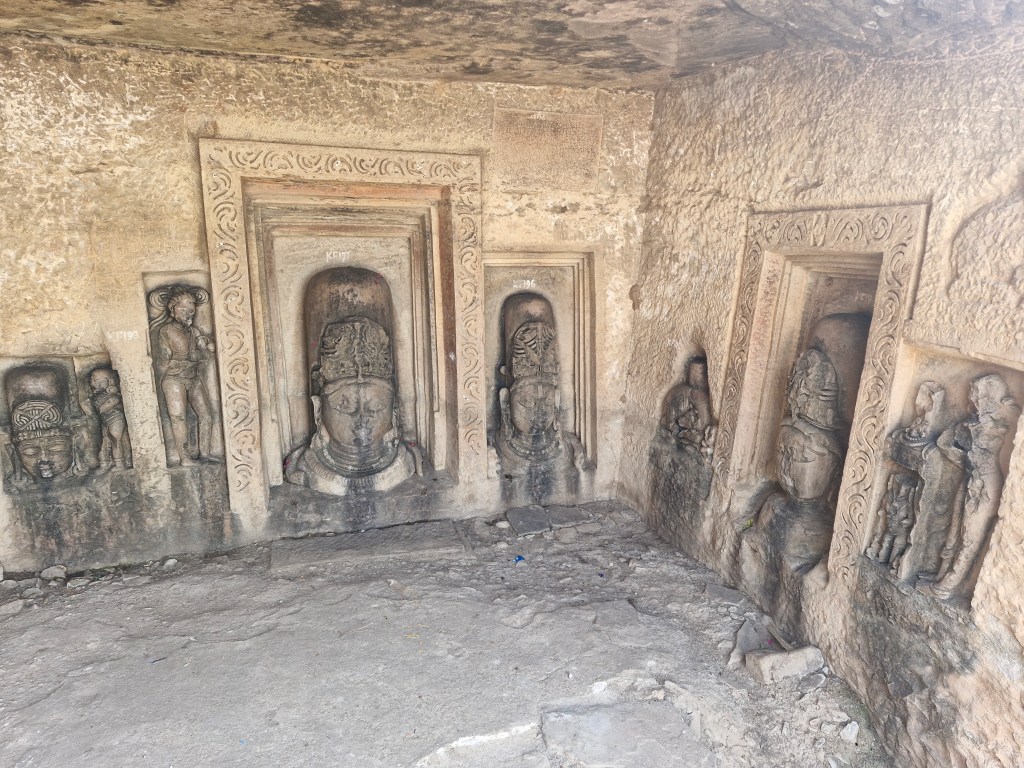
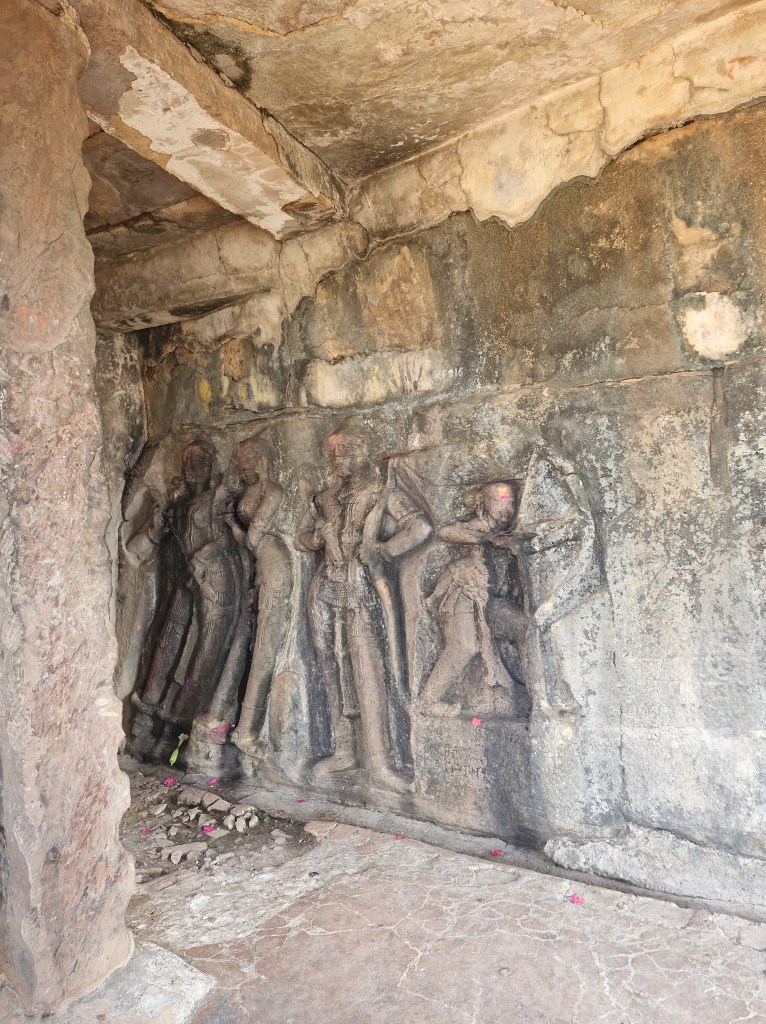
But much of the facade is now heavily damaged and effaced.
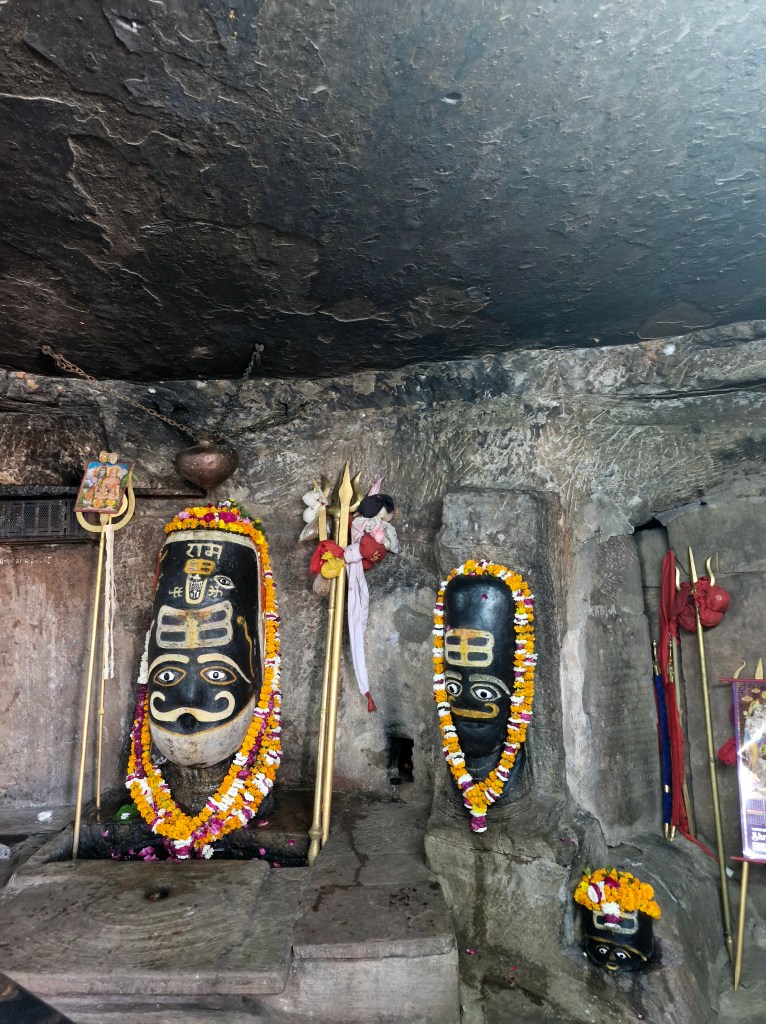
A small passage runs towards the garbhgriha. The cave contains an Ekmukhi Shivling. Interestingly, it is a blue stone one. An idol of Parvati accompanies a little to the right of the Shivling. The cave side is relieved by several pilasters, on which are sages and devotees’ figures.
There are several inscriptions on the pillars and walls, of which, Chandela ruler Madan Verma’s inscription is significant. Stylistically, the sanctum may be assignable to the Gupta period and the mandapa to the Chandela period. Regular readers of this blog know that I am a Mahadev devotee.
I prayed for a few minutes to Neelkanth Mahadev during which the priests conducted a small pooja. They were also kind to let me click pictures inside.
Kaal Bhairav Carving
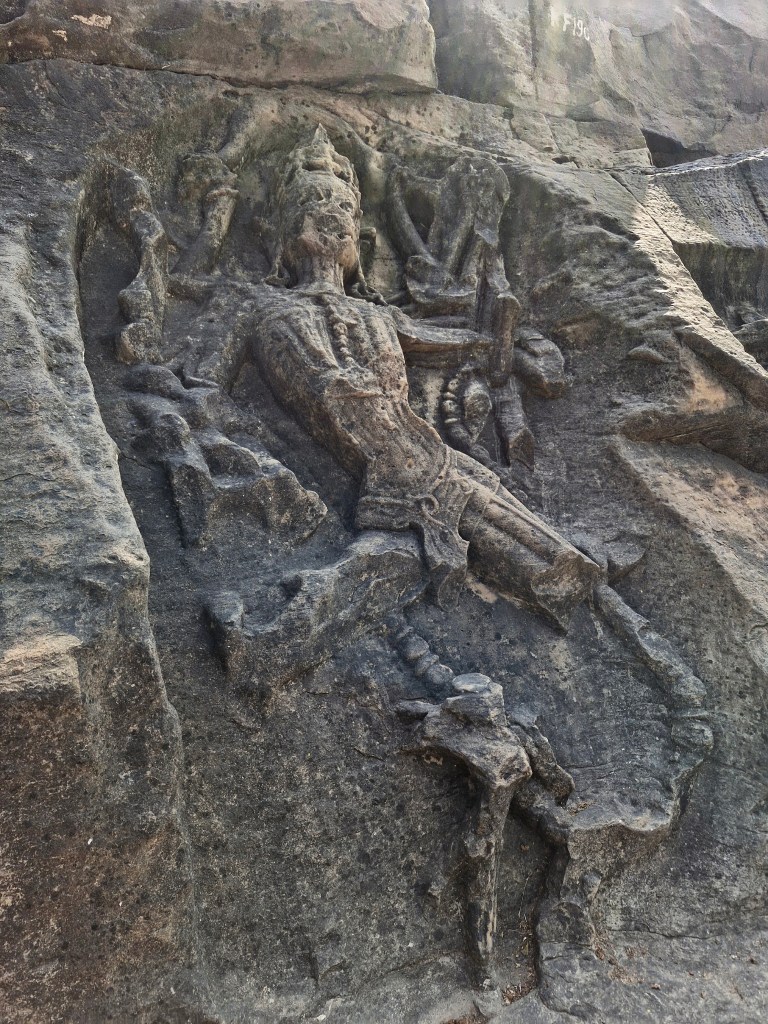
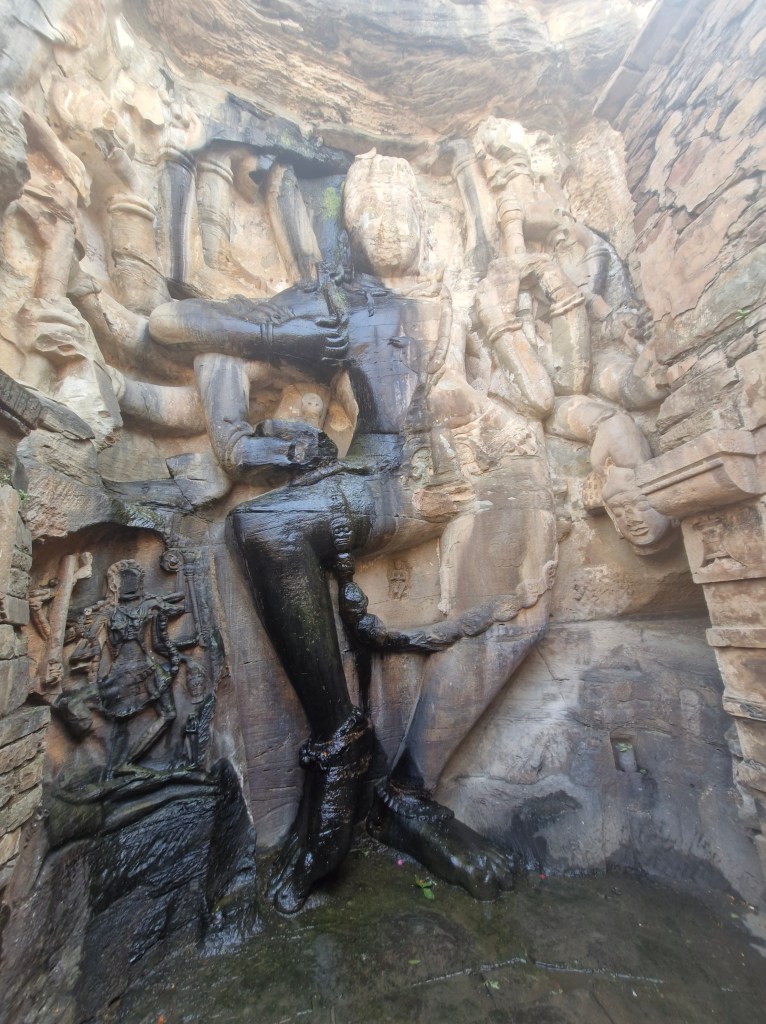
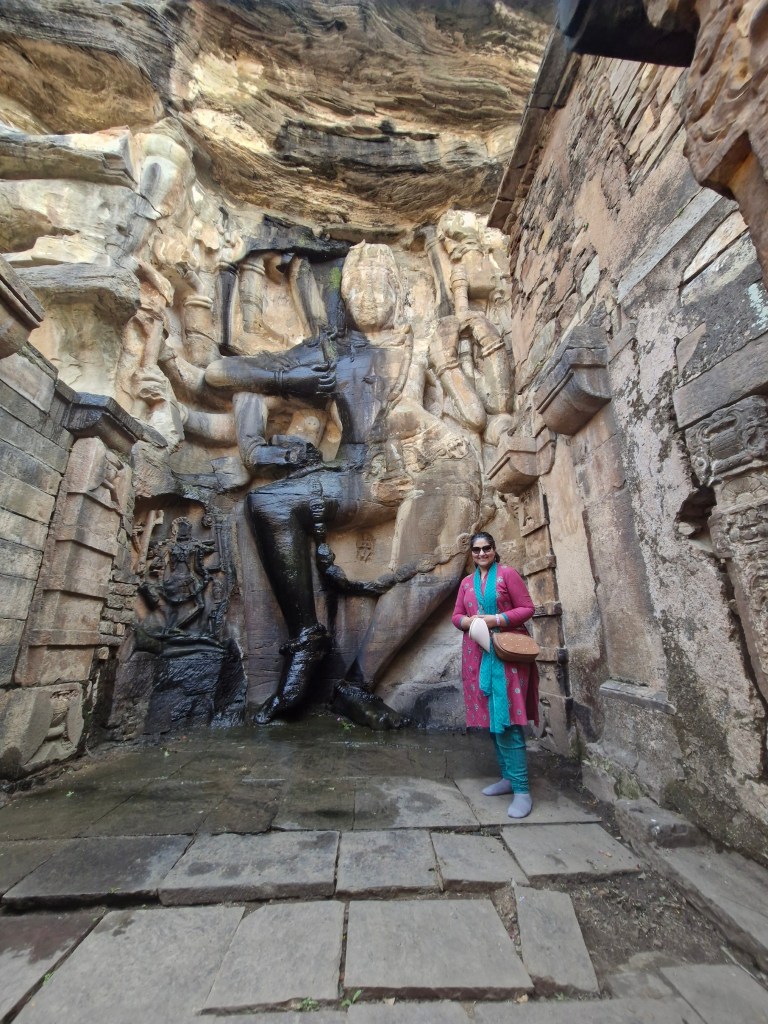
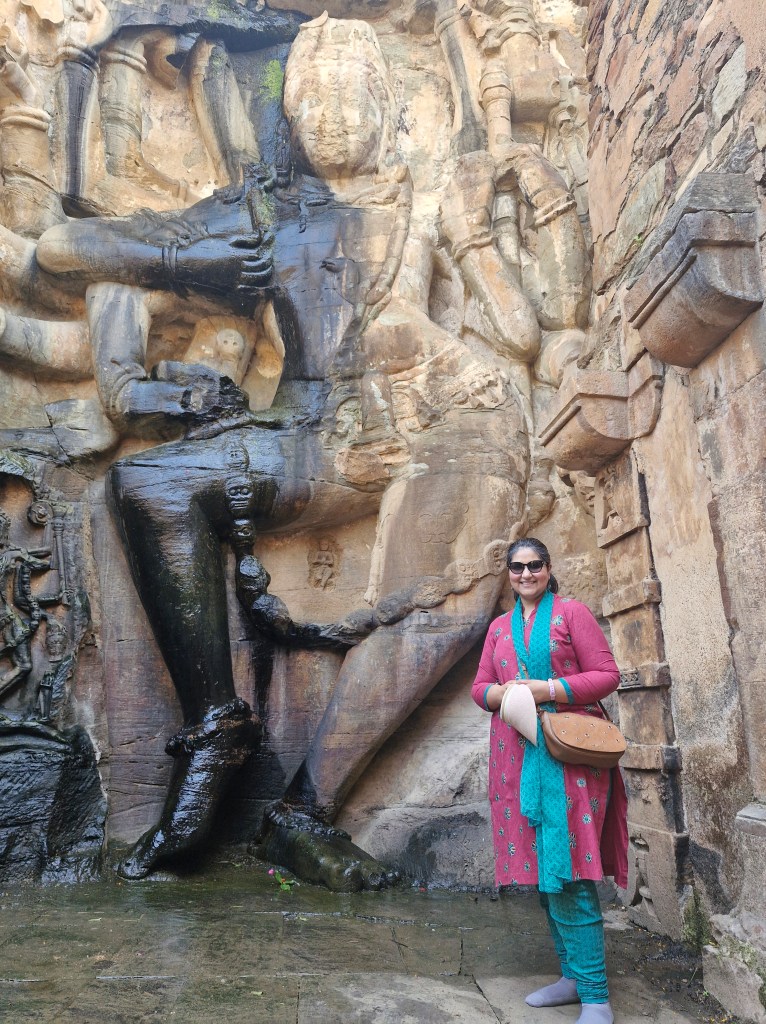
Adjacent to the Neelkanth Mahadev Temple is a massive multiarmed sculpture of Kaal Bhairav carved into the rock cliff. This standing Kaal Bhairav (also called Gajantak Shiva) measures 24 feet. This is one of the largest such idols in India. It was made by cutting the rock of the Kalinjar Fort.
Kaal Bhairav is depicted with 18 arms, holding a sword, an axe, a club, a shield, a bowl of blood, and some laddu. The trident, common in depictions of Shiva, is absent. There is a rock-cut tank on the top left side of the Neelkanth Mahadev Temple.
From the Neelkanth Mahadev Temple, water steadily drips over the Kaal Bhairav carving, giving it a half black & half brown appearance, perhaps adding to its ferocity & mystery. Undoubtedly, this carving is one of the major attractions at the Kalinjar Fort.
We then began our arduous ascent to the top of the Kalinjar Fort. The steps are not for the fainthearted and the weak-kneed (literally). My knees were on fire by the time I reached the top. This was despite the fact that I took breaks along the way to admire the friezes.
Kotitirth Tank
There are many small & large reservoirs in Kalinjar Fort most of which are rock cut. The Kotitirth Tank, a large, artificially formed tank in the rocky surface of the hill, is one of the important attractions. There were several temples around the tank; some of them are now only in ruins.
The walls of the Kotitirth Tank were profusely decorated with sculptures which were lime – plastered in later times. According to scriptures, various diseases are cured after taking bath in this tank. It is said in the Mahabharat – “Whoever bathes in the lake of the gods in Kalanjar acquires the same merit as if he had made a gift of 1000 cows.”
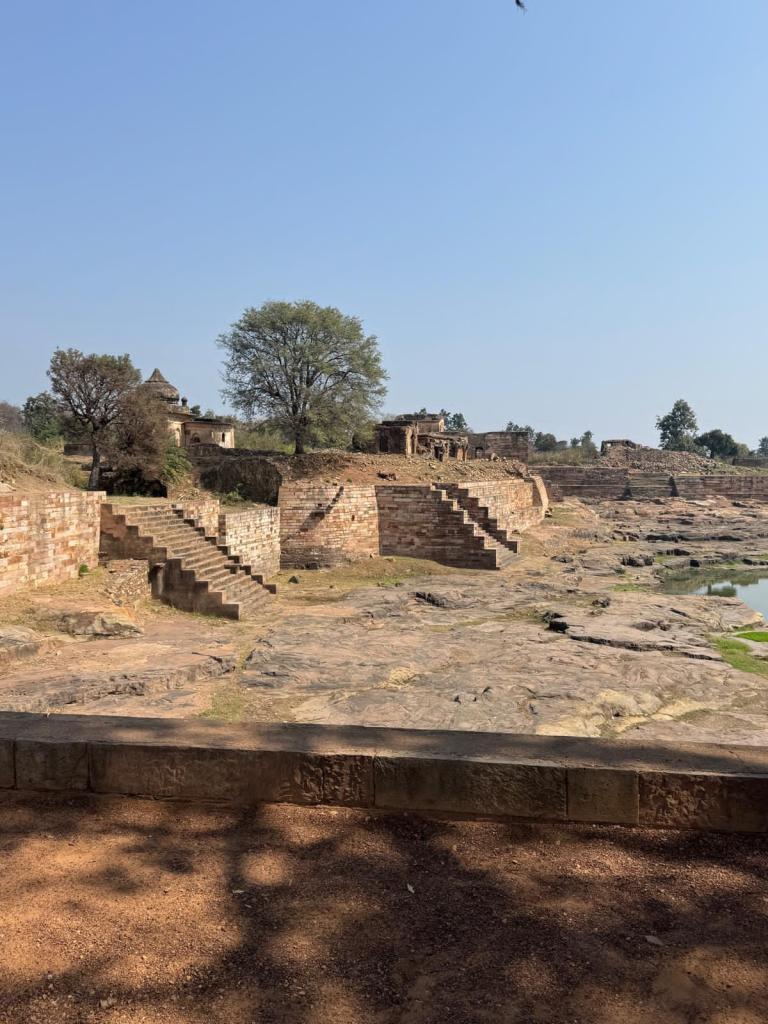
We visited the sacred Kotitirth Tank. Here, I could feel history whispering through every ripple. The Chandela rulers built this tank. Later dynasties nurtured it. The pond is a blend of utility, spirituality & heritage. The monuments around it include Raja Aman Singh Palace, ruins of several small temples, a sculpture shed and a mosque.
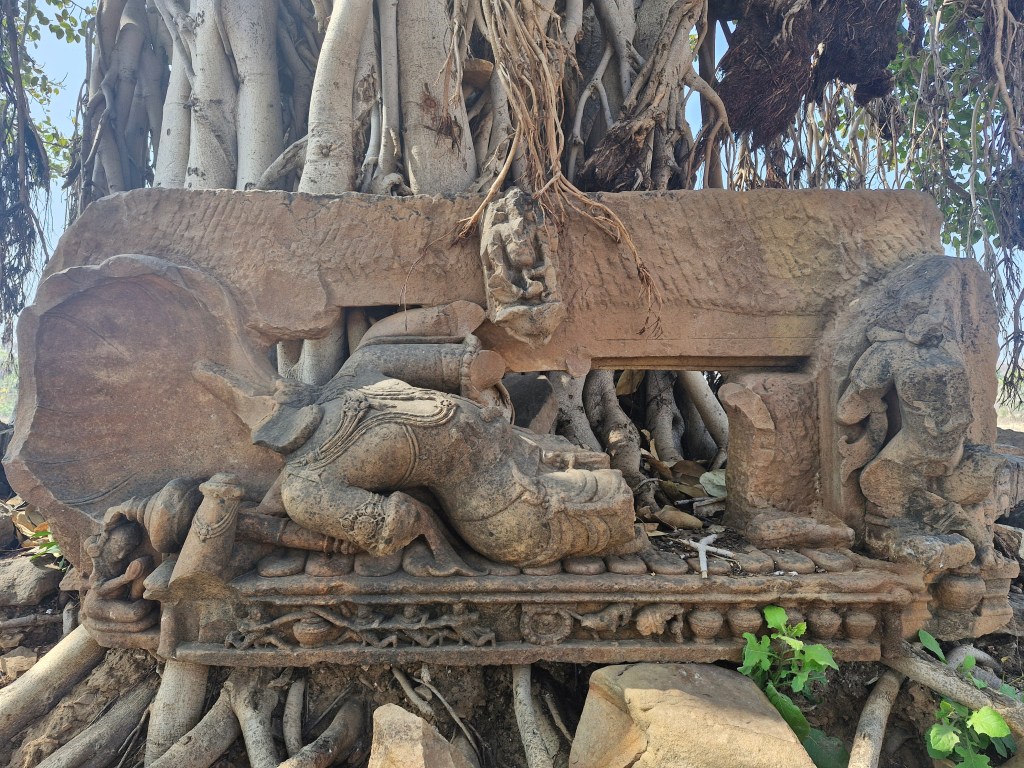
A relief ruins showed Lord Vishnu reclining on His Sheshnag and a smaller carving underneath of the Samudra Manthan.
Raja Aman Singh Palace
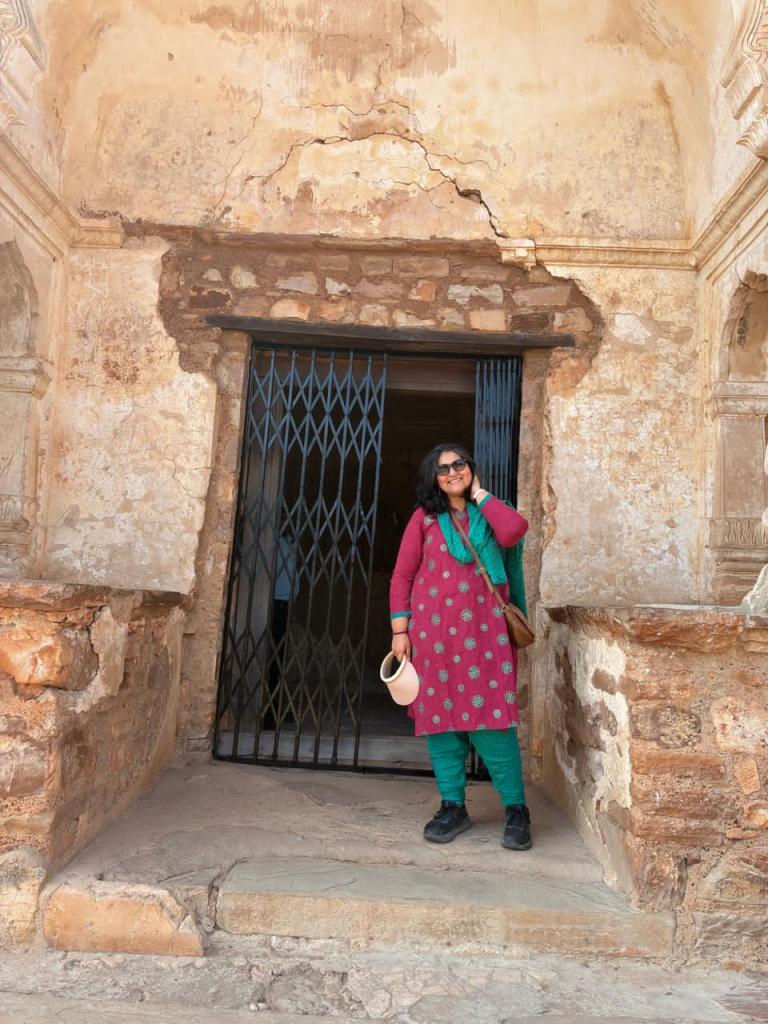
Adjacent to the Kotitirth Tank is the Raja Aman Singh Palace. It belongs to the Bundela period but its arches and geometric Indo-Islamic artwork on the walls do reflect a bit of the last Mughal era residents of the Kalinjar Fort. The sculpture shed was a jackpot for us history lovers. It had innumerable sandstone artifacts like busts, figures, reliefs, an Ekamukha linga etc.
Lunch Halt
Lunch was, again, prepared for us at a local villager, Shivpal ji’s house. This time, a large bush of bright red hibiscus greeted us. I fell in love then & there. This again was a traditional north Indian village home. It was built using locally – sourced materials.
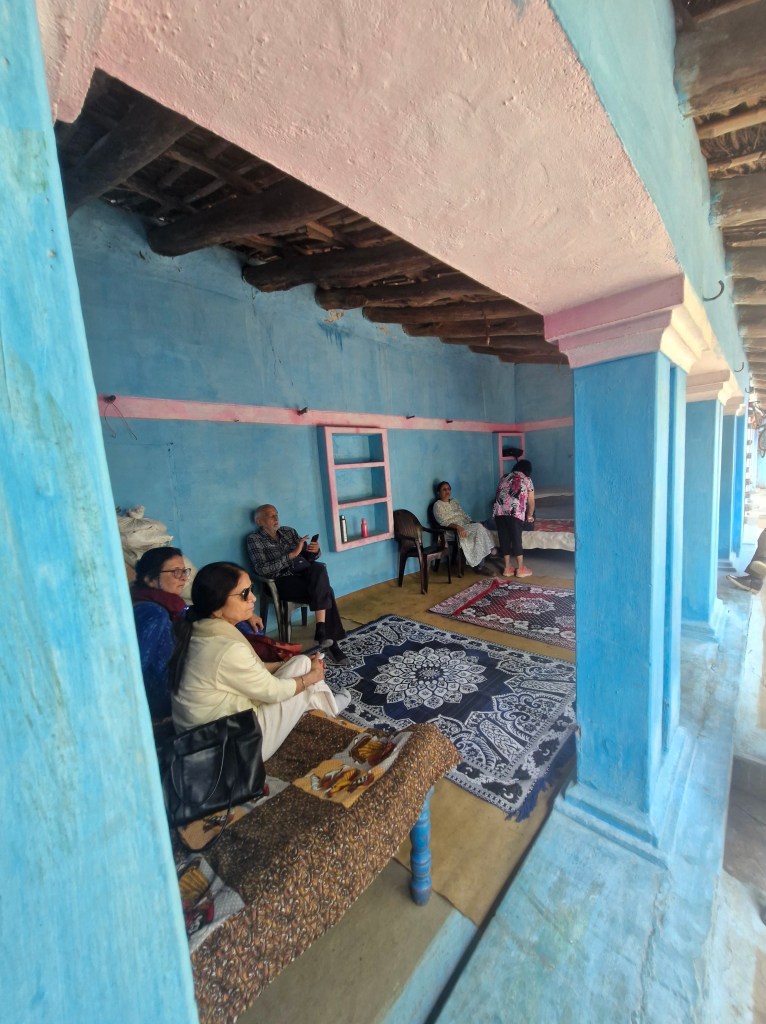
The ceiling had exposed, thick wooden beams. Thick masonry columns supported the extended roofline. The primary space was a deep, shaded verandah where we were seated. The walls featured alcoves. Large rugs covered the floor.
The vibrant blue lime – wash on the walls was a hallmark of many Indian villages. The pink accents on the trim & niches were decorative flourishes. Need I say how much I loved these north Indian villages homes?
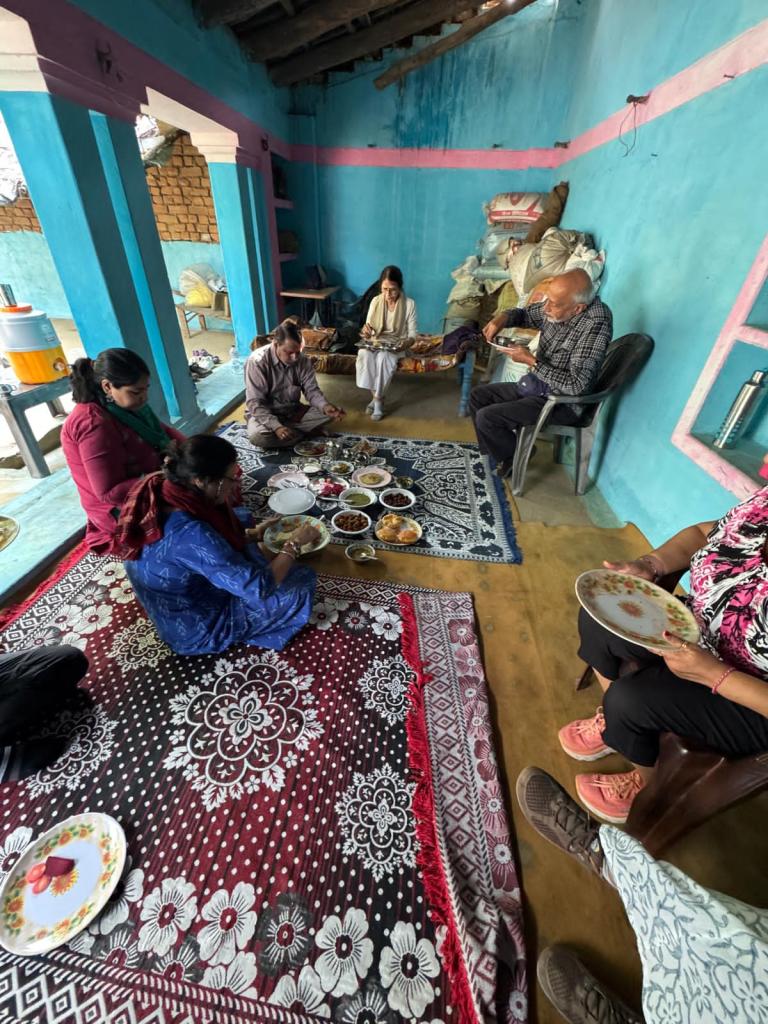
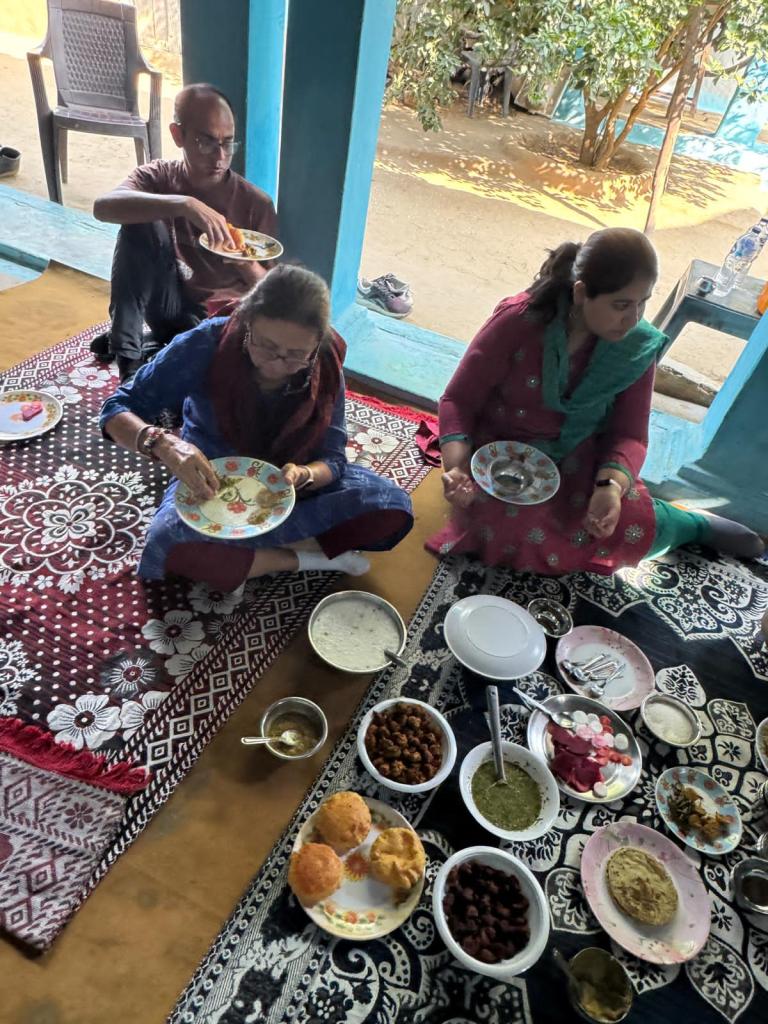
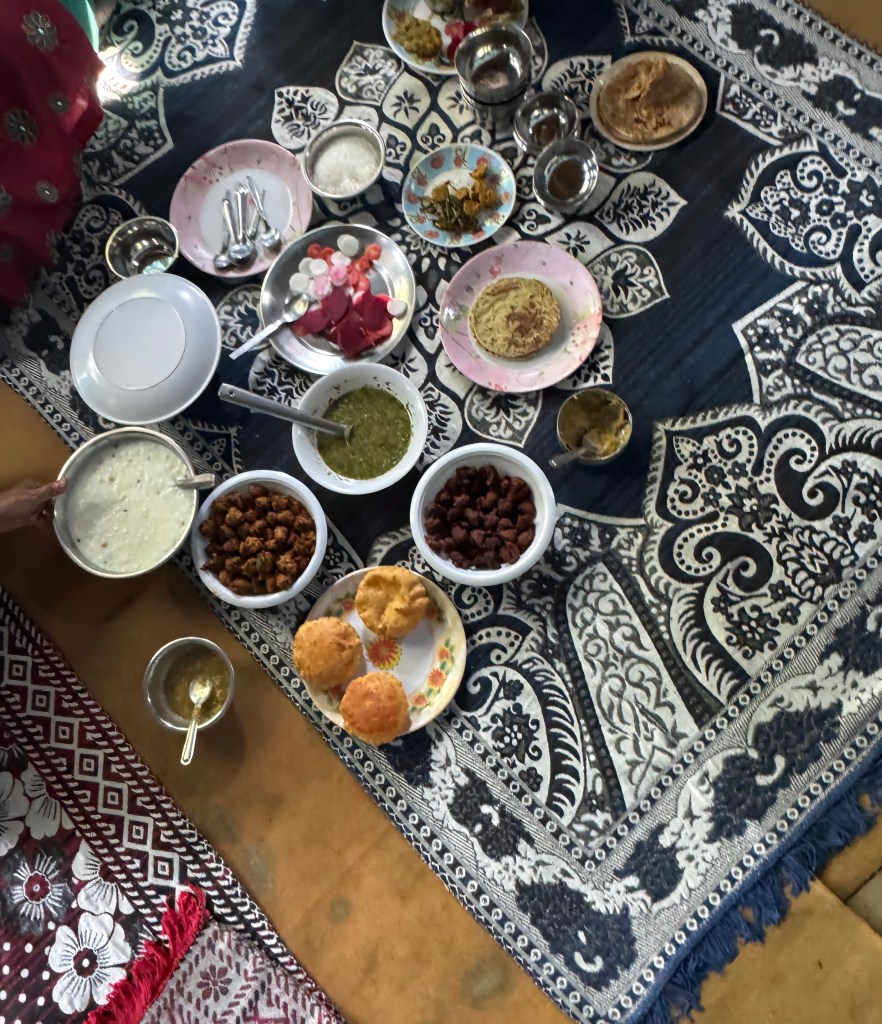
An even greater spread awaited us. Salad, two kinds of pakodas, two kinds of rotis, poori, two kinds of vegetables including a seasonal saag, chutneys & pickles, curd, kheer & whatnot. We were spoilt for choice! And the taste – divine again.
We stuffed ourselves silly. I think, in our hyper – urbanised environment, we’ve just lost the real taste of the grains, vegetables etc. As we ate, we chatted up with Shivpal ji. While he & his were warm & welcoming, I felt a bit uncomfortable about us asking them about their assets, education, livelihood, standard of living etc.
I felt we were coming from a place of privilege and asking these deeply personal questions which we ourselves would never stand if anybody asked us. I shared my concern with Samir later who informed that the villagers are actually happy to share all these aspects of their lives.
This was later corroborated by HH Keshavendra Singh in Rampura. But I was left with an unsettled feeling. Our education and awareness should make us more sensitive, no? But, what I DID like was where everybody saw inequality, I saw courage & resilience.
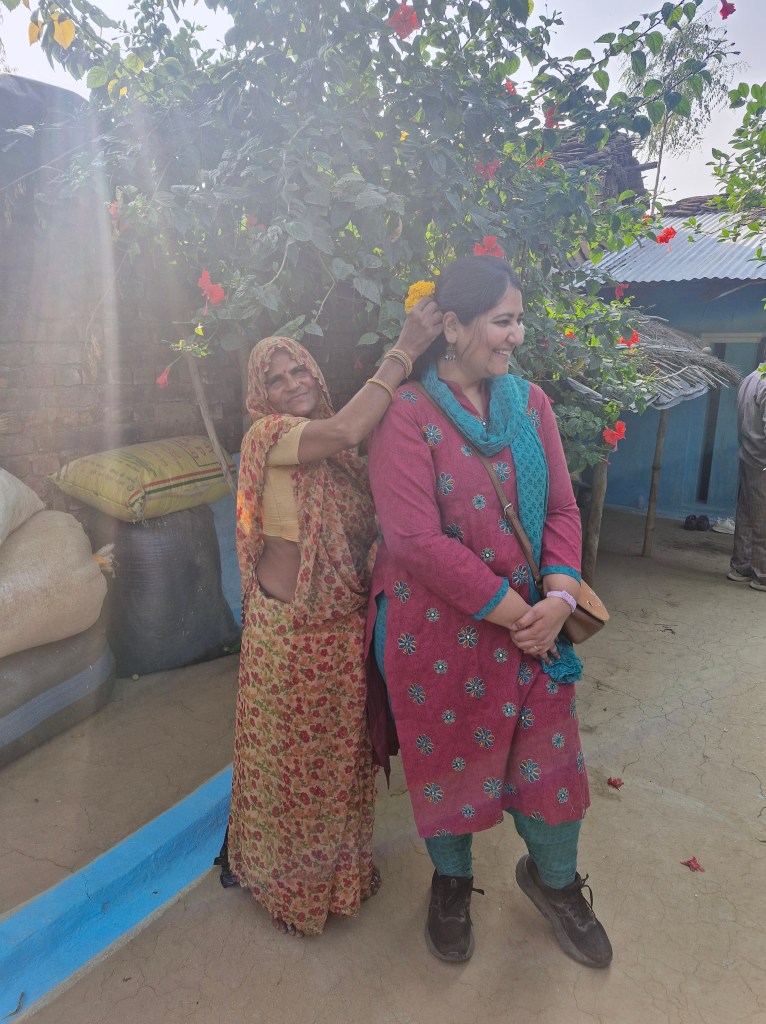
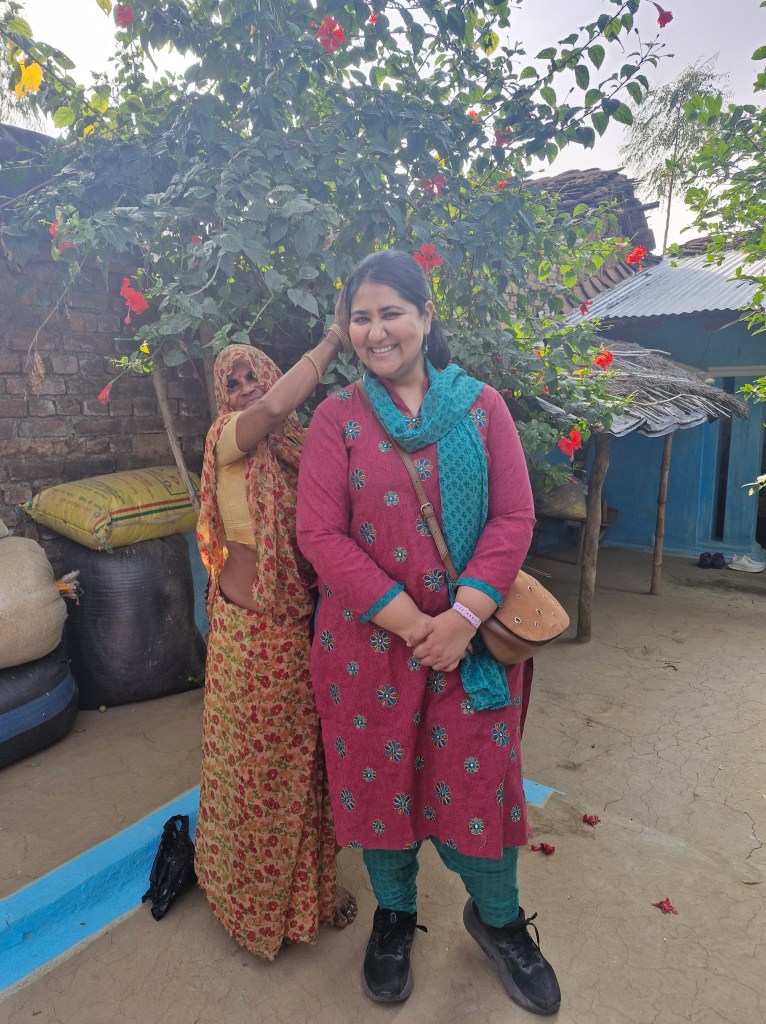
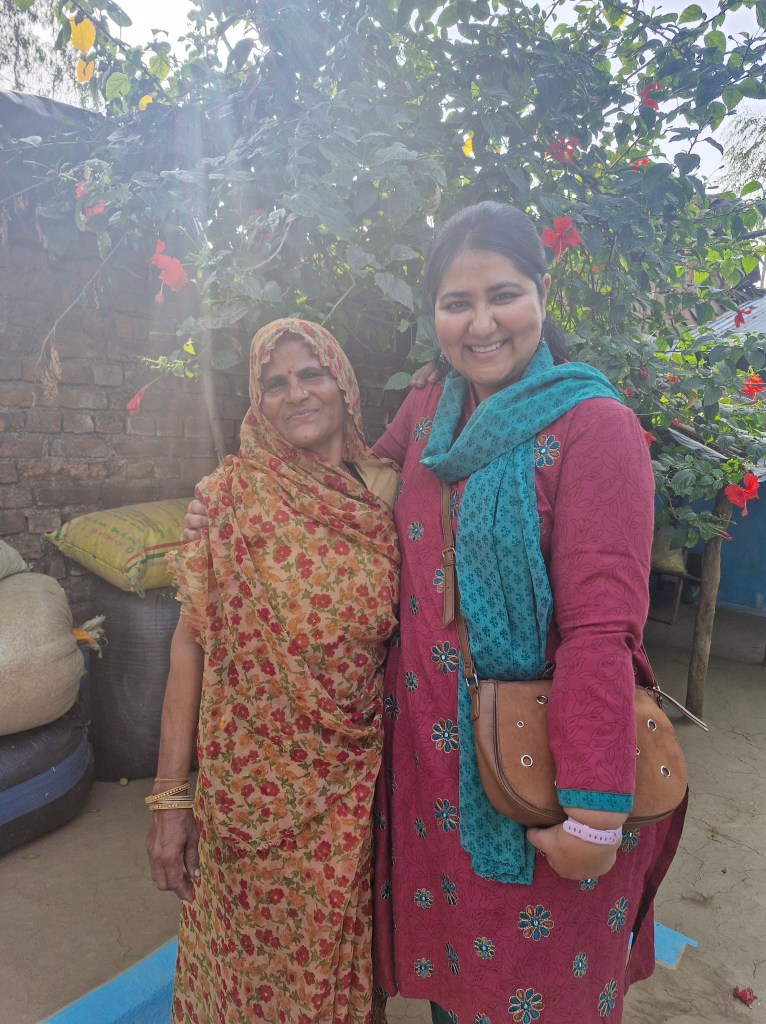
Every individual, every family I met was determined to make something of themselves, no matter how small, & no matter how adverse the circumstances. Despite their hardships, their smiles shone through. While then it had impacted me greatly, I’m now realizing that it actually changed my life…
Shabri Waterfall
A long drive later, we reached the last halt of the day – the Shabri Waterfall or, as a recent renaming makes it, the Tulsidas Waterfall. an interesting caste angle there! My Bundelkhand Trail was quite full of these caste equations. For me, being a north Indian & travelling to the hinterlands frequently, it wasn’t really a shock but for my Mumbai fellow travellers, it surely was!
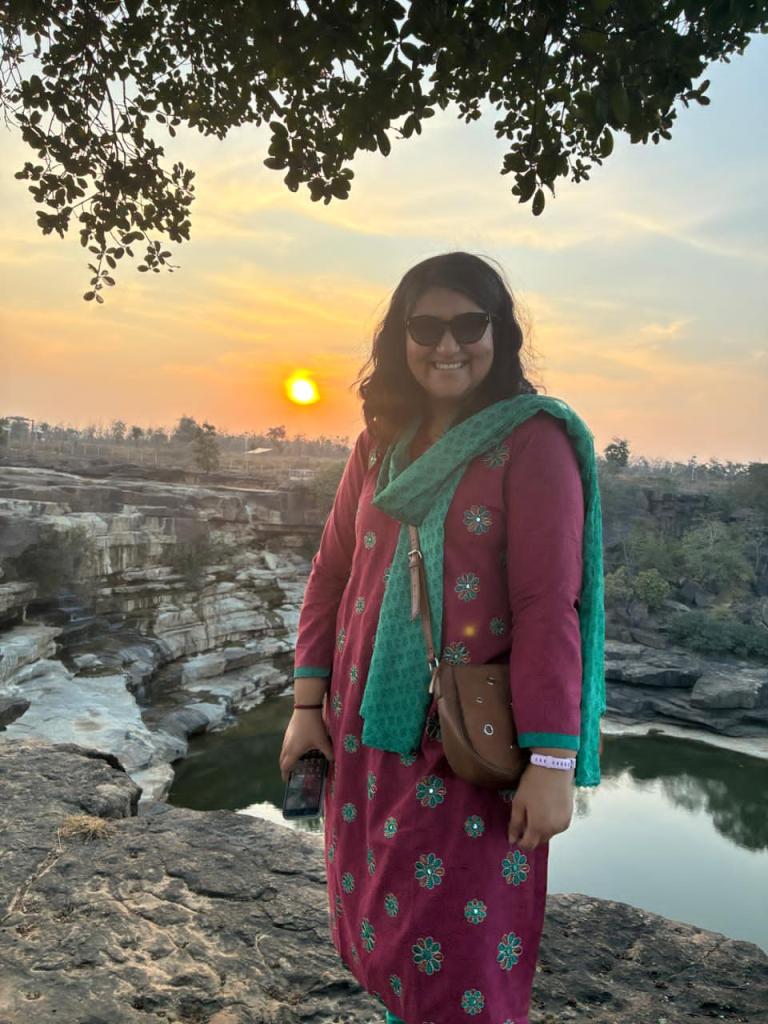
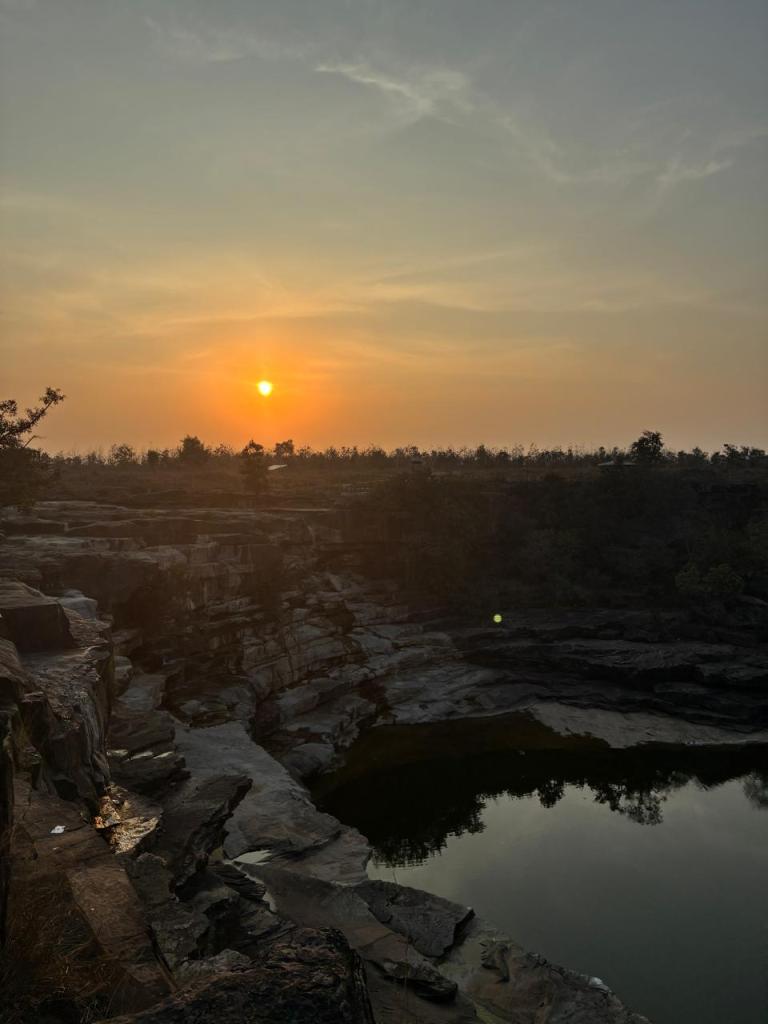
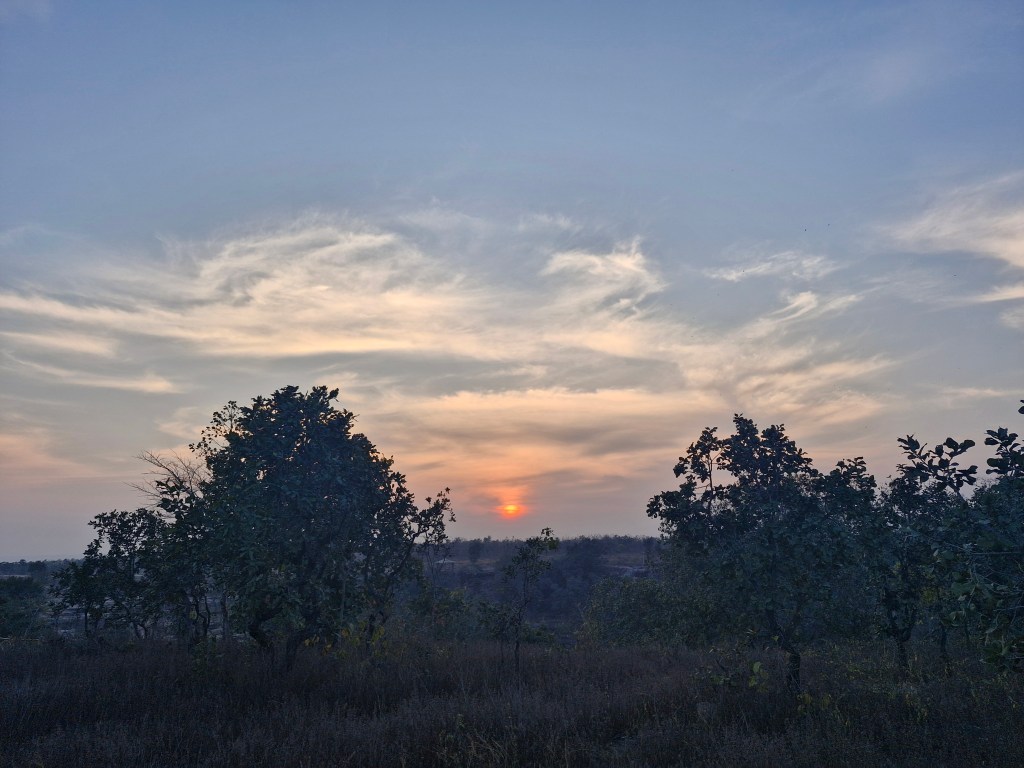
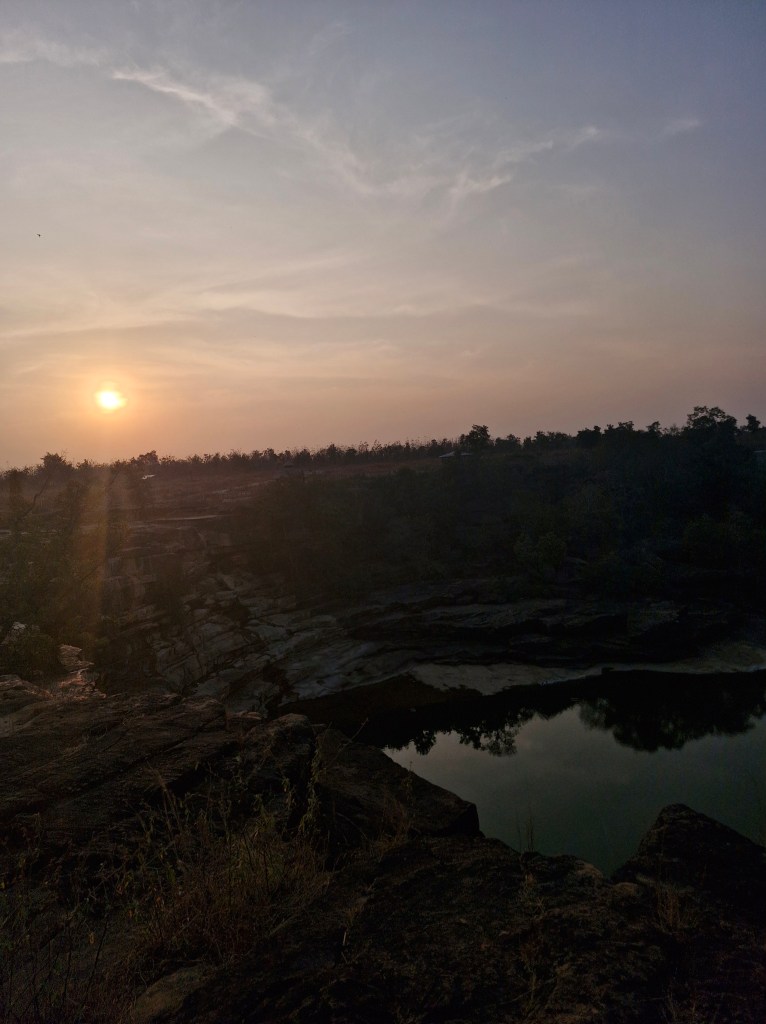
We faced initial disappointment when the security guards told us that visiting hours were over. We’d reached a bit after 5 PM. But we begged our way into their hearts and they agreed to a short visit. We walked towards the Shabri Waterfall and gasped as the setting Sun made the entire landscape magical.
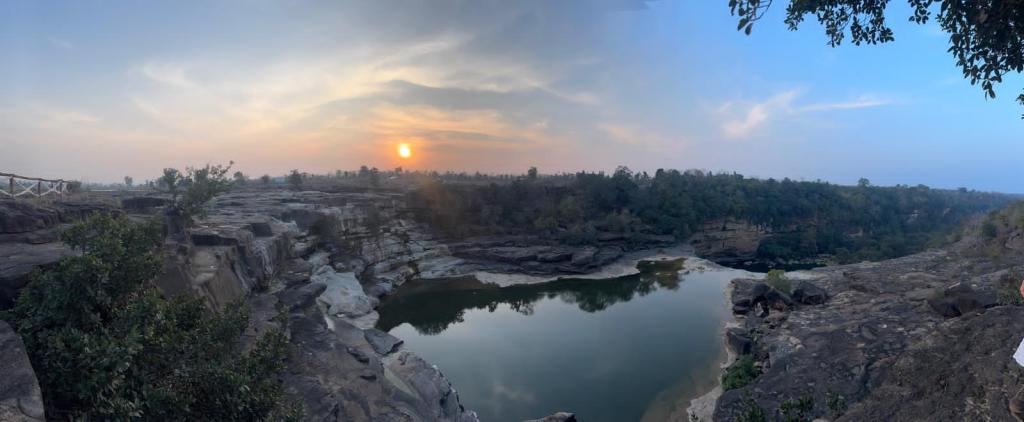
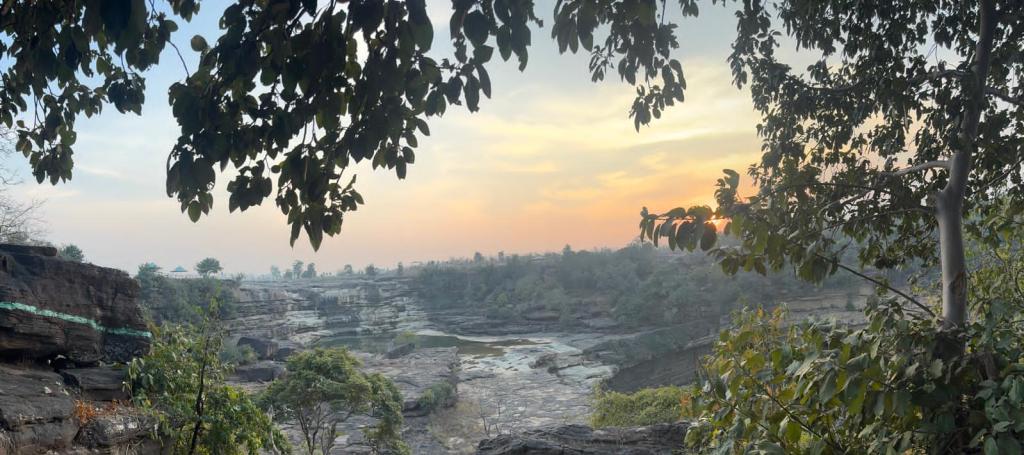
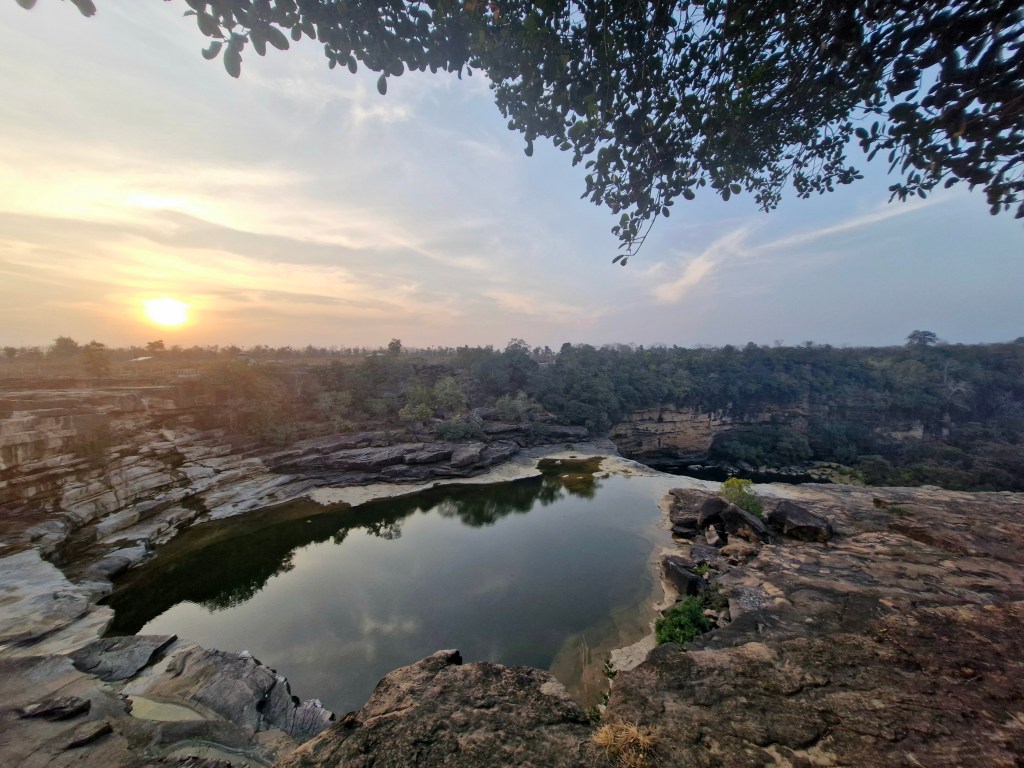
But first – It is said that Lord Ram visited Shabri at this spot during His exile. He tasted the berries she offered Him. I believe, earlier, one had to trek to the Shabri Waterfall but now, a proper drivable road has been constructed but on the other side.
There are also plans to build a resthouse where people can stay the night, if they wish.
The Shabri Waterfall surroundings were serene and peaceful, with lush greenery and a variety of flora and fauna. The water wasn’t much due to it being winter but the landscape at that golden hour made up for everything. I would say it is a must-visit destination for those who seek adventure, spirituality, and tranquillity.
Accommodation Review
Rahi Tourist Bungalow
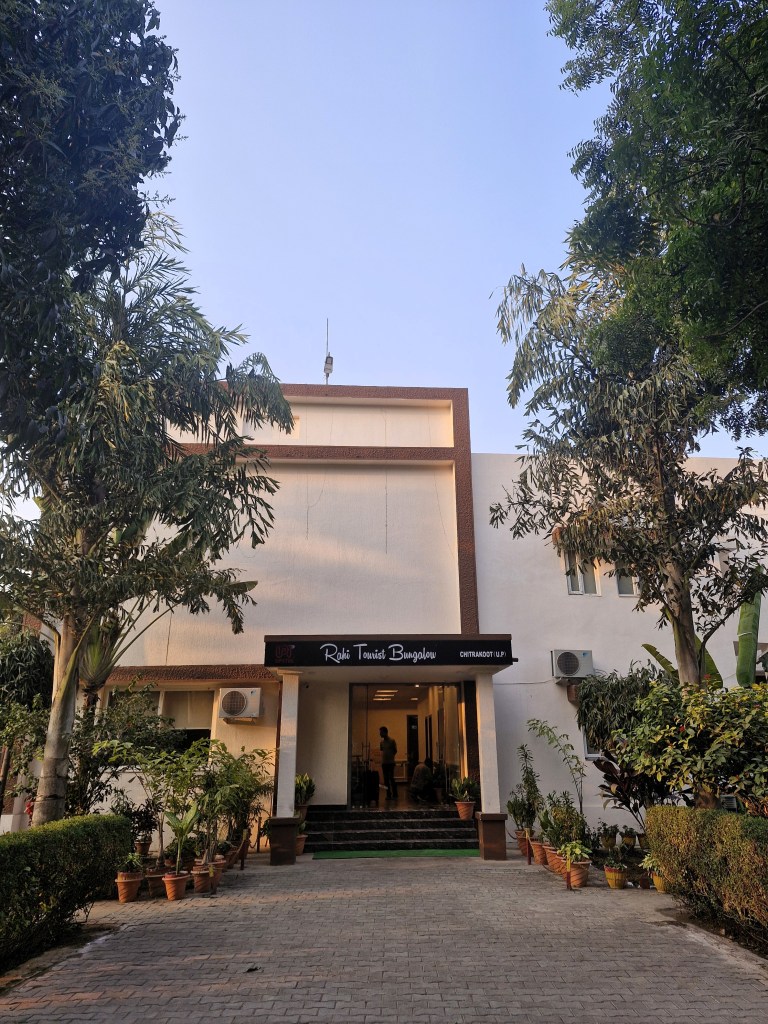
The Rahi Tourist Bungalow is owned by the Uttar Pradesh State Tourism Department. Like government hotels, the staff is a on the older side but has a great sense of hospitality. We were taken good care of even though one serve did talk A LOT.
The Tourist Bungalow premises were spacious with gardens and a driveway/ walkway where I strolled post dinner on both the nights. I’ll say it was basic but in a good way. Clean, comfortable beds, running warm water, functional kitchen with decent food, parking space, proximity to the temples etc. – all check!
Given the basic accommodation options available in Chitrakoot, I’ll recommend the Rahi Tourist Bungalow as a good place to stay.
What I saw in Chitrakoot & Kalinjar was definitely heartwarming, but what I felt was way more important. Satisfied. Traveler. Delighted. Impressed.
Stay tuned for my Day Five blog post. Once-in-a-lifetime trip I took… Truly changed my life and me!
