
Did you read the Day One of the Bundelkhand Trail blog post? If not, you can do so here. The experiences were so overwhelming that I didn’t think a single post would do justice to that whole road trip. So, bear with me as I break down each day for you.
Today, it is time for Day Two of the Trail – continuing at Prayagraj.
The Deep Dive India itinerary appeared to be delivering on its promise of adventure. The Day One evening was spent lazily at the Planter’s Bungalow. We ate delicious snacks at The Perch while Amresh P Singh sir told us about the heritage bungalow.
Amresh sir holds court while I try to finish my work…
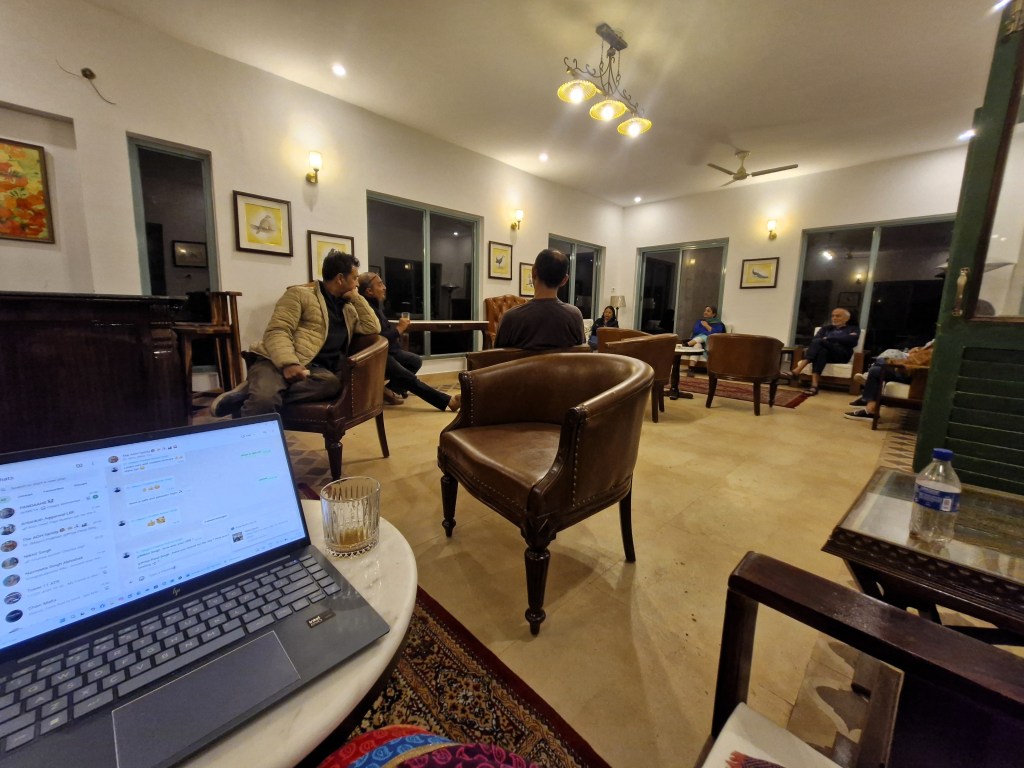
We then proceeded to eat dinner made with ingredients grown at the bungalow grounds.
My Day Two began with me completing some Samvada work before I could go absent all day. This was followed by a delicious breakfast. Before I boarded the Urbania, Amresh Singh sir pointed out a small owl, perched right above, well, The Perch.
We then headed back to Prayagraj. On our way, we crossed mustard fields and the River Ganga. Our first stop was the Law Museum and Archives.
Law Museum and Archives
One of its kind in India
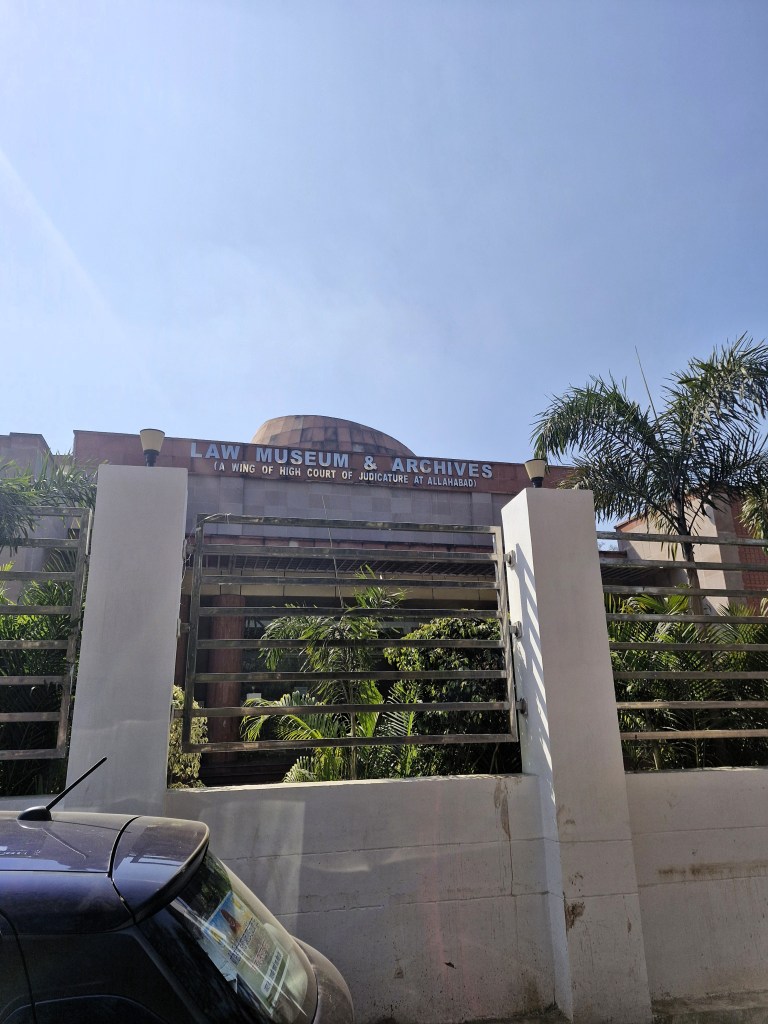
This was a first for me. I have been to many museums (yeah, ask N about my love for museums) but never to a law museum. The Law Museum and Archives at Prayagraj is one of its kind in India. Today, it stands as a repository of not only our legal heritage but also its cultural heritage.
Important facts, cases, debates, history, incidents, rare manuscripts, personality details, artwork details etc. are exhibited. The curator took us around and showed us the most interesting exhibits. My favourites were judgment in the historical Chauri Chaura case, rare Mughal farmaans, Mithila dynasty manuscripts, British emblem carved in wood, and witness box.
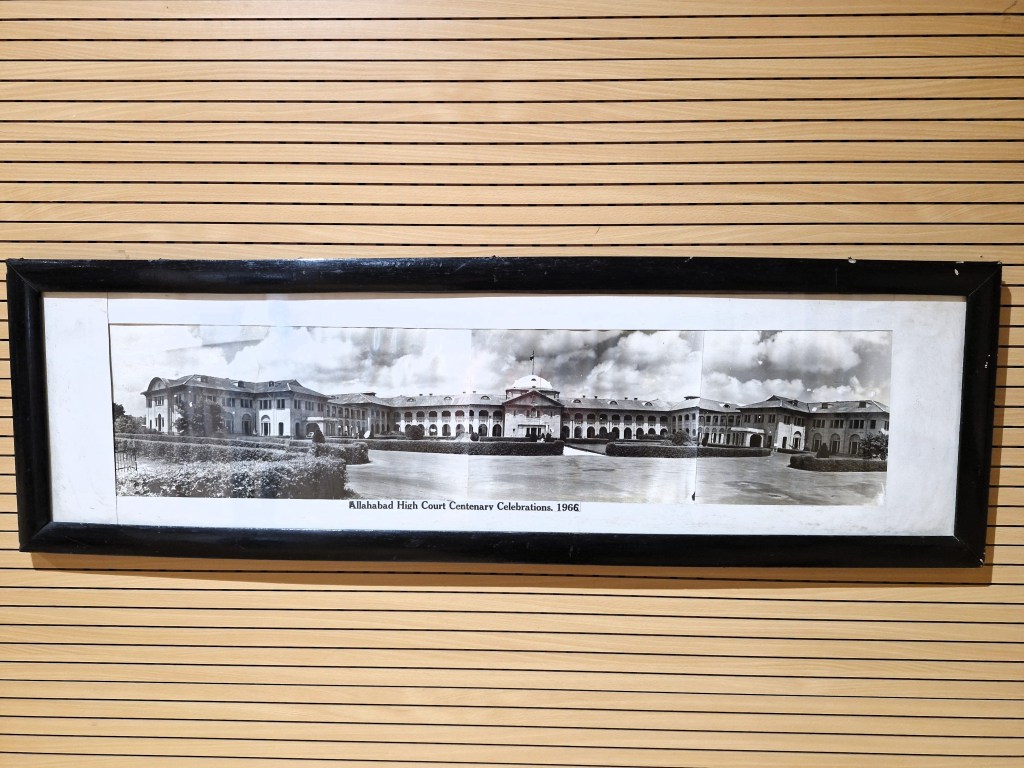
We then saw a video that narrated the story of the Allahabad High Court and this museum. For somebody who does not understand the law much, (but follows it blindly), the Law Museum and Archives was, nonetheless, informative and interesting.
The Law Museum and Archives truly offered a profound glimpse into India’s judicial legacy and historical richness. We then headed to the All-Saints Cathedral that we had crossed the previous day and that had immediately captivated me.
A treasure trove of all things legal!
All Saints’ Cathedral
The All-Saints’ Cathedral, also called Patthar Girja, is a Gothic – styled architectural gem. It was designed by the same British architect who also designed Kolkata’s Victoria Memorial (read my blog post on the Victoria Memorial here) and Mumbai’s Crawford Market – Sir William Emerson.
As we entered through the gates, we were greeted by the imposing facade of the protestant All-Saints’ Cathedral and the lush greenery that surrounded it. It had a serene atmosphere. Its rounded boundaries at the intersection added to its unique charm, making it a picturesque sight for us.
I loved the gargoyle waterspout on the roof. As we went around the All-Saints’ Cathedral, we admired its grand doors. Vaibhav Maini then showed us the (incomplete) two towers that Emerson had planned, flanking the main entrance; but they ran out of funds and the towers remained incomplete.
Can you spot the gargoyle waterspouts?
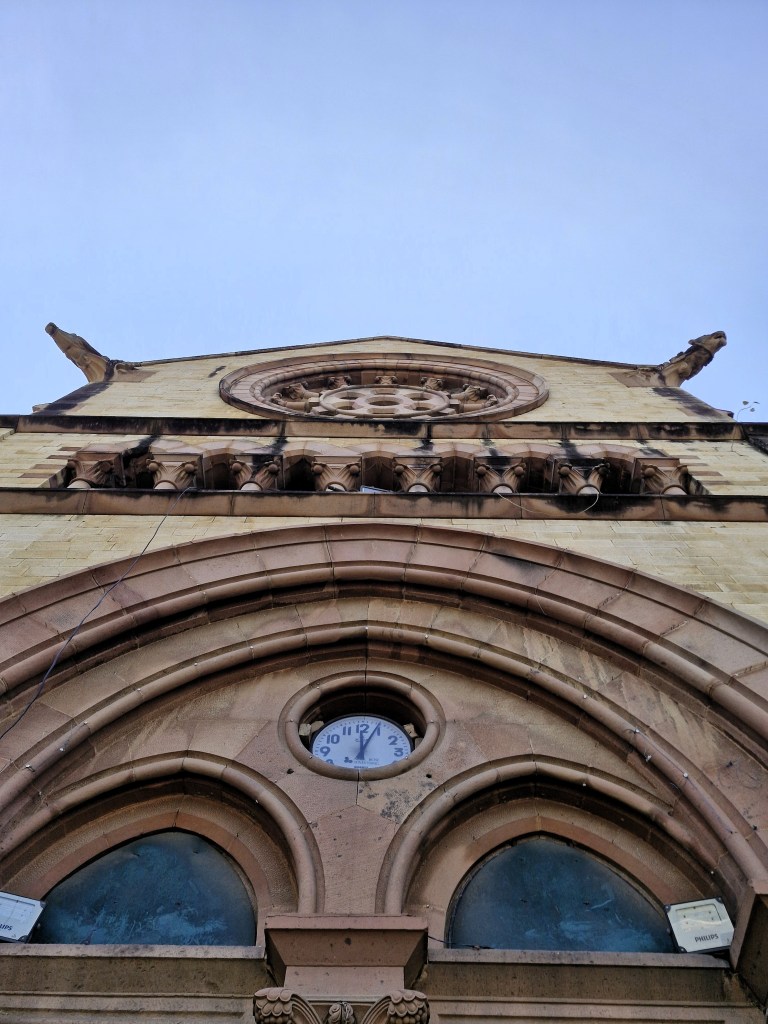
I also noticed, in the gardens, that nature was slowly reclaiming the premises of the All-Saints’ Cathedral. It was becoming part of a living forest. We then stepped inside where we couldn’t help but appreciate the intricate architectural details, the ornate marble altar and the grand pulpit.
But, the beautiful stained-glass windows stole the show for me. They bathed the space in a soft, colourful glow. Also, apart from the central nave in the All-Saints’ Cathedral, there are two narrow aisles alongside which, when empty, made for a beautiful photo.
I then noticed something interesting. There were memorial plaques all around; a few of them contained names like Mohan Singh etc. these being Hindu – sounding names, I asked about it. Samir Kher informed that when missionaries converted Hindus, they made the upper caste Hindus retain their names and surnames while, for the lower castes, the names underwent a change.
This was to make others realise that even upper caste Hindus were converting and attract more people towards conversion! You learn something new every day, don’t you?
Beautiful arches and doors…
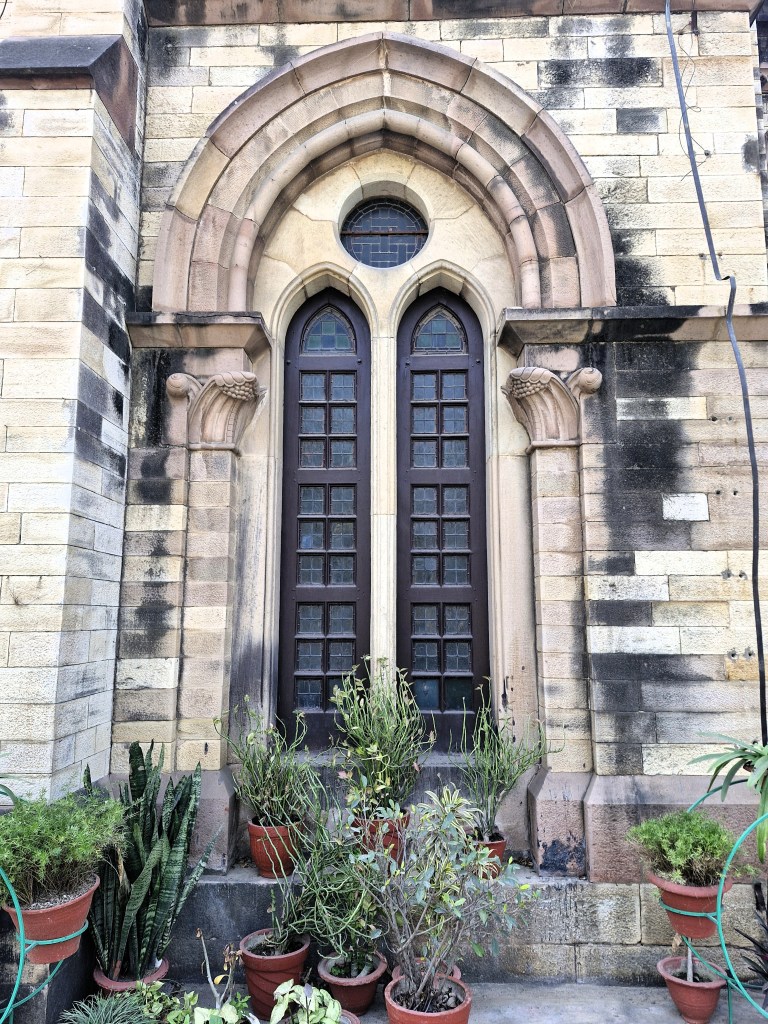
Anyway, to conclude, like all historic buildings, the All-Saints’ Cathedral needs restoration. Vaibhav echoed this appeal too and mentioned how he has been raising this with the concerned authorities. It goes without saying that we must safeguard our heritage for future generations to be able to appreciate it.
Vizianagaram Hall, University of Allahabad
This was something I wasn’t ready for. (Dhurandhar style – Ladies & gentlemen, you’re not ready for this!) It was as if I had stepped into an Arabian Nights location in the middle of Prayagraj. (It was also then that I realised that what I had assumed to be a mosque when I had crossed it the previous night was actually THIS!)
But first, credit again to Vaibhav for arranging this visit for us. Getting a university to allow visitors in the middle of an academic session is not an easy task.
Straight from Allahabad to Arabia…
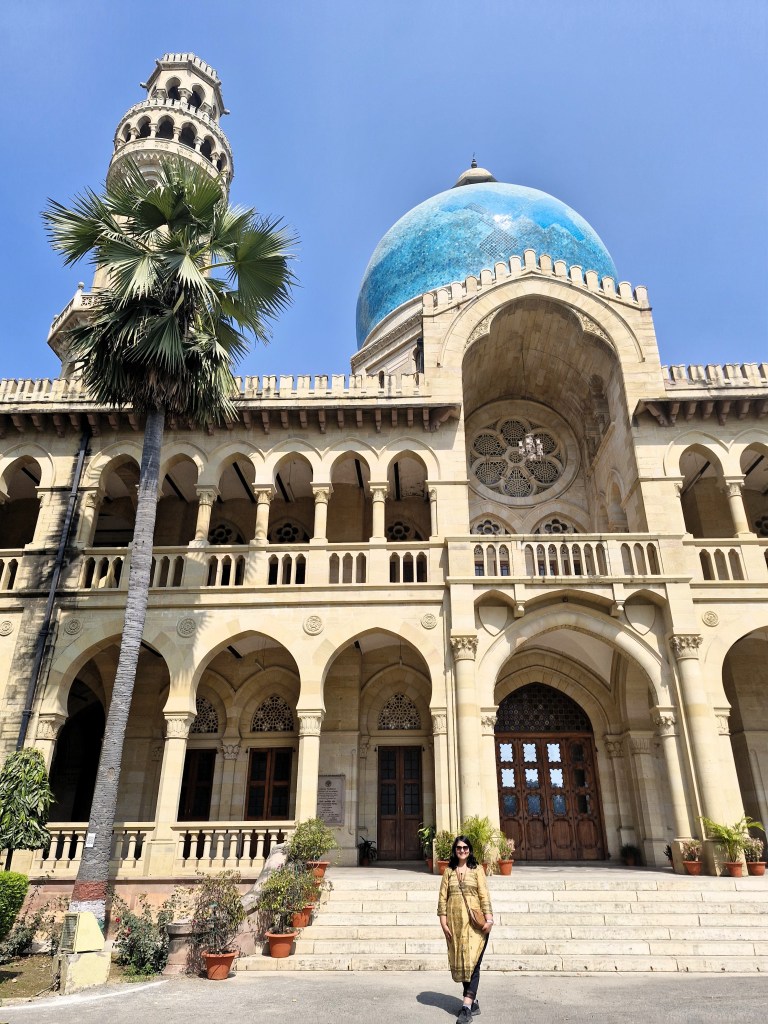
Our Urbania rolled into the University premises and as we disembarked, our jaws dropped. To think that the Vizianagaram Hall was once a pile of damaged window panes, shattered pillars, pigeon droppings dotting the floor etc is unimaginable seeing the restored beauty today.
And this wasn’t even too far back. This sorry state was as recent as 2012 while the restored Vizianagaram Hall was inaugurated in 2021. This really underscores the point that governments MUST invest in restoration and maintenance. To be fair, much has happened but also, much needs to be done.
Trivia – Did You Know? – The Allahabad University is also known as the Oxford of the East!
So, anyway, the Vizianagaram Hall was earlier called the Muir Central College. An 1880s building, it was, again, designed by Sir William Emerson. Its stone buildings include a convocation hall, reading rooms, teachers’ rooms, and a 200-foot-high tower.
My jaw – drop moment!
The construction cost of the Muir Central College included government grants and personal donations from prominent individuals. The then Maharaja of Vizianagaram generously donated a substantial sum, commemorating which the convocation hall was renamed Vizianagaram Hall.
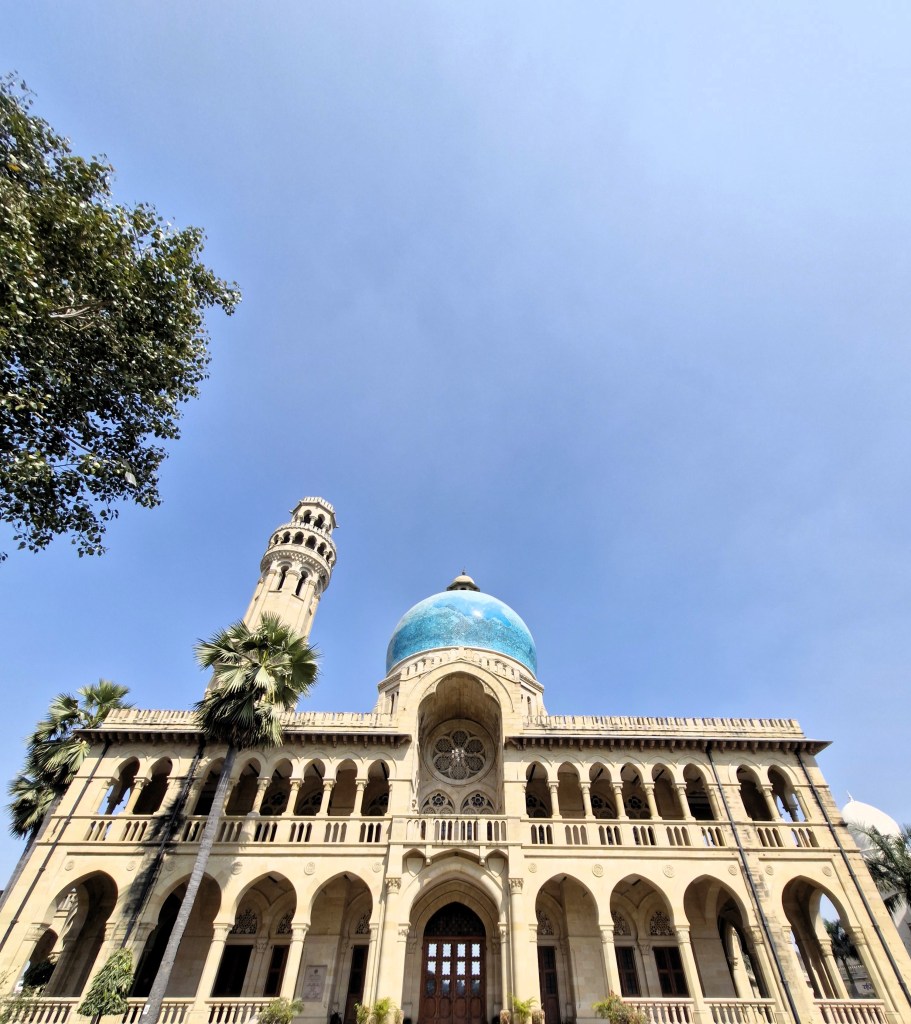
The Vizianagaram Hall stands in all its glory and grandeur on the Science Faculty campus of Allahabad University. It is a combination of Egyptian, Gothic and Indo – Saracenic architectural styles. It wasn’t just the Egyptian style or the scintillating blue dome that made my jaw drop but also the fact that there were palm trees surrounding it!
Did I say Arabian Nights? Yes, I’ve said that already.
The dome of the Vizianagaram Hall is clad in glazed tiles imported from Mintons Limited, England. The minarets and glazed tiled dome are constructed in perfect symmetry and balance. The rich colour of the dome captivated me with its majestic presence.
The grand corridors of learning
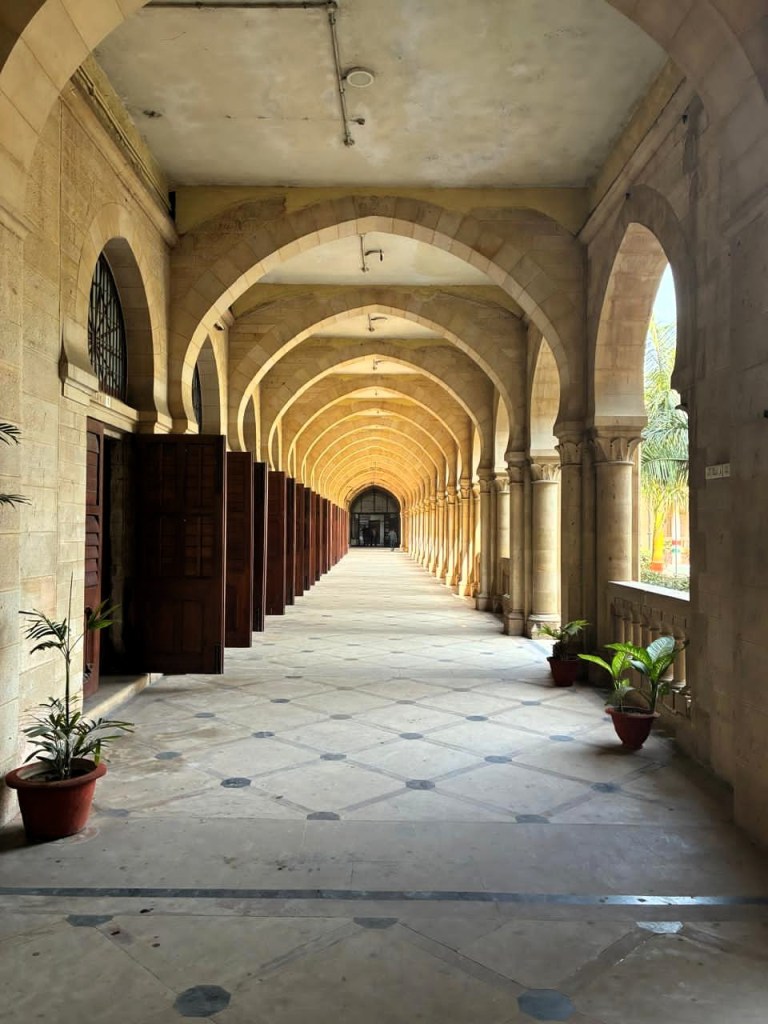
Along with the elegant and rich architecture of the Vizianagaram Hall, its courtyard garden is adorned with seven fountains. Its striking design speaks to our immense cultural pride. It reminded me of the opulence seen during the zenith of the Mughal rule.
The colourful stained-glass windows, pointed arches, and ornate intricate decorations of the Vizianagaram Hall create a marvellous structure of grandeur.
We then moved inside the convocation hall. In its glorious days, it saw meetings attended by kings. It was then used as an examination centre. Plaques to honour the generous donors hung all around the hall. Its floor is paved with marble and mosaics, with the globe etched into the floor.
The chamber floors are paved with red stone from Shivrajpur, Chunar, and Agra. The slender columns and lighter system of frescoes allow more light inside, displaying a dazzling display of colour as the sun’s rays strike the stained glass. A life-size statue of William Muir stands at one end.
The statue has a book in one hand and a guide map of Muir College.
The plaques above hold the donors’ names. Behind me, the globe engraved on the ground in marble.
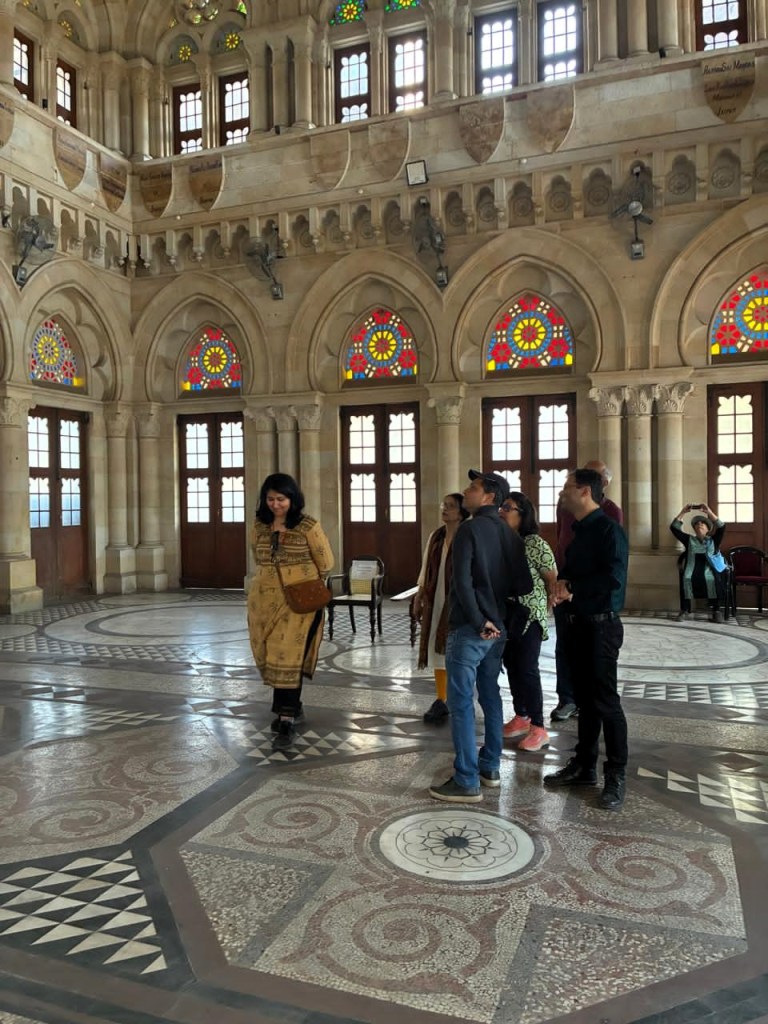
Almost every surface of the iconic Vizianagaram Hall was a discovery. We then took a round around it and stepped into the garden to see two old banyan trees.
Senate Campus
After the Vizianagaram Hall, the Senate Campus underwhelmed me. As it did everyone I guess because nobody really wanted to explore it in detail. Anyhow, like a dutiful travel blogger, let me tell you a bit about it. Built in the 1910s, it showcases (again) Indo – Saracenic architecture.
The Senate Campus was designed by Sir Swinton Jacob. It features chhatris and jharokhas. But its distinctive feature is a clock tower which certainly adds to its grandeur. It reflects colonial era heritage. Restoration efforts are underway here. Compared to the Vizianagaram Hall, it was underwhelming but as an independent building, it is actually an iconic landmark of India’s educational and architectural legacy.
Now tell me – Isn’t this underwhelming compared to the Vizianagaram Hall?
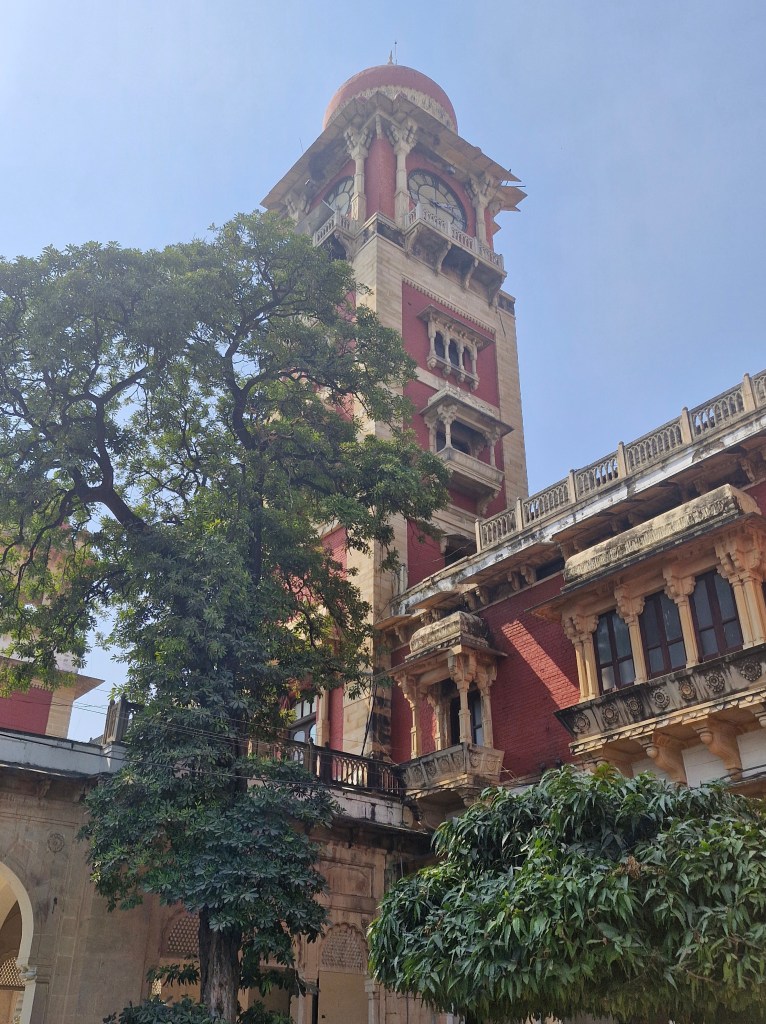
Anand Bhawan
I, of course, remembered this from the book Anand Bhawan Memories and Other Personal Essays by Indira Gandhi. Built in the 1930s by Motilal Nehru, this building served as the residence of the Nehru family when Swaraj Bhawan, their palatial mansion in the same premises became the headquarters of the Indian National Congress.
Once a hub of India’s struggle for independence, Anand Bhawan served as a meeting place for leaders and a symbol of nationalist activity. As we moved around the house, we saw different parts of it preserved. Its rooms, with their high ceilings and intricately-carved furniture, can be seen through glass partitions.
My imagination made me visualise how the dining room would have sounded with the dinner table conversations of a room full of influential people.
The Anand Bhawan behind me
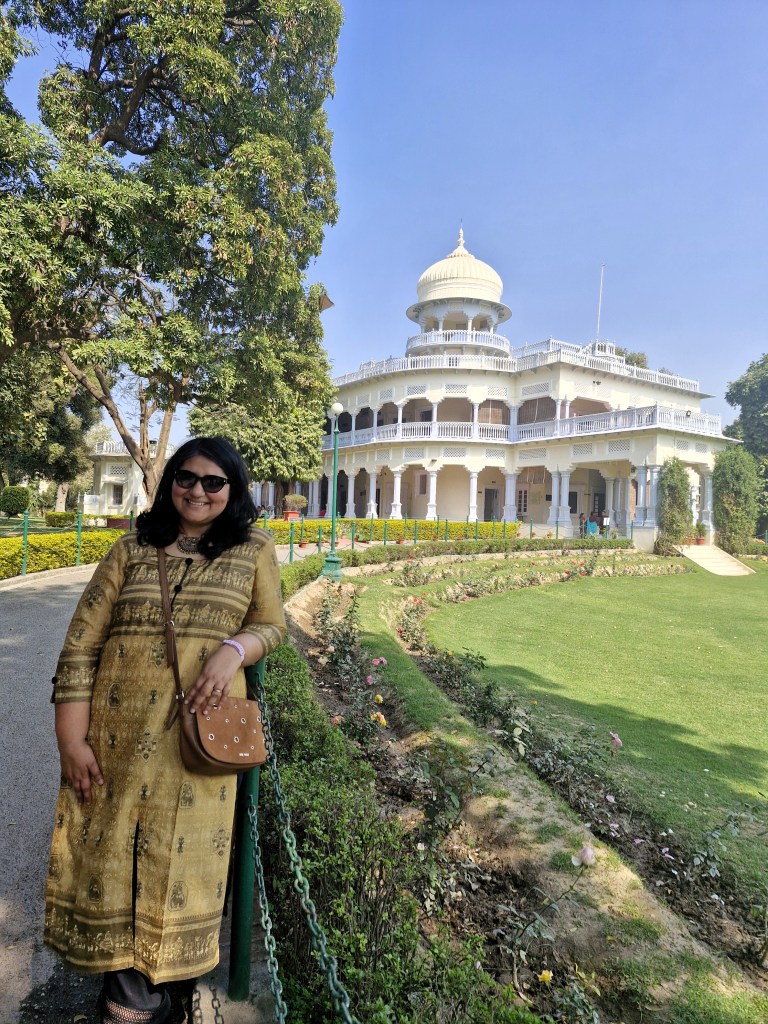
Anand Bhawan connected directly to Jawaharlal Nehru, Kamala Nehru and later Indira Gandhi. We saw the platform where Ms. Gandhi’s wedding ceremony took place. We also saw photos from her wedding day. The museum is linked to India’s history but may still be a less – known site.
Our visit was a heritage exploration and a tribute to the role of Anand Bhawan in India’s freedom movement. It is open from 9:30 AM to 5 PM, except on Mondays and public holidays. It is located in the Civil Lines area, about four kms from the railway station, and 12 kms from the Airport.
The best time to visit is from October to March, when the weather is pleasant and cool. You can visit Swaraj Bhawan in the same visit.
We then took a break for lunch. We headed to Alimento Restaurant and Café. We were seated immediately as Vaibhav had already made arrangements for us. It boasts of a multi – cuisine but I stuck to my formula of ‘when in Rome, do as the Romans do’. I had my fill of Kakori Kebab with Ulta Tawa Paratha both of which were decent.
Lunch under the Sun in winter – yes!
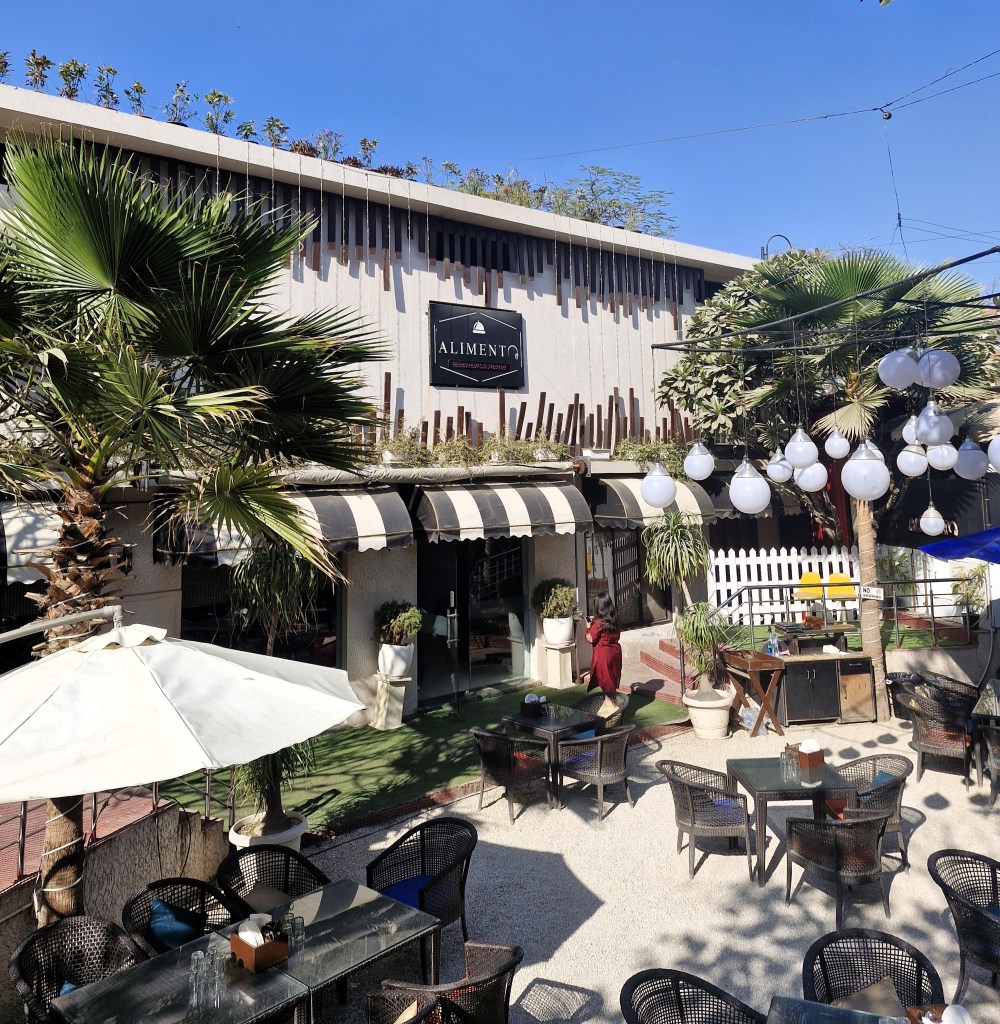
The vibe of Alimento Restaurant was certainly cosy. I liked their alfresco seating. Though the sun was warm, in the shade, we felt perfect. We were there during lunchtime but I could imagine how it could get crowded in the evenings – full of families having dinner, friends catching up over coffee or couples having romantic date nights.
Khusro Bagh
Our post – lunch siesta was robbed by Khusro Bagh. This was the tomb of the heir to the Mughal throne and other royals. Akbar disliked his son Salim’s the carefree lifestyle and rebellious attitude and did not want him as his successor. He wanted Khusrau Mirza, Salim’s eldest son to succeed him, but it was not to be.
Salim had his own plans. After Akbar’s death in 1605, he ascended the throne and came to be known as Jahangir. Shah Begum, a Rajput princess, was one of his wives. She gave birth to Khusrau Mirza. Unable to tolerate the conflict between her husband and her son, she committed suicide by taking an overdose of opium.
Nisar Begum’s Tomb
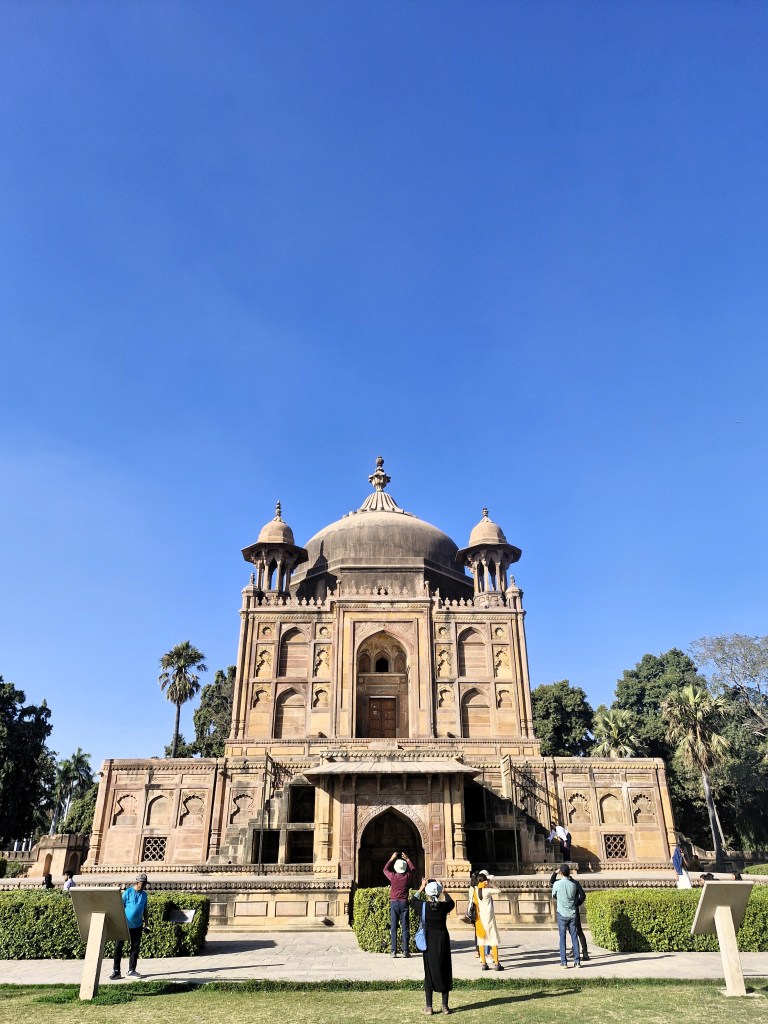
Jahangir built this magnificent tomb in her honour. It stands in the centre of the grand Khusro Bagh. Standing on an octagonal plinth, the two-storied structure is topped with a square chhatri, supported by 12 pillars. It has minimum ornamentation apart from a few recessed arches and jali windows.
Then, Khusrau Mirza was dissatisfied with his father ascending the throne and rebelled against him. The rebellion was suppressed. He was taken prisoner and partially blinded. His brother, Shah Jahan, still considered him a threat and had him executed.
Khusrau Mirza was laid to rest in a magnificent tomb next to his mother’s tomb. His tomb was commissioned by his sister Nisar Begum). This is a square structure standing on a square plinth and is crowned with a massive dome. The dome is flanked by four chhatris; slender minarets mark the four corners.
Khusrau Mirza’s tomb too also has a share of battlements, jali windows and recessed arches giving it an elegant look.
Shah Begum’s Tomb
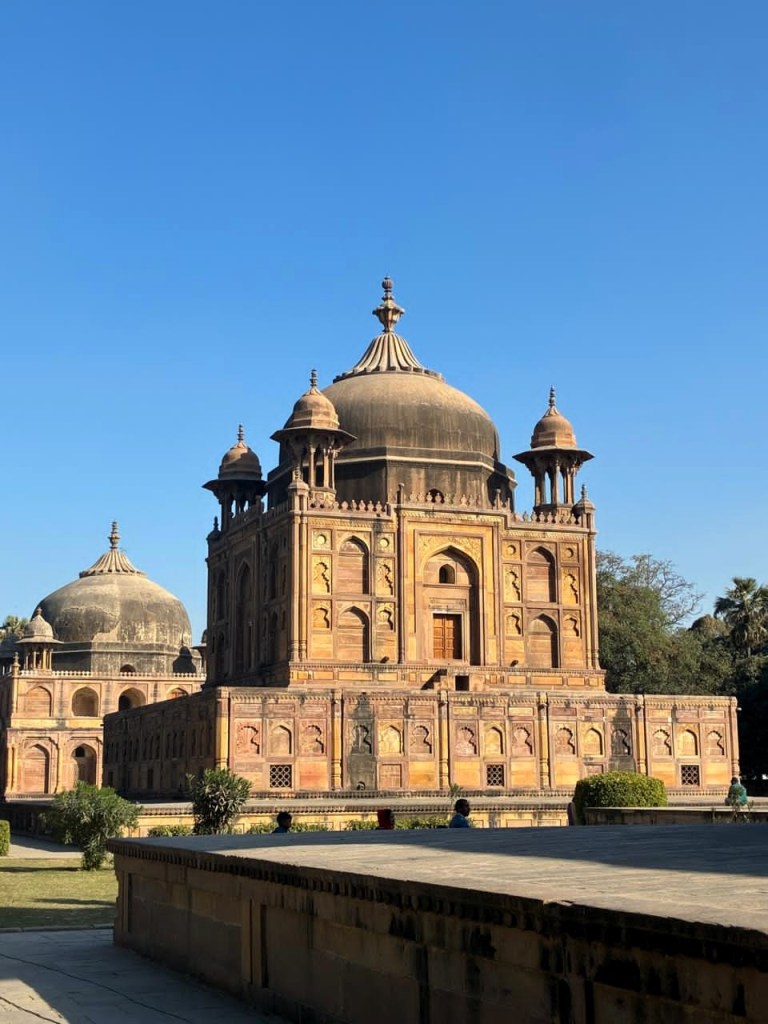
Sandwiched between Shah Begum’s tomb and Khusrau’s tomb is Nisar Begum’s tomb. She constructed it herself. It is the most architecturally elaborate and ornate tomb here. The square tomb stands on an elevated square plinth. It is crowned with a massive dome, flanked with four chhatris on the four corners.
Nisar Begum’s tomb has elaborate ornamentation work with decorative battlements, intricate jali windows and recessed arches.
The space between the three tombs is occupied by two beautiful ornate fountains. There was a fourth structure – Bibi Tamolon’s Tomb – but it was on the other side; the group did not want to walk all the way in the sun. But we did see the grand gateway of Khurso Bagh from a distance.
This grand gateway is not used for entry anymore. We roamed around the large green spaces of Khusro Bagh. It is a Mughal-styled char-bagh garden complete with fountains and water channels. It is protected under the ASI. It has orchards with mango and guava trees.
Shade is important as Vaibhav briefs us about Khusro Bagh!
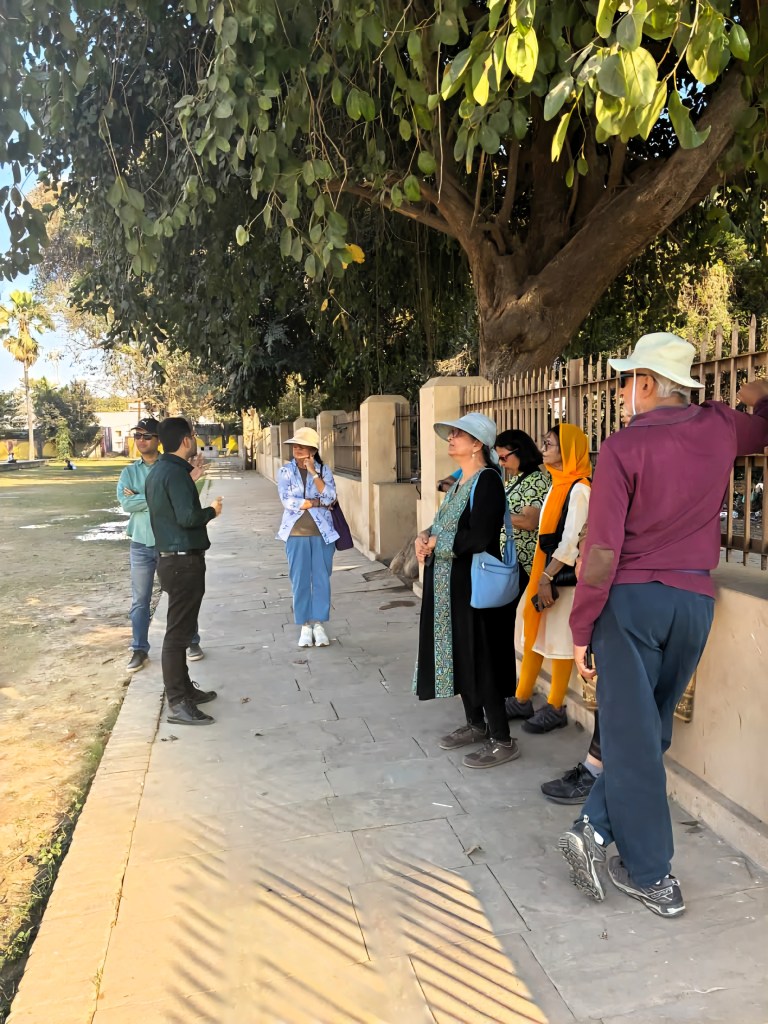
The Khusro Bagh serves as an open space for locals, who frequent it for morning and evening walks. It is open from 6 AM to 7 PM. Entry is free. Photography is allowed. But, entry inside the tombs is prohibited.
Sangam Confluence
For me, this was the highlight of the day. Religion over history any day!! We headed to the Sangam (confluence) ghat where, again, Vaibhav had worked his magic. Despite the Maagh Mela going on, and routes restricted for vehicular movement, he got us right to the ghat.
We then hopped onto a comfortable rowboat for a The Sail of Ecstasy Heritage Boat Ride. Our private boat ferried us along the Ganges on a fascinating ride. It gave us a feel of both the religious and historic aspects of the mighty rivers Ganga and Yamuna while we sailed past the fort, dock and temples to the final confluence.
Sunset at the Sangam
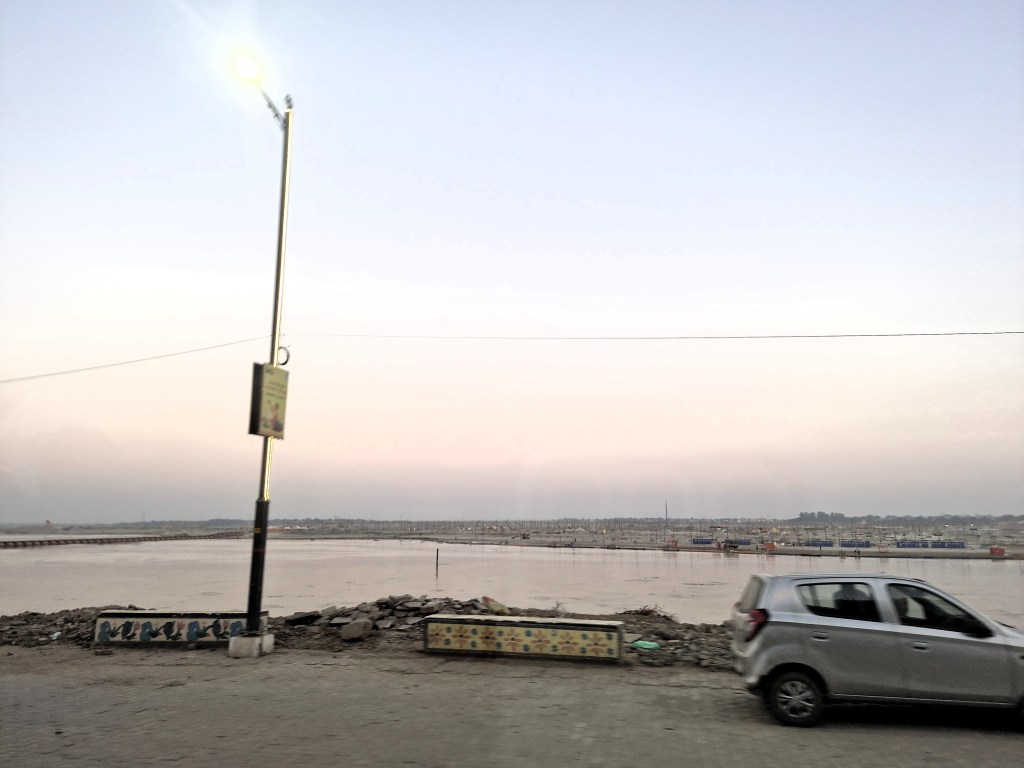
Samir and Vaibhav regaled us with historical narratives while Madhukar pointed out the different aquafauna to us.
As I had written in my previous blog post, Sangam is where the Ganga, the Yamuna and the mythical Saraswati merge. As we reached this point, we could see the different colours of the two rivers – the brownish Ganga and the blackish Yamuna.
We dipped our fingers in the holy waters and sprinkled some drops on ourselves, hoping that the supreme powers will bring happiness to us.
When we reached back on the bank, the setting Sun made for a perfect photo-op. Also with Akbar’s Fort in the background. I actually have photos with the Sun forming a halo around my head! Goddess energy? Always!
Allahabad Food Trail
We then went to Chowk on a curated tour to discover the best savouries and sweets of Prayagraj. The Loknath locality is known for its food offerings. The marketplace is vibrant and filled with diverse goods and local culture. We utilised battery rickshaws for convenient transportation in this crowded area; I recommend you do so too.
The Loknath market offers fresh produce, spices, traditional sweets, and famous namkeen shops. Our first stop was the Nirala Mishthan Bhandaar. This shop has been functioning since 1949, serving chaat and sweets. It is, indeed, considered a legendary street food spot.
Nirala Mishthan Bhandaar has the reputation of preparing everything with pure ghee. We got a chance to relish some flavoursome Aloo Tikki Chaat, Gulab Jamun and Kaale Gaajar ka Halwa. The Aloo Tikkis were fried to perfection and then topped with tangy chutneys, yogurt, spices, and garnishes that created its signature chaat flavour.
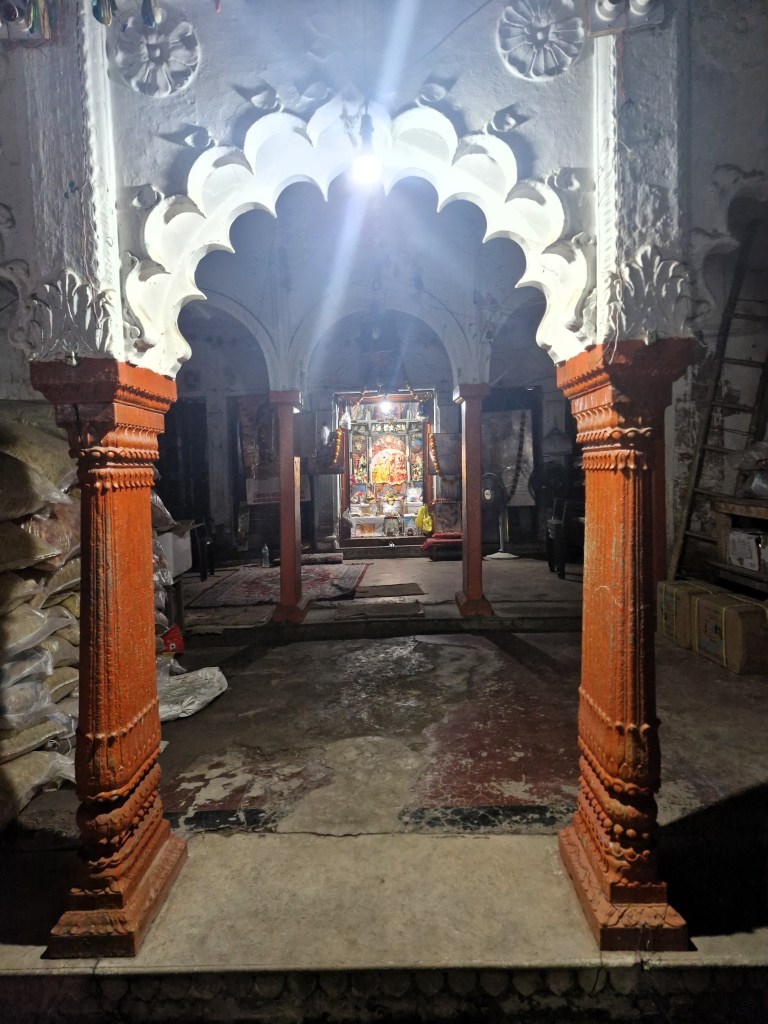
The peaceful shrine in the middle of the chaotic lane
Both the sweets too were delicious. The Kaale Gaajar ka Halwa was my first!
We then moved ahead to stop at a shop that’s known for its Sohan Halwa. But I’d had my fill by now and I stood away, not even letting the aroma entice me. Instead, Samir and Vaibhav invited me to see a small shrine next door, absolutely hidden from the chaos of the lane outside.
This Sita – Ram shrine seemed to be someone’s personal temple.
We next moved to Hari Ram & Sons. This shop seems to have a cult following with even NRIs stocking up on these masalas to take back home. Their signature offering was Dum Aloo Masala which I picked for N. But this shop has any and every masala that you can imagine as well as Indian savouries, or what are commonly known as mixtures.
The joy of good food…
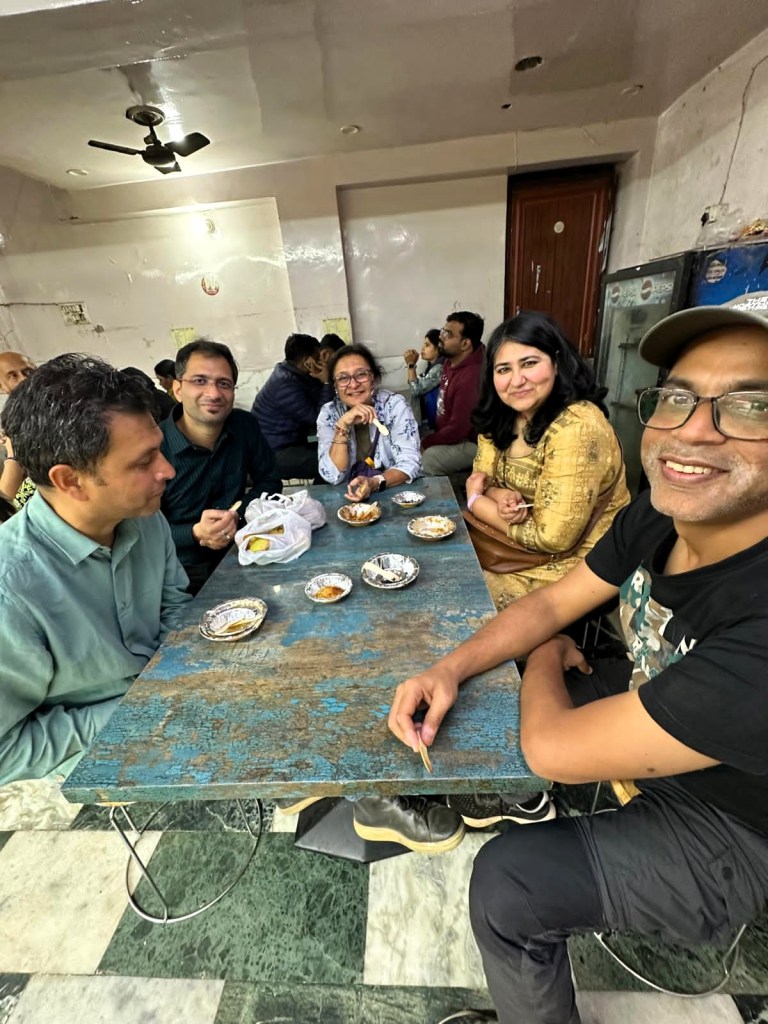
This brought an end to our food trail. Without a doubt, the Loknath area was a sensory overload. Though, if you’re fussy about hygiene, you may find this locality a little troublesome. For example, when I was standing at the entrance of the Nirala Mishthan Bhandaar, waiting for the others, I could smell the stink from the drain flowing underneath.
This brought an end to Day Two of the Bundelkhand Trail for us. And an end to our time in Prayagraj too. We boarded our Urbania and made our way to Planter’s Bungalow.
Planters’ Bungalow
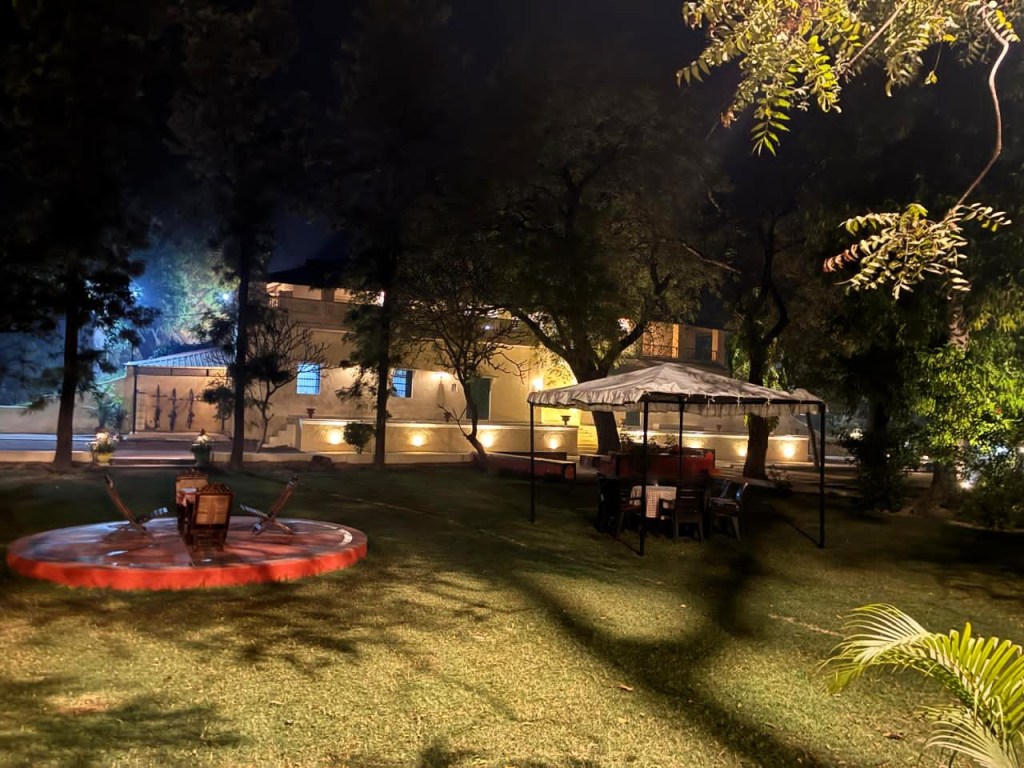
Built in the 1860s, the Planters’ Bungalow was originally home to a British indigo farmer. It was later acquired by the Pratapgarh king who used it as his personal retreat. Today, it has been restored to its original state. It has charming verandas where you can just lounge the day away.
I’ll return one day, some day, to enjoy the pool in a non – winter month.
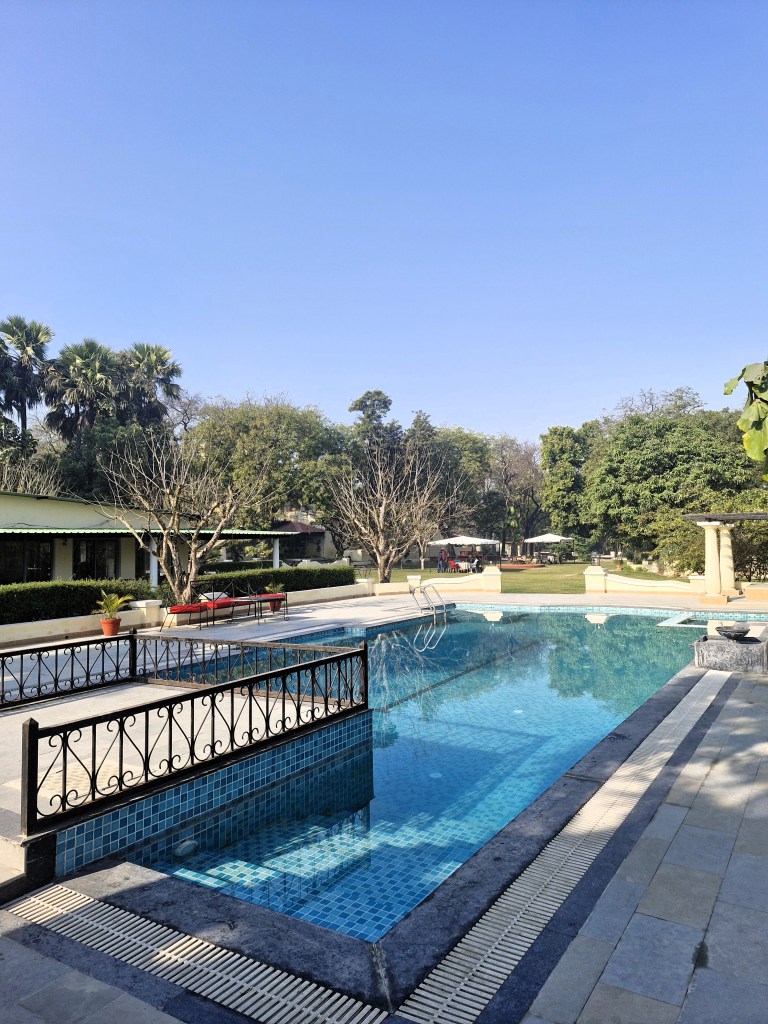
Our rooms were appealingly – decorated with ensuite bathrooms and while it is a heritage bungalow, our rooms were well – appointed with all modern – day comforts.
When you stay here, you can enjoy the Planters’ Bungalow at your leisure. The evenings were late but I spent some time walking around the estate on my last morning there. You can also observe the ongoing farming activities. It is a birder’s paradise with its large canopy of green orchards; Madhukar took a few other guests birding but I preferred to sleep in.
Both the evenings, we lounged and enjoyed our host Amresh sir’s hospitality at The Perch. He regaled us with stories about the Planters’ Bungalow, how it was restored, what are the activities undertaken there today etc. He also narrated stories about the surrounding region.
Our dinners too were curated meals representative of this region. For me, the dishes were akin to what I’ve eaten since childhood but for the Mumbai travellers, all of these were a novelty. Dinner table conversation too was informative and interesting with Amresh sir describing the produce and the cooking methods.
Glowing after dark
Great company, great conversation, great food – what a fitting end to a great day!
What I saw in Prayagraj was definitely blissful, but what I felt was way more important. Satisfied. Traveler. Pleased. Awed.
Stay tuned for my Day Three blog post. About a once-in-a-lifetime trip I took… It has truly changed my life and me!
