
Did you read the introductory blog post on my Bundelkhand journey? If not, you can do so here. The itinerary was packed. The experiences were overwhelming. I didn’t think a single post would do justice to that whole road trip. I couldn’t even do it justice in a couple of posts.
So, bear with me as I break down each day for you. I will share what I saw, what I felt, and what I took away.
As I’d mentioned earlier, the itinerary by Deep Dive India was thrillingly drafted. It had the promise of adventure. The trip began with the Doab (Do’ab) region and then progressed to Bundelkhand.
Doab
Simply put, Doab is the land between two (do) rivers (ab). (Ab means water.) {Just like the Punjab is the land between five (Punj) rivers (ab).} The word traces its origins to Persian. It’s commonly used in the Indian subcontinent. This alluvial land, between two converging rivers, is highly fertile and is, thus, the cradle of civilizations.
In India, the best-known doab is the Ganga – Yamuna one. It makes up the north Indian plains. Yes, this is the same famous land. It has been the center for many conflicts and invasions due to its habitability. It also has high agricultural productivity.
The Ganga – Yamuna doab has been crucial to India’s geography as well as history. And this is where our Trail began!
On the first day, I took an IndiGo flight from Delhi to Prayagraj. This was the meeting point for the whole group. A short and uneventful flight later, I landed and was welcomed by a beautiful mural inside the airport. On coming out, I met Samir Kher, the Deep Dive founder.
An Urbania awaited me, with the other tour guests already seated inside. We were a group of seven. The other six were from the same family or friend circle. This made me, yet again, a solo traveler. With Samir and his partner, Madhukar Jha, and our Urbania driver bhaiya, we were a group of 10.
All of us were kicked for some Prayagraj sightseeing but, first, lunch!
Prayagraj
Landing at Prayagraj and watching the river flowing along side…
Right at the center of the Ganga – Yamuna doab lies the city of Prayagraj. This is actually the spot where the two rivers converge, giving birth to the holy spot called Triveni Sangam. This is one of the oldest cities in India. It can be found in ancient scriptures, referred to as Prayag or Prayagraj or teerthraj.
Prayagraj is considered the place where Brahma offered the first sacrifice after creating the world. It is one of the holiest pilgrimage centers in India. At the Triveni Sangam, not just the Ganga and Yamuna come together. The dried, invisible, mythical, underground Sarasvati also meets there.
This makes the Triveni Sangam sacred to Hinduism. Of course, after the 2025 Maha Kumbh, who hasn’t heard of the Triveni Sangam or Prayagraj?
Moving on from religion, Prayagraj has tremendous historical importance too. It has seen the rise and fall of dynasties and the arrival and departure of many historical figures. The Chinese traveler Hieun Tsang visited during King Harshvardhan’s reign.
The Mughal Emperor visited this region and created the imperial city of Illahabad (which later became Allahabad). Prayagraj was where Emperor Shah Alam II signed over the ‘diwani’ rights of Bengal to the British. This action laid the foundations of the British empire in India.
During the British raj, the capital of the northwest province was moved to Prayagraj from Agra. It played a critical role in India’s freedom movement. This was from the first struggle of Indian independence right up to our actual independence.
Prayagraj gave India its fourth oldest university – the Allahabad University. It has given many prime and union ministers to India.
I’m ashamed to admit the next after writing all this. Despite such mythological, historical, political, and geographical importance, successive central and state governments relegated Prayagraj to a tier 3 status. It is only in the recent past that it has once again begun to shine!
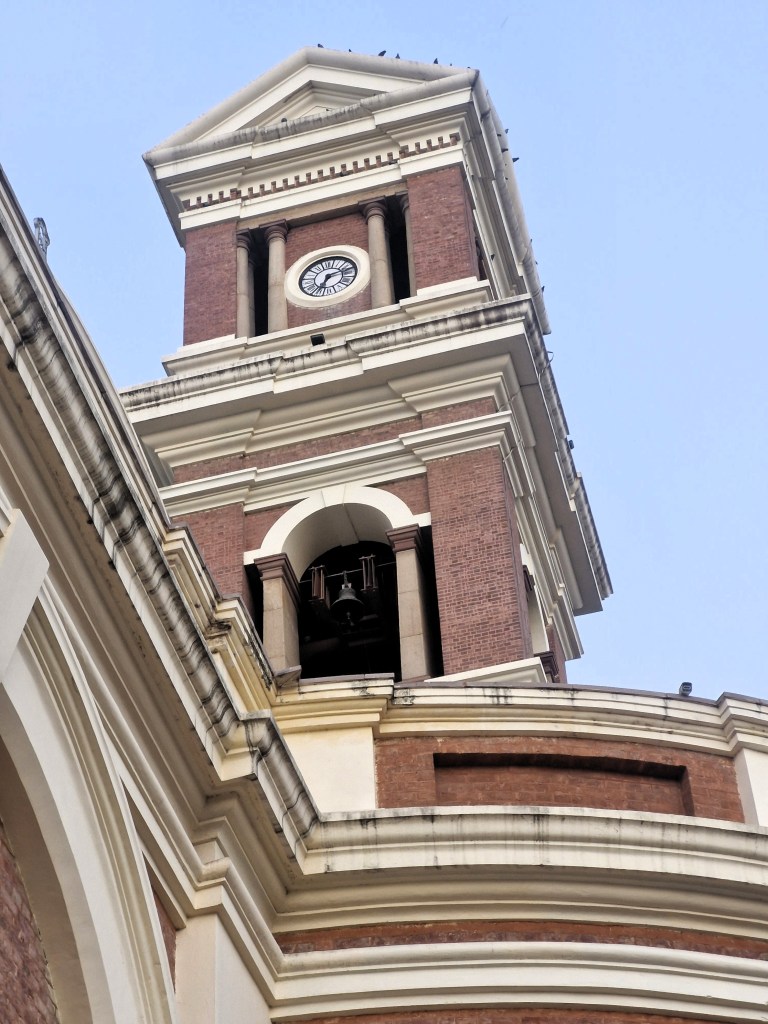
The bell tower at the St. Joseph’s Cathedral
I hope it is onward and upward from here. (Or, should I say ‘backward’, to reclaim the past glory?)
We made our way to Indian Coffee House for lunch.
Indian Coffee House
The Indian Coffee House appeared to be a cathedral at first glance. It looked more like a cathedral than a coffee house because of its high ceiling and arched entrance! Vaibhav Maini, our Prayagraj guide, joined us here. The Coffee House was established in 1957 and is located within the Darbari Building in the heart of the city.
The ‘trailblazers’ at the Indian Coffee House
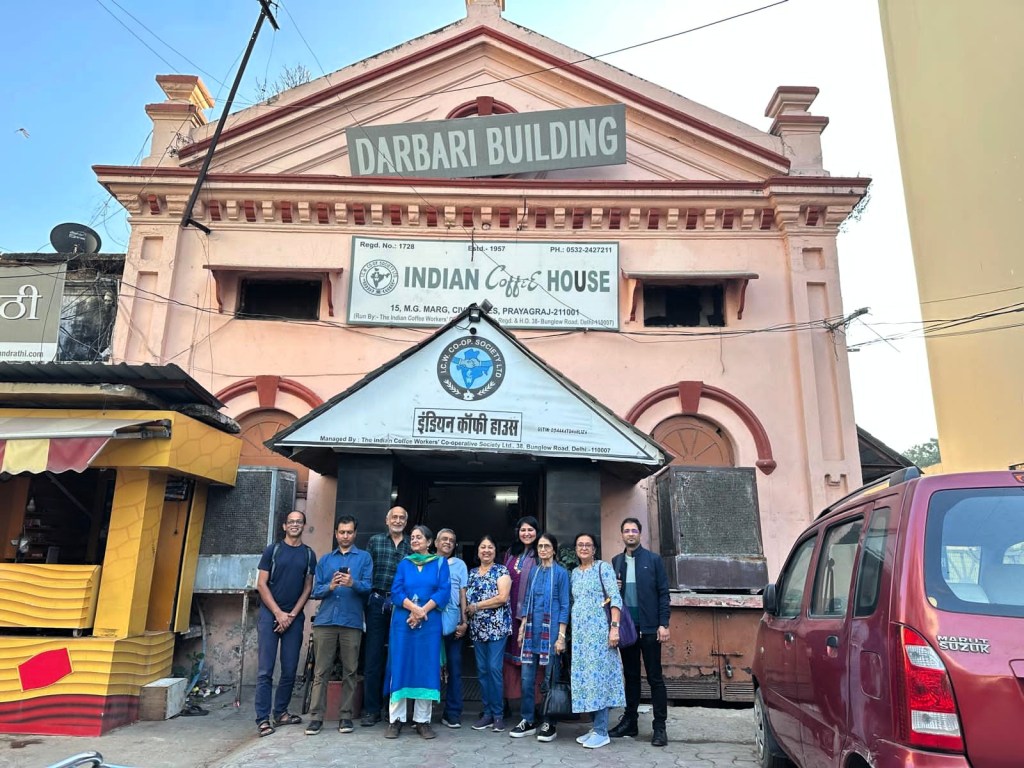
The Indian Coffee House has an old-world charm with its basic (aluminum) chairs and (mica-topped) tables. It has a high ceiling and those black Bakelite switches! Vaibhav informed us that it has long been a meeting point for intellectual discourse.
The Indian Coffee House has been a hub for academicians, politicians, thinkers and writers. It has seen debates and discussions on literature, politics and social causes. Personalities like the late Harivansh Rai Bachchan and VP Singh were frequent visitors.
Chai pe charcha or coffee with conversations – what do you prefer? For me, as long as it adds to my knowledge, either is okay! In that spirit, almost all of us ordered Filter Coffee. I went with a Mutton Dosa which was flavorful. I sampled a bite from someone else’s Mutton Cutlet and that was flavorous too.
As we ate, Vaibhav gave us a brief about the origins and the importance of Prayagraj. I thought I’d not absorbed any of it. I was so engrossed in my Dosa. But I think I did okay!
Yes, they still wear that hat at the Indian Coffee House!
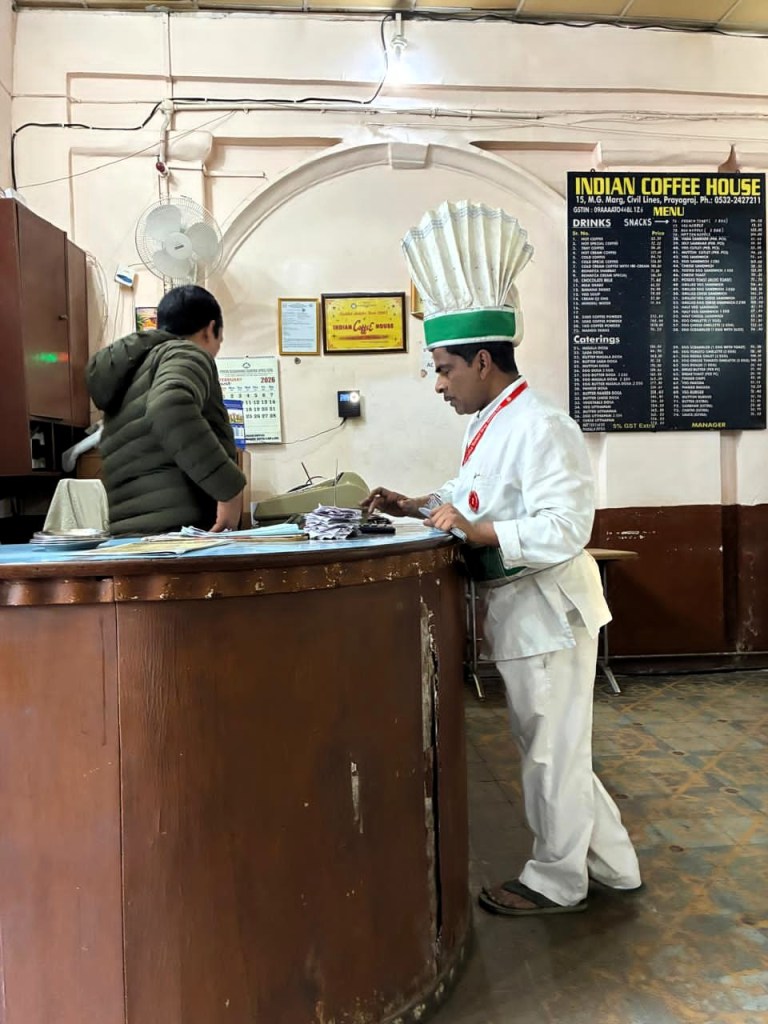
The Indian Coffee House is flanked by other historical companies like Rajkamal Prakashan. Trust Deep Dive to arrange even the lunch in a historic setting!
Next stop – the Board of Revenue. As we drove towards this, we crossed the All-Saints’ Cathedral. It was classy but I would get a chance to visit it only the next day.
Board of Revenue
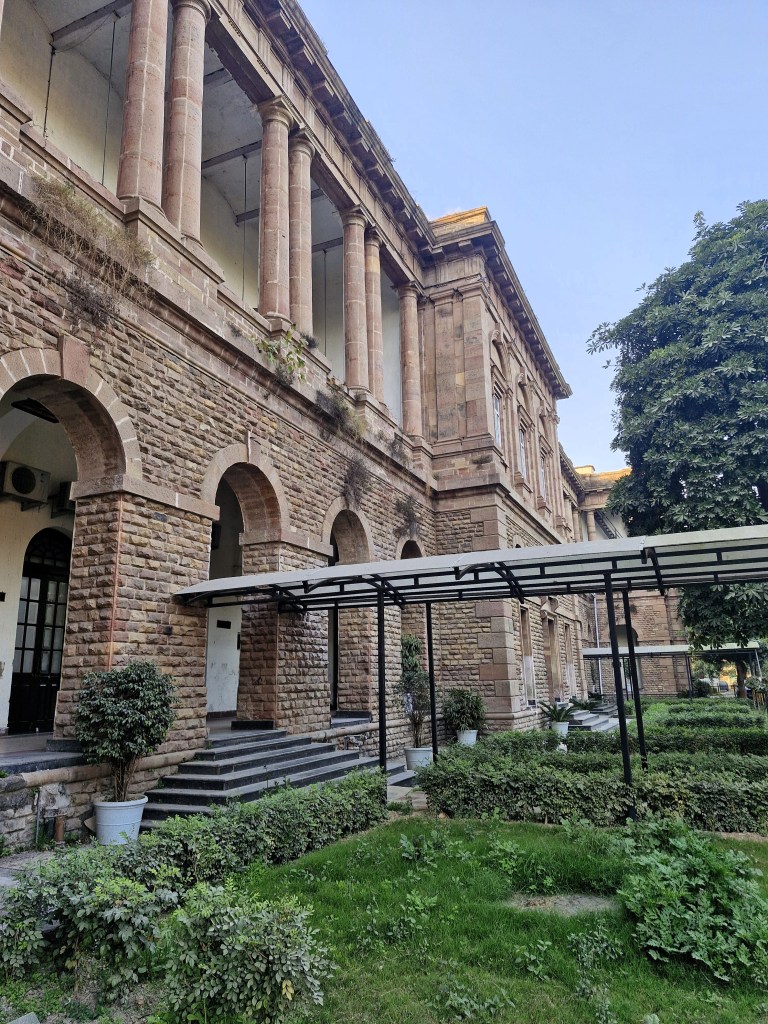
Our Prayagraj trail comprised British – era architecture. The Board of Revenue was the first of many. It was established in the 1830s on the Queen’s Road. It is actually one of the four similar grand stone buildings on both sides of Queen’s Road, housing government offices.
Approaching the Board of Revenue premises
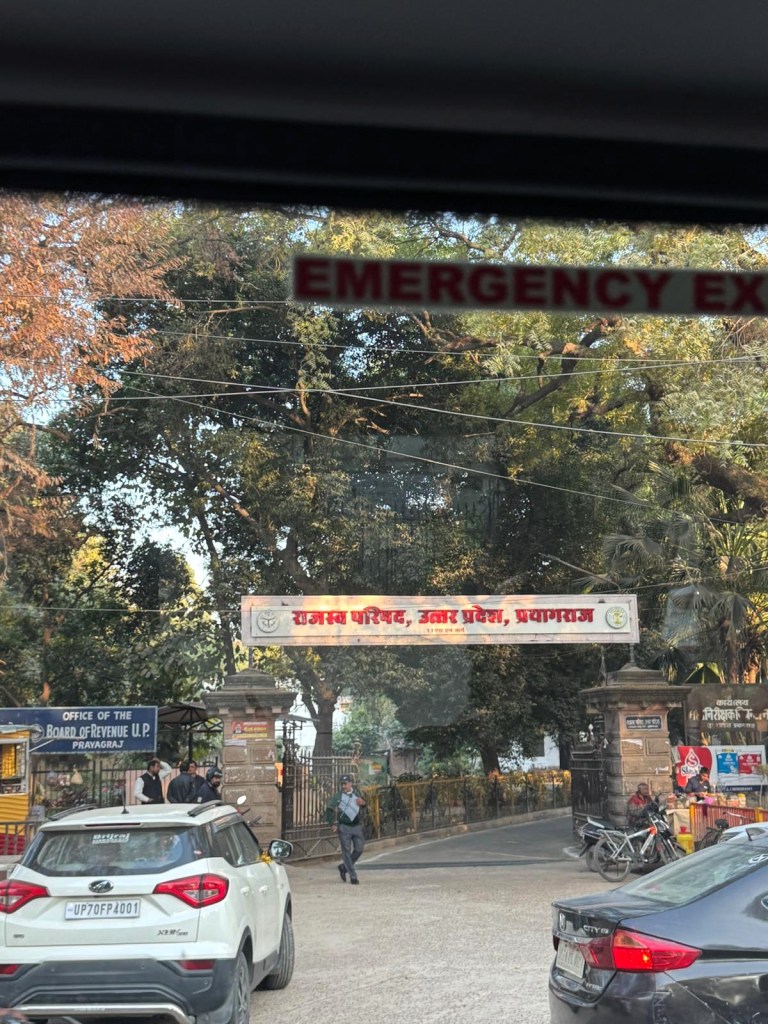
All of the four buildings have a military – influenced style.
The Board of Revenue building has that red – brick colonial architecture. You can see this style across many of the British – era cities/ towns. We didn’t go inside, it being a government office, but we saw the slightly frayed out but imposing staircase.
The doors and arches, true to their time, were massive.
It was early evening by then. At that golden hour, the sun-rays fell on the Board of Revenue. It looked like a cube of gold or fire. What a sight! My only peeve here was the number of posters put up of lawyers and their associations. Our skylines are ruined by these narcissistic public figures.
Gorgeous architecture at the Board of Revenue
Mayo Hall
We drove further down to Mayo Hall. It is colloquially known as ‘Myohaal’. Now, it is called the Amitabh Bachchan Sports Complex. As we entered through the gate, I was left awestruck at the tower looming in front of me. It looked like a church spire more than anything else, but Vaibhav said this building was never a church.
The tower at Mayo Hall also had neither a bell nor a clock. So, what was its purpose? I’ll be honest – this building left all of us confused and intrigued. But that doesn’t take away the unique elements we saw there. We noticed the zodiac signs marble engraving on the floor.
There were also capitals with dragon and griffin engravings. Additionally, there were busts of different civilizations, like Red Indians and Greeks.
The Confusing Myohaal!
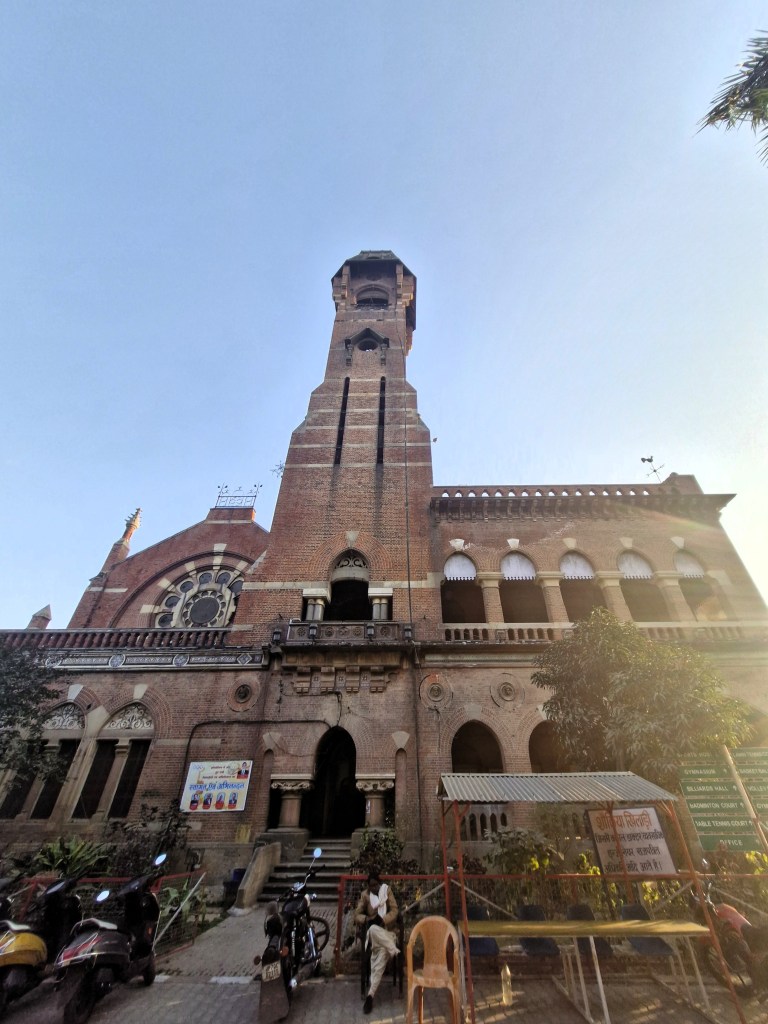
The table tennis room again made us question if the Mayo Hall was actually designed as a church. One end rectangular, the other oval. Stained glass windows. A long nave like layout. And the oval end almost resembling an altar. The high ceiling containing frescoes.
Okay, my hypothesis is that this building was designed as a church but never got consecrated; convince me otherwise please!
On the other side of this mysterious Mayo Hall was a monstrous glass facade building. Why? God why??
St. Joseph’s Cathedral
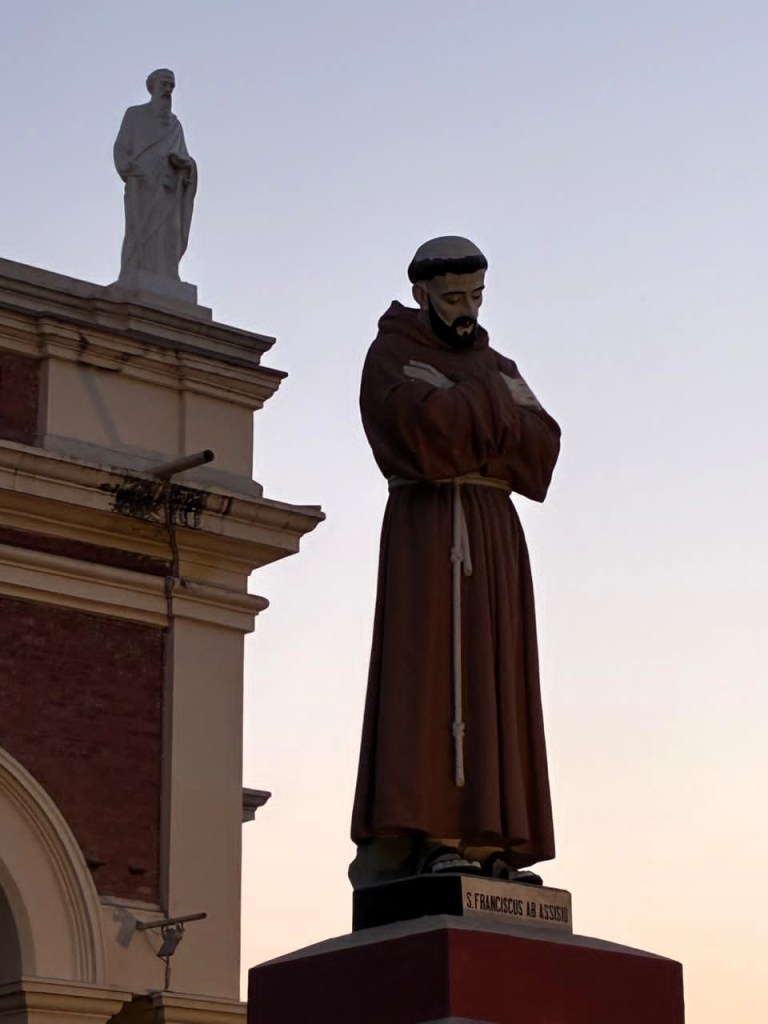
The statue of St. Francis of Assisi at the St. Joseph’s Cathedral
Vaibhav then took us to his Alma mater – St. Joseph’s College. Credit to him for arranging a visit to the Cathedral after work hours!
St. Joseph’s Cathedral was built in the 1870s, making it historically important. It has naves, a high steeple & beautiful bells. It has quite an eclectic architecture. Its facade is impressive with statues of Christ the Redeemer, Apostles Peter and Paul, & St. Francis of Assisi.
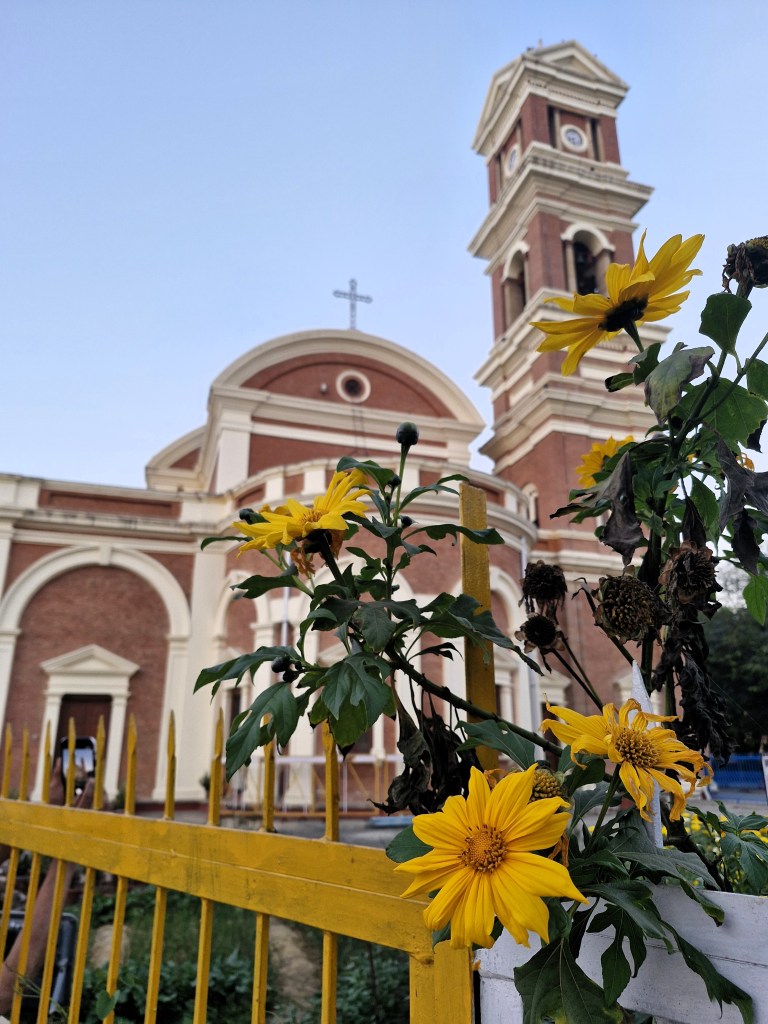
We experienced Italian architecture in India at the St. Joseph’s Cathedral. Still, before we entered, we were captivated by the yellow flowers (Mexican Sunflowers/ Tree Marigolds) growing in its garden. And then we got lucky as the bells chimed at the hour of 6 PM.
We then spent time inside appreciating the intricate artwork on the walls & ceiling.
Mexican Sunflowers in the foreground, St. Joseph’s Cathedral in the background
This brought an end to Day One of the Bundelkhand Trail for us. Day one of Prayagraj too. We boarded our Urbania. We made our way to our accommodation – Planter’s Bungalow. It was about 15 kilometers from Prayagraj.
The Planter’s Bungalow is a heritage bungalow. I shall write about it in more detail in my next blog post.
What I saw in Prayagraj was definitely beautiful, but what I felt was way more important. Satisfied. Pleased. Awed. & like an Explorer.
Stay tuned for my Day Two blog post. This is about a once-in-a-lifetime trip I took. Sure, it has truly changed my life and me!
