

A 1990s childhood in India was incomplete without train travel for most middle-class families. And so was it with me and mine. With the advent of airplane travel, the frequency of train travel reduced.
Nevertheless, my fascination for it never fully went away. Even today, I look for excuses to travel by train. I especially have a thing for all the ‘special’ trains run by Indian Railways.
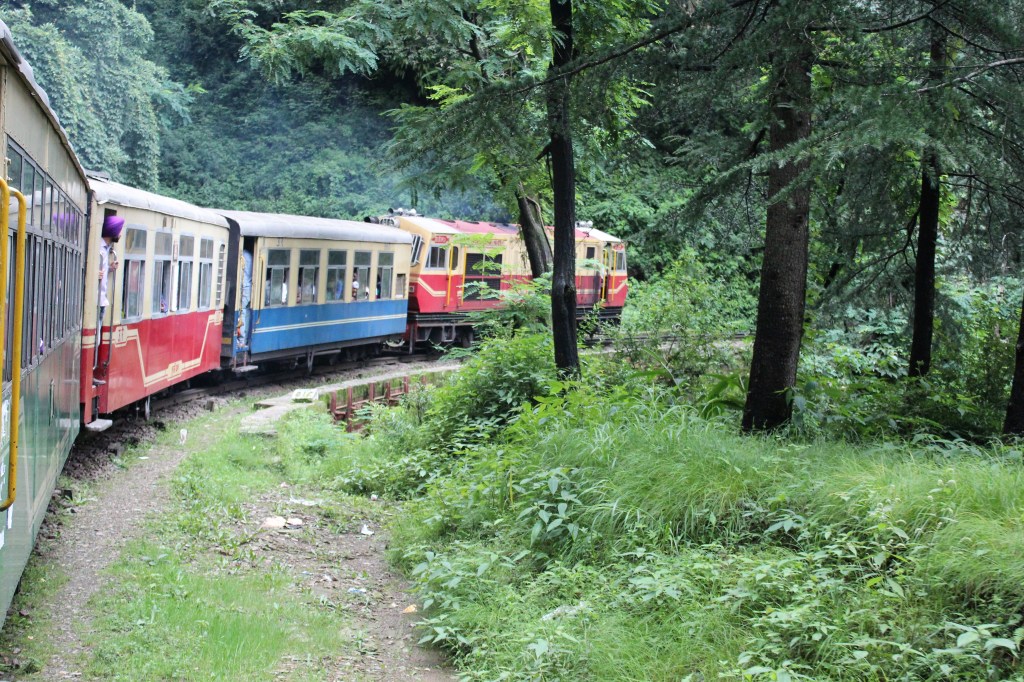
One of my earliest memories of such special trains were the ‘toy trains’ run on mountainous routes. A toy train is nothing but a narrow-gauge rail that typically traverses scenic routes on hilly terrains.
There are three toy trains in India. They are the Darjeeling Himalayan Railway, the Kalka – Shimla Railway, and the Nilgiri Mountain Railway. My fascination with toy trains took me to the Kalka – Shimla Railway in 2014 (read about it here).
I visited the Darjeeling Himalayan Railway in 2023 (see it here).
I also went to the Nilgiri Mountain Railway recently. In this blog post, I write about the Nilgiri Mountain Railway details and about my experience.
(P. S. Ooty, Ootacamund and Udagamandalam are all names for the same hill station. For ease, I’ll refer to this beautiful Nilgiris destination as Ooty.)
The History
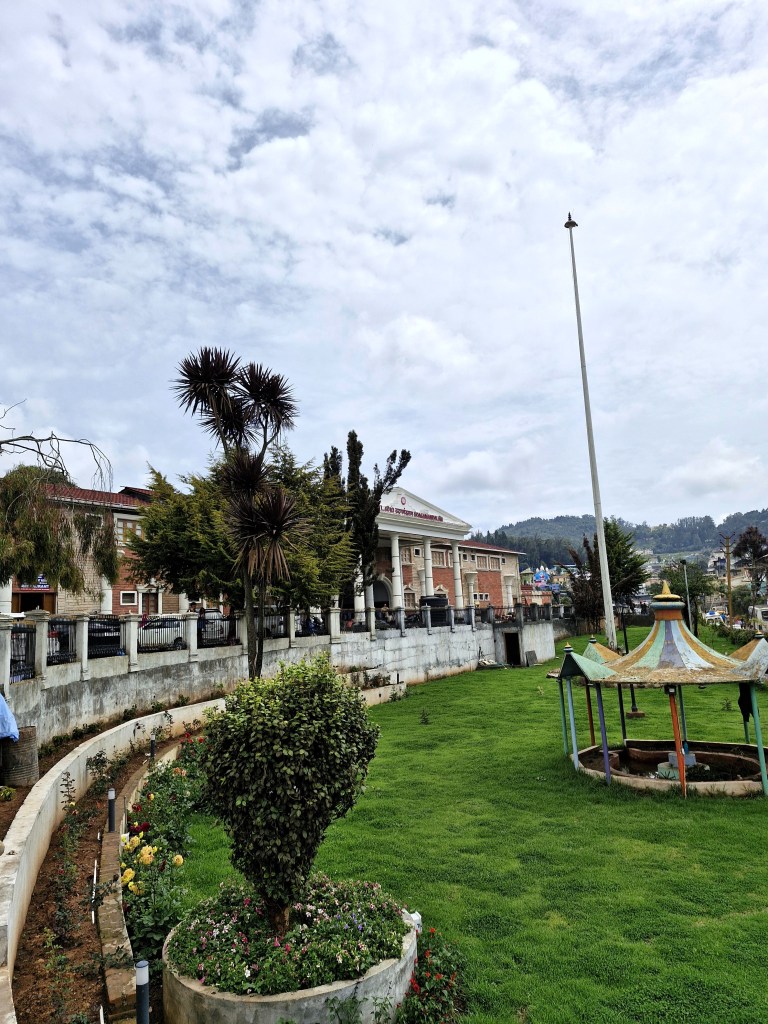
The Nilgiri Mountain Railway was completed and opened for traffic in 1899. It then ran from Metupalaiyam to Coonoor but was extended till Ooty in 1908.
The Nilgiri Mountain Railway line was built to easily transport ‘tea’ from the Nilgiri mountains to the plains. It was then moved to the ports for shipping to Britain.
The Route
The Nilgiri Mountain Railway is located in Tamil Nadu. It runs from the base station of Metupalaiyam, situated at the foothills of the Nilgiri mountains. The train travels to the hilltop destination of Ooty.
The Nilgiri Mountain Railway has plenty of curves with the sharpest one at approximately 20 degrees. There are 16 tunnels between Kallar & Ooty all of which are in excellent condition.
The region covered by the Nilgiri Mountain Railway gets ample rainfall during the southwest monsoon. It also receives ample rainfall during the northeast monsoon.
How To Book?
On the IRCTC website, under the Book Ticket section, enter the From station as Metupalaiyam (MTP). Next, set the To Station as Udagamandalam (UAM).
Then, choose your date of travel and hit Search.
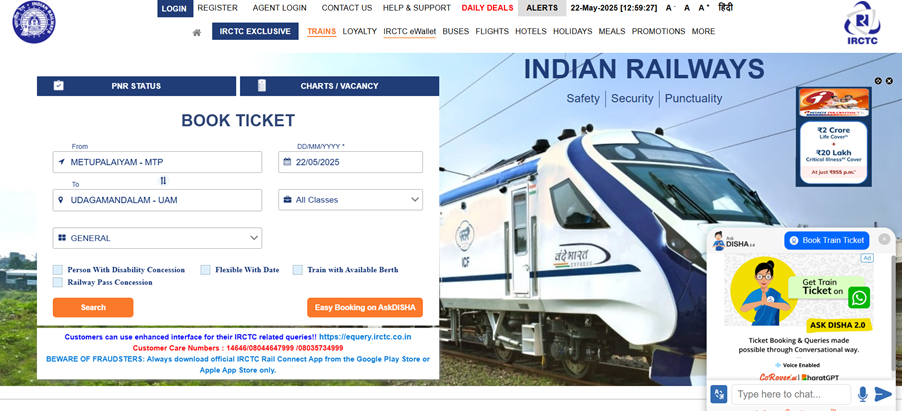
Depending on your travel date, you will see one or more trains. In summer, Indian Railways runs a few extra trains (called Special trains) to cater to the higher footfall.
The MTP UAM PASS (56136) is a regular train that runs every day at 7:10 AM from Metupalaiyam. There are other trains that don’t run daily but that will show up depending on your travel date.
So, be a little flexible to get a wider range of choices.
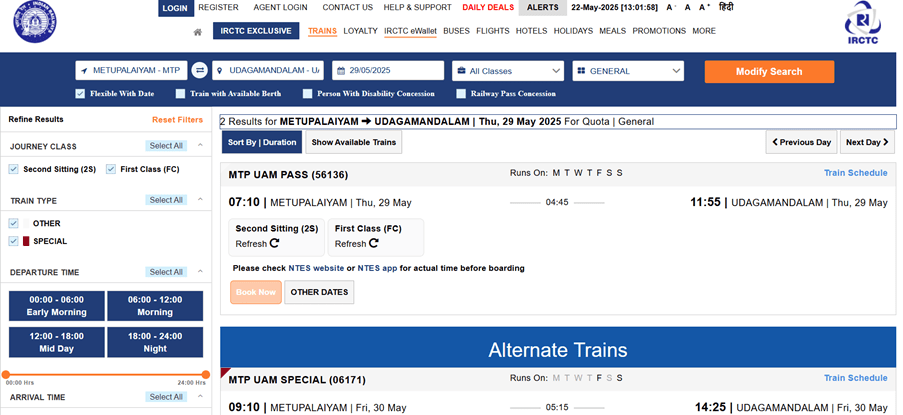
All trains on this route are considered toy trains. They are narrow gauge and have fewer coaches (compared to ‘standard’ trains seen in India). So, go ahead and choose the one that suits your time.
There are two classes of journey available –
- Second Sitting (2S) – A Second Sitting has a three-by-three configuration. This means you can end up with a middle seat which will hamper seeing the views. But this is also a cheaper choice at just INR 295 (INR 965 for the summer special train).
- First Class (FC) – A First Class has a two-by-two configuration to sit. That means you are guaranteed a window seat and can enjoy unrestricted views. Still, this is also an expensive choice at INR 600 (INR 1,470 for the summer special train).
The rest of the booking is as you would do for any other train in India. Choose class, click on Book Now, login to the IRCTC portal, fill in your details, pay and done!
P. S. You can book tickets at the railway station too. But, the availability of tickets at the last minute is not guaranteed. My co-passengers mentioned that they had tried for the last two days.
But, the train was coming up as ‘fully booked’. It was only when cancellations happened that they got tickets. One co-passenger mentioned that their father had to continue by road.
They managed to get only two tickets. They needed three tickets. So, to avoid such a scenario, I recommend you book a ticket beforehand.
The Journey
The Nilgiri Mountain Railway is one of the legacies from the colonial era. But this mountain railway is not about getting to Ooty. The journey is the trip. Starting at Metupalaiyam, the toy train makes the steep 46 kilometers climb in five hours.
Each bend in the track brings vistas worthy of any postcard. You chug past bridges, count the tea gardens, and listen to the rain rushing by. You can howl through the tunnels with the rest of the passengers.
You gush past streams. Let the cool breeze touch your cheeks. As you snake through the Nilgiris in the toy train, you are bound to revisit your childhood. Journeys back then were lazy and unhurried.
You can stop at the almost empty stations on the way. At these stops, you can see how the little stations have been maintained. They are cared for with love and pride.
My Experience
I had booked my journey from Ooty to Metupalaiyam on one of the summer special trains (UAM MTP Special). My train was set to start at 11:25 AM and reach at 4:20 PM.
I got to the station in advance as I wanted to walk around that too. There is just one platform on the Ooty station. A restaurant, a souvenir shop, a retiring room and a toilet section make up the entirety of the platform.
I saw plaques at a couple of places. They celebrated the Nilgiri Mountain Railway receiving the UNESCO World Heritage Site honour. I crossed the railway track and went to the other side.
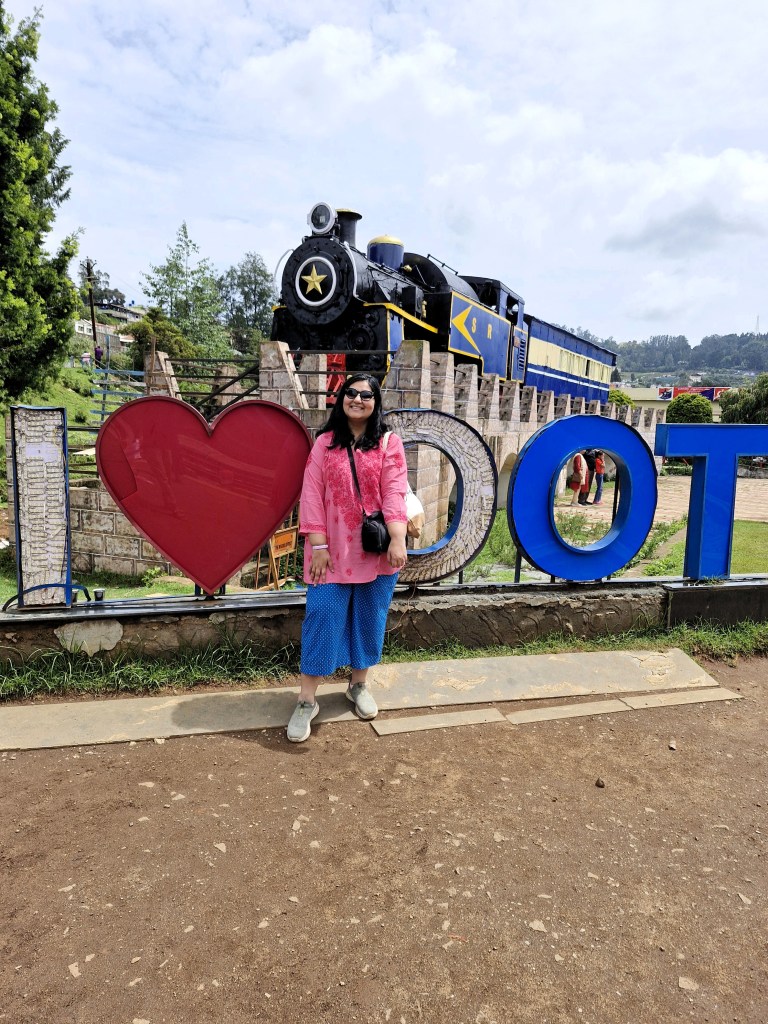
An engine and a coach are mounted at a vantage point. There is a large ‘I Love Ooty’ sign in front of it. When I turned back towards the Ooty Station, I saw it in its entirety.
The Ooty Station is small, but also adorable. Seeing the rush on the little platform, I ascertained that the train was going to be full. I bought a fridge magnet from the souvenir shop.
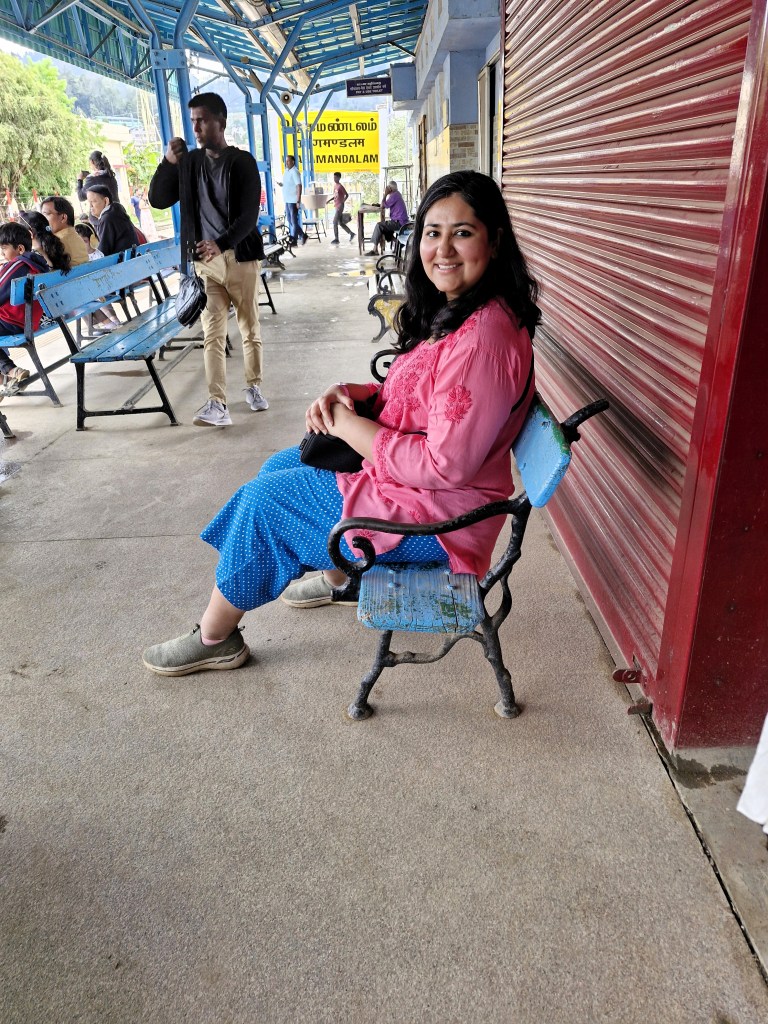
Then, I sat on an empty bench. I waited for the train to arrive. That did not take much time. There was the usual scramble to board when the train arrived.
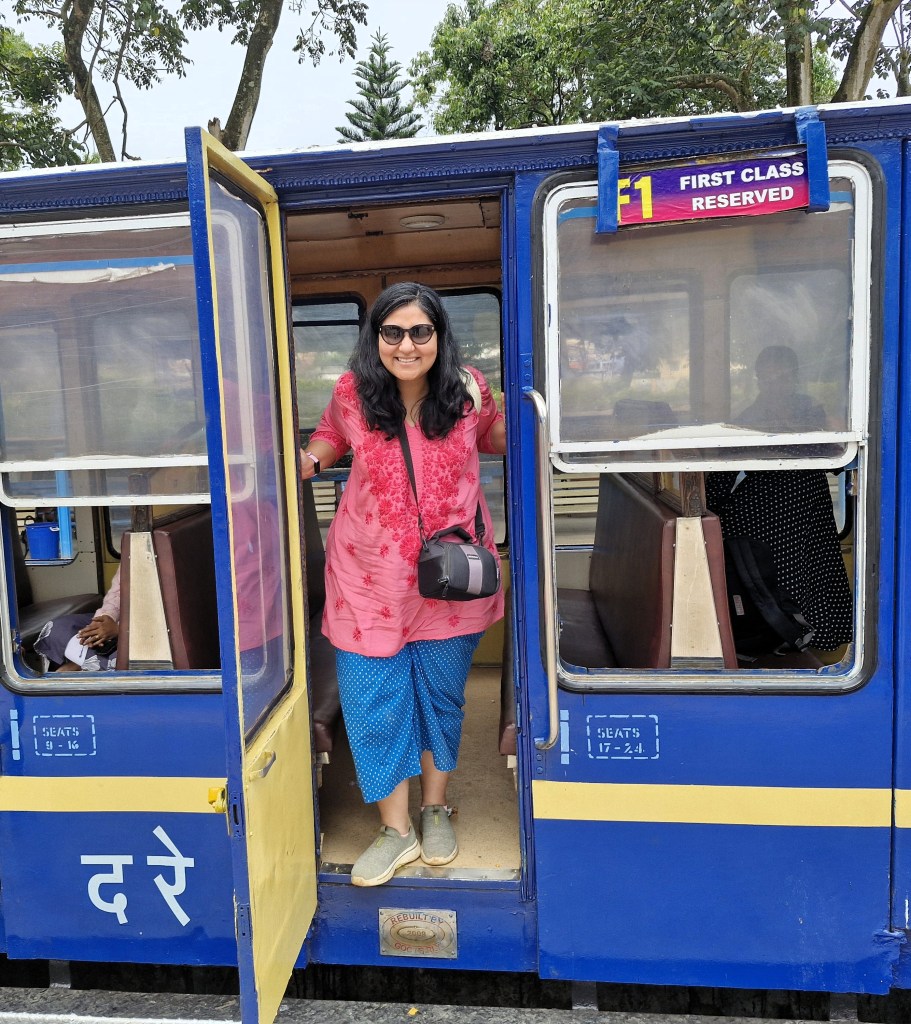
But with reserved tickets, it did not matter if I went early or late. Travelling First Class, I had a confirmed window seat and I poised myself to make memories of a lifetime.
The inside of the coach was like a cute boxcar. The train chugged down the hill from Ooty. Despite it being summer, the Nilgiris were awash with greenery.

I crossed multiple water bodies with furious muddy waters running downhill. I smiled when my co-passengers howled and screamed during the tunnel rides.
I marvelled at the tea gardens. The lush forests created a calming vista. I derived immense pleasure seeing pine forests. The chhuk – chhuk of the train and the gentle chatter of the passengers was almost like a lullaby.
Colourful houses and places of worship dotted the horizon. Then, dark clouds loomed over us. soon, it began to pour but the little toy train kept going.
I enjoyed the light drizzle falling on my arm. But, when it turned a little more, my co-passengers shut the windows. On the glass panes, I enjoyed seeing the raindrops make their way back to the ground.
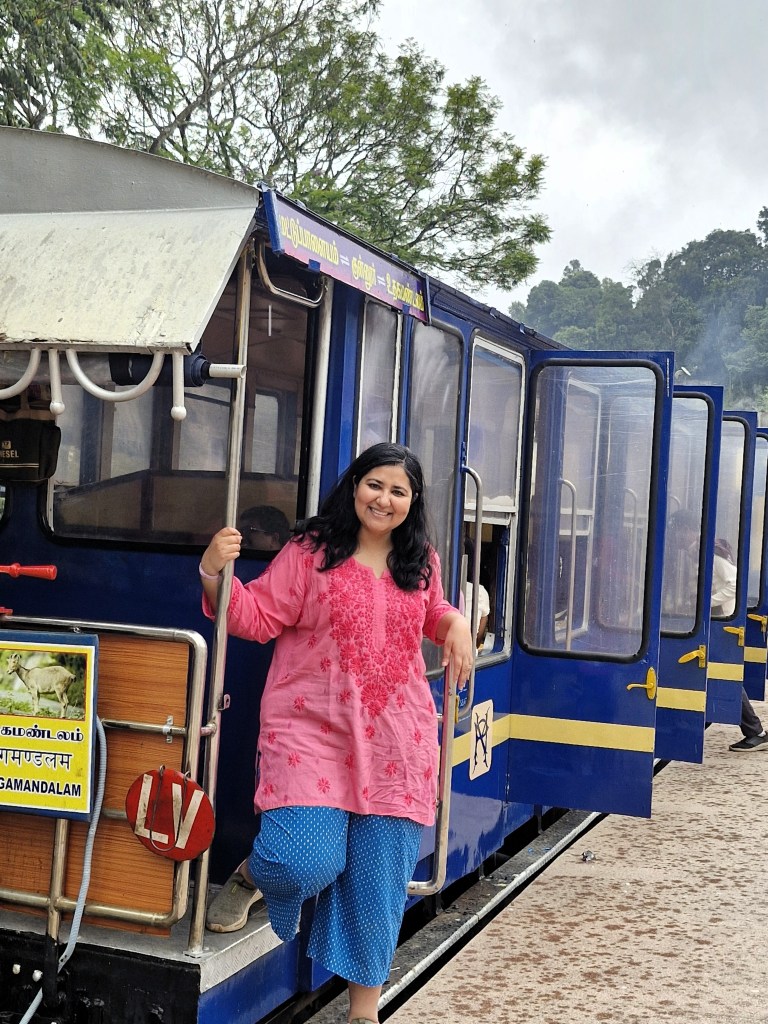
The first of the stations began. Please note that the summer special trains have only one designated halt at Coonoor. The other trains stop at Lovedale, Aravankadu, Runnymede, Adderley etc.
The train pulled into Coonoor at 1 PM. It had a good 30 minutes’ halt here as the engine was changed here (diesel to steam). I used the time to click photos, to grab a bite and to use the restroom.
The Coonoor station was straight out of a postcard. A small building with sloping roofs had flowerpots hanging all around. It also had an engine mounted a little way up.
There were plenty of murals on the walls. I watched with fascination. The steam engine whistled as it approached to attach to the coaches. It bellowed white smoke.
With the engine change done, we were ready to start again. Most of the passengers disembarked at Coonoor which meant I could stretch my legs and make myself comfortable.
I sat mesmerized as the train curved every time. Through my little window, I saw the engine. Its wheels were going round, and its plume of smoke rose up. A sense of joy and wonder rushed through me.
The train made three unscheduled stops – Aravankadu, Runnymede and Kallar. I got down, stretched my legs and clicked a little more. On the Runnymede to Kallar stretch, I glimpsed a beautiful aqueduct too.
Eventually, the flora changed from the pine forests to the banana and palm trees. That was the signal for the end of the journey – we had arrived at the foothills.
My train chugged into the Metupalaiyam station at about 4:05 PM.
Throughout the journey, I had felt different emotions. It began with excitement. It then moved to a sheer sense of wonder at this engineering marvel. And it culminated with a deep peace I felt within me.
Points To Note
- The best time of the year to ride the Nilgiri Mountain Railway is throughout the year. Still, the monsoon season can be a dampener.
- The Nilgiri Mountain Railway is not typically used to ‘commute’ between places. This is because it does not make sense from a time perspective. Coimbatore to Ooty, by road, takes three hours. Going from Coimbatore to Metupalaiyam to Ooty would take a total of six hours.
- The Nilgiri Mountain Railway, thus, is purely used from an experience, sightseeing POV. Most passengers opt for the Ooty to Coonoor stretch to get their share of the experience. Cabs are sent ahead to Coonoor. They pick up passengers and then either bring them back to Ooty or take them to the next destination.
- Ooty to Metupalaiyam is a good five-hour journey. After the first excitement has worn off, it can get a little repetitive. So, you can consider doing just one of these stretches if your goal is experience (& you’re not a train fan like I am) –
- Metupalaiyam to Coonoor (3.5 hours but steam engine)
- Coonoor to Ooty (1.5 hours but diesel engine)
- Ooty to Coonoor (1.5 hours but diesel engine)
- Coonoor to Metupalaiyam (3.5 hours but steam engine)
- The Nilgiri Mountain Railways trains have neither catering services nor toilets onboard. So, time your biological needs to Metupalaiyam, Coonoor or Ooty stops!
