
I began travelling solo after a break of five years. I promised myself to make an effort to explore more of South India. November arrived, and it was time to head to Chennai. Then, I planned to traipse to Mahabalipuram. I had already visited Pondicherry, Auroville, and Tranquebar in the past.
I was prepared to be drenched in sweat just after landing in Chennai. Yet, my visit coincided with Cyclone Ditwah. The weather was pleasant for the four days I was there. (I’m, nevertheless, not taking away the severity of the cyclone and the destruction it wreaked. My condolences for all the lives lost and speedy recovery to all injured.)
The thrill of exploring the Mahabalipuram temples was reason enough to be gung-ho. The town is at a distance of less than 60 kms from Chennai. The route can be either the East Coast Route (ECR) or the Old Mahabalipuram Road (OMR). I’d reserved a Savaari cab and took around 1.5 hours to reach.
Mahabalipuram – A Brief Introduction
The Pallava dynasty built Mahabalipuram between the fourth and the ninth centuries AD. It was once a port city. It serves as an excellent introduction to the majestic and much famed – South Indian temple architecture. Most monuments are monolithic and have been carved out of a single rock.
Mahabalipuram is a small town; it is possible to visit the monuments in a single day. I’d planned to start early. The Sun can get harsh after 9 AM. Nevertheless, it turned out to be a non-issue for me. Still, I would recommend you start early.
The international importance of Mahabalipuram was recognised in 1995 when it was granted a World Heritage Site status by UNESCO. Also, to clarify, there is no connection between King Mahabali and Mahabalipuram.

Mahabalipuram – Historical Attractions
The Mahabalipuram Group of Monuments includes four categories. These are bas-reliefs, temples, man-made caves, and rathas. Rathas are chariots carved from single boulders. They are designed to resemble temples and are used in temple processions. Bhagirath’s Penance and Krishna Mandapam are bas-reliefs. They adorn massive rocks near the town centre.
The immaculate Shore Temple presides over the beach. The Mahabalipuram monolithic shrines and rock-cut cave temples are spread across a landscape. It is heaped with boulders and rocky hillocks. The landscape is also interspersed with greenery. There are man-made caves and monolithic structures, in different completion stages, that are scattered through the area.
At the Mahabalipuram Beach, there is a Durga Cave that can be accessed only during low tide. The locals consider the deity there as the fishermen’s protector. Every year, a festival celebrates the goddess with locals rallying around the cave temple. At this time, the tide is really low and the sea is far back from the shore.


Stay – Four Points by Sheraton
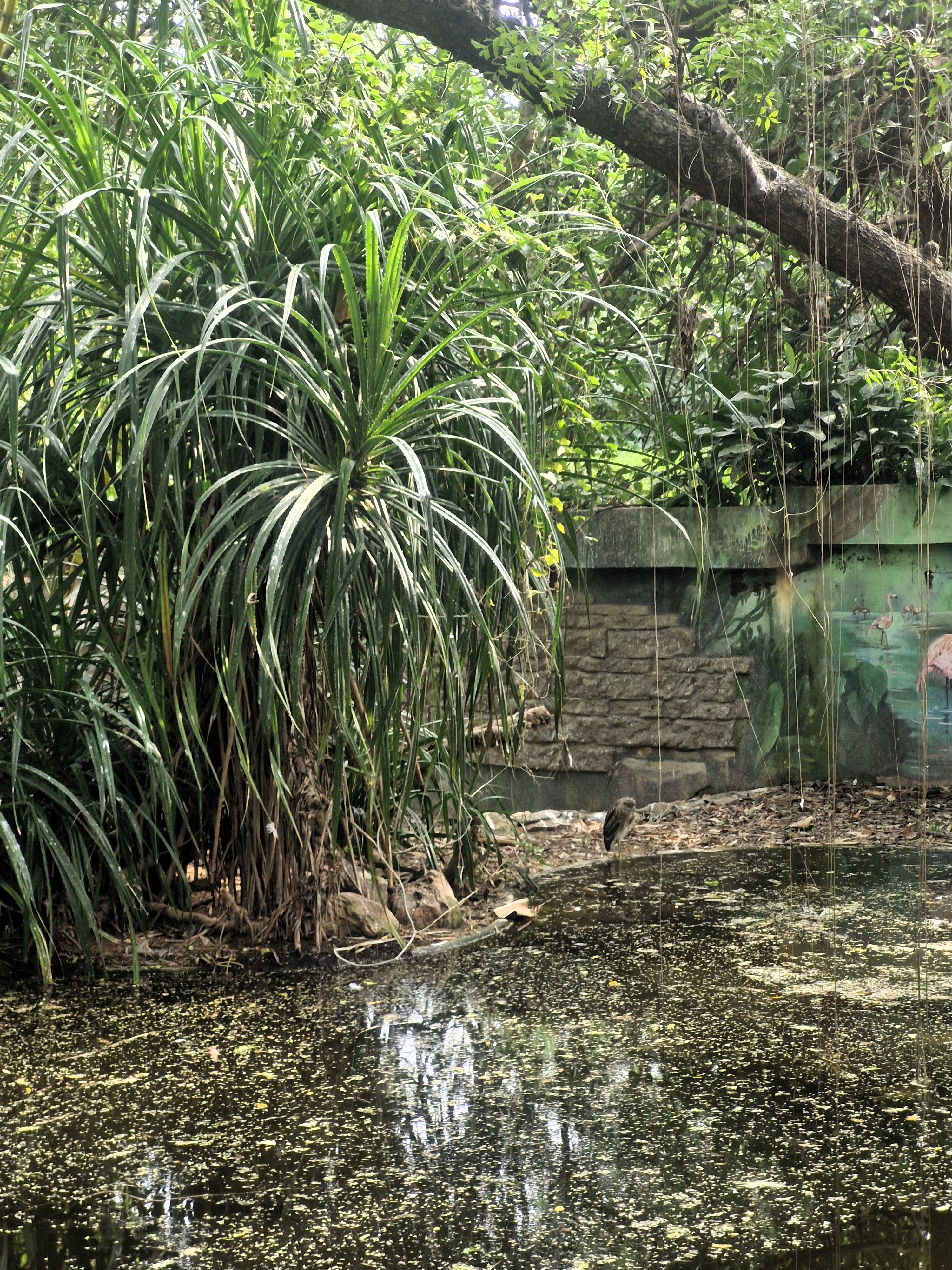
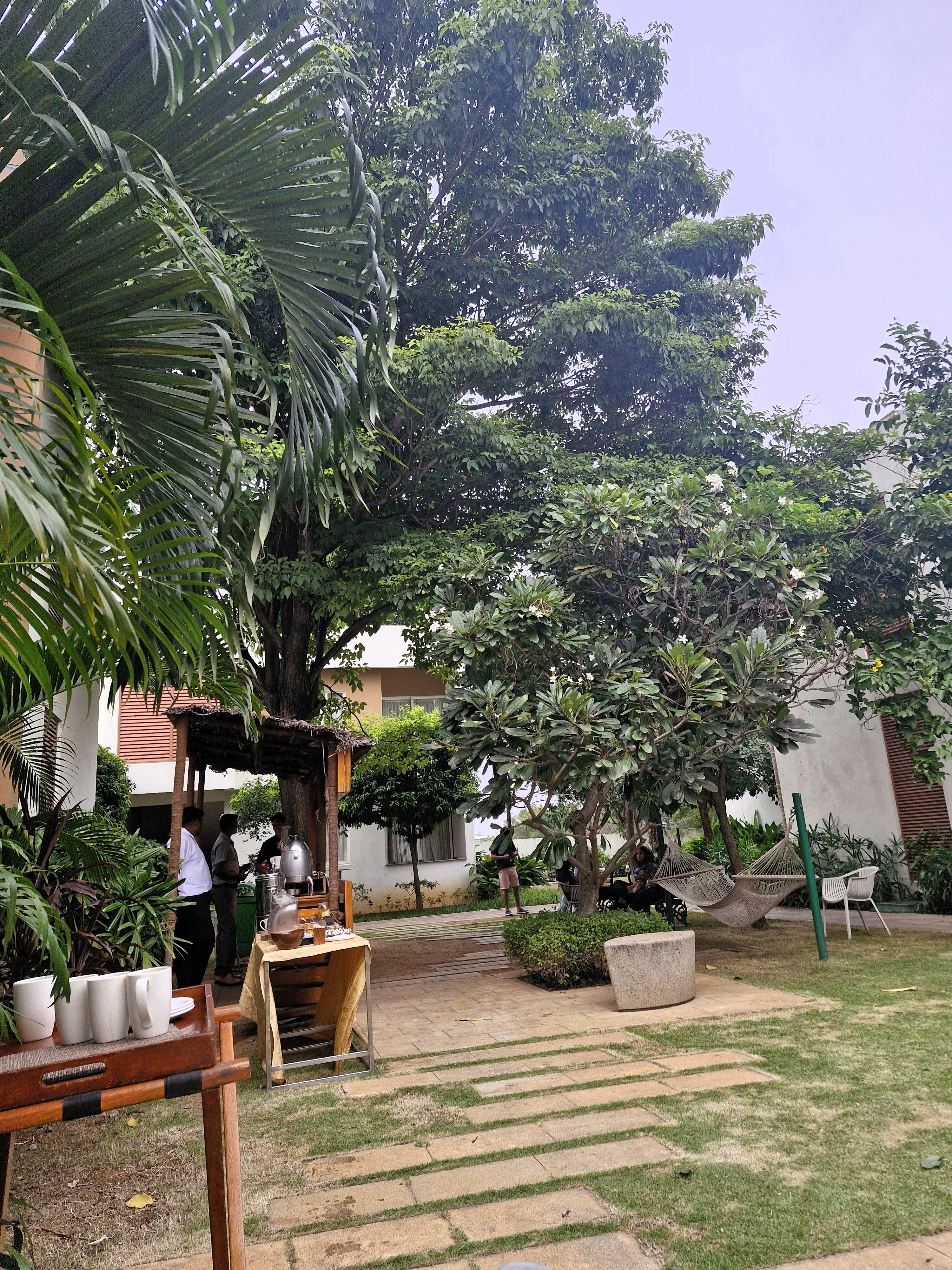
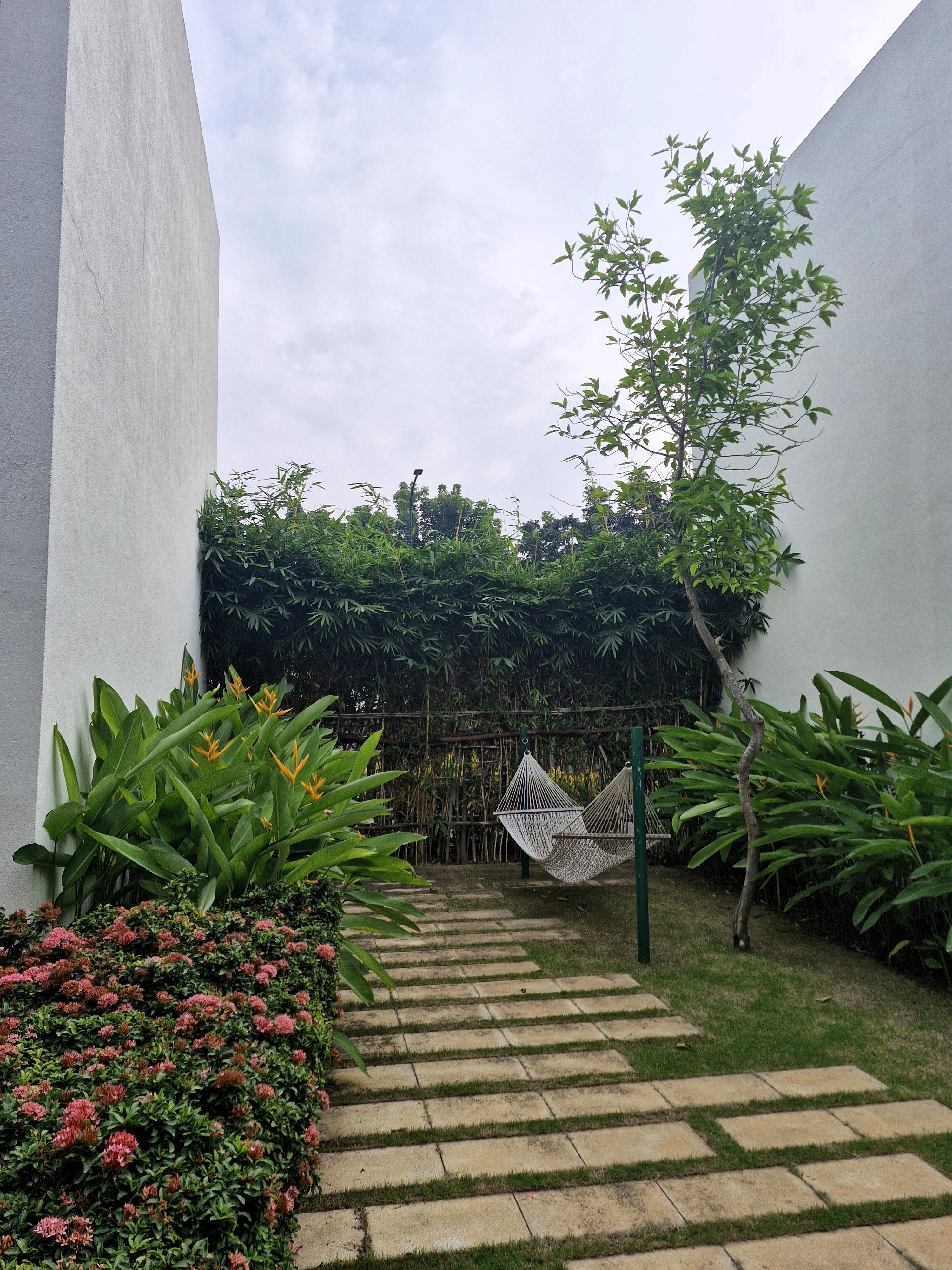
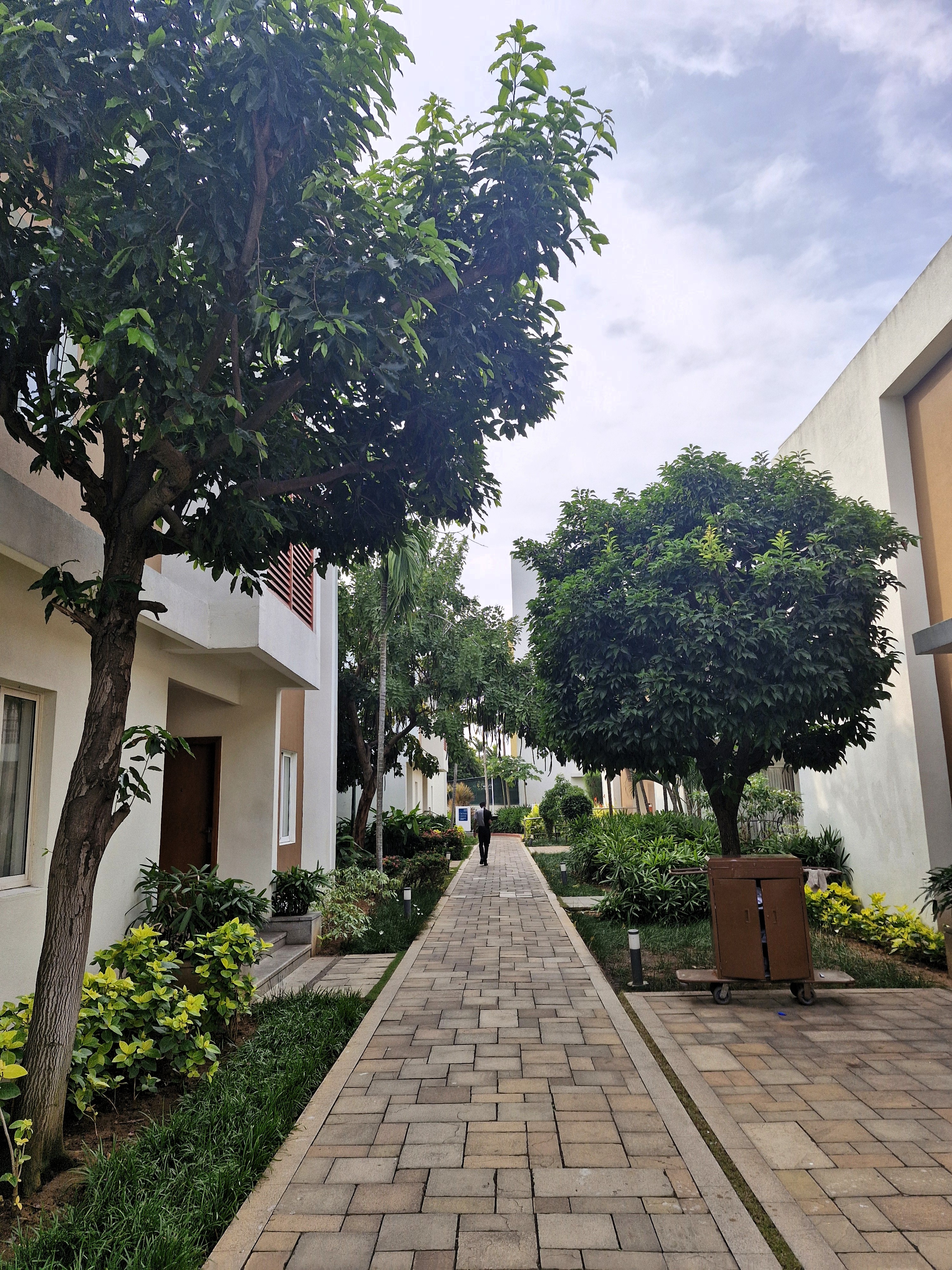
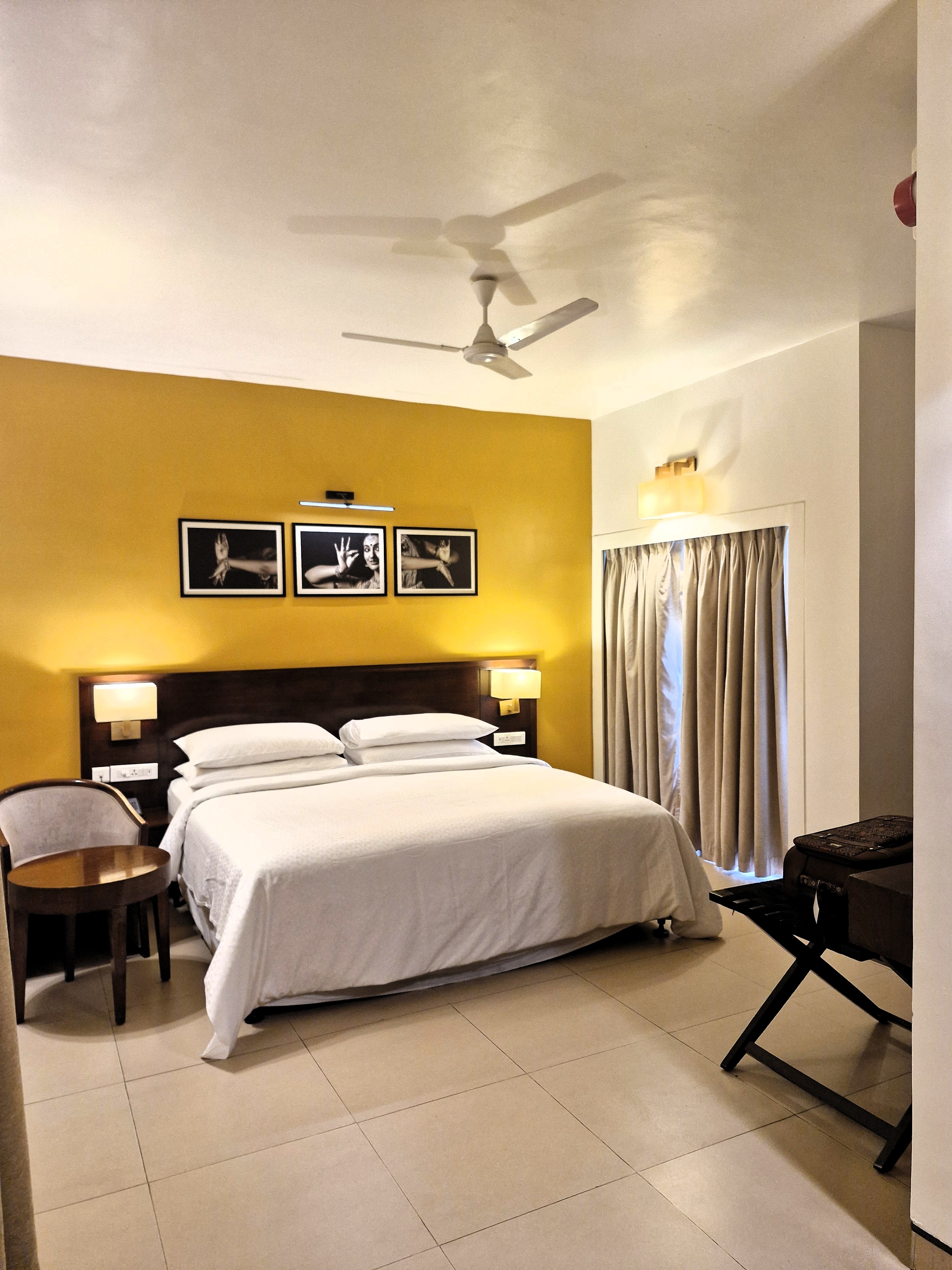
I’d reached Mahabalipuram at 3 PM. The helpful staff at Four Points ushered me to the warmth of a Garden View room. After a delicious lunch at the inhouse restaurant Petals, I retired to my room for a nap. Evening time was peaceful with birdsong in the gardens. I was happy to let myself loose and enjoy the moment with the strong breeze whispering stories from the past.
Being on the east coast, the sunset is on the opposite side. As I’d planned, sunrise was the best way to wake up the next day. The next morning, I was up at the crack of dawn. I got ready and headed to the Group of Monuments. I began at the Shore Temple.
Mornings and evenings are the best time in Mahabalipuram, when nature is beckoning to you with calmness. After all, this Pallava capital is said to be a ‘Lost City.’ You can wait for the legend behind it towards the end of this blog post. Some believe that it had the greatest architecture of that time. I had booked the tickets for the Group of Monuments, in advance, on the Archaeological Survey of India website.
I engaged a guide, an old but energetic and friendly man called Balu G, who not just guided me through all the monuments but also bailed me out with cash when we took an auto/ when I wanted to buy a fridge magnet/ when I wanted to donate at the Arulmigu Sri Sthala Sayana Perumal Temple (me being me, I was roaming around with an empty wallet BUT UPI rocks!)
The route Balu G & I took started at Shore Temple and continued to Panch Rathas, Mahishasuramardini Cave, and Lighthouse. Then, we went to Roya Gopuram, Varaha Cave Temple, and Ganesh Rath. We also visited Krishna’s Butterball (read about it here), Bhagirath’s Penance, and Panch Pandava Cave.
Finally, we saw Krishna Mandapam and Arulmigu Sri Sthala Sayana Perumal Temple. I write about each of these in detail below. Bear with me for longer! All this sightseeing took me 2.5-3 hours. Add the time I spent buying miniature granite figures. All around Mahabalipuram, you can see artisans carving stone statues – Buddha, Ganesha, Shiva and various other mythological figures.
I returned to my hotel where a fabulous breakfast awaited me. I ate idli, pepper idli, medu vada and masala dosa, savouring the rich taste. My wish to eat only the local cuisine was satisfied throughout this trip. Tasty! After a siesta, I booked an Uber rental and headed to The Madras Crocodile Bank Trust and Centre for Herpetology.
i had a late lunch at A2B but I will not recommend that. Back at the hotel, the breeze was cool. It coaxed me into a Masala Tea at the complimentary High Tea at Trumpet Point. Later in the evening, I sipped a Bloody Mary at the inhouse bar, Nectar, followed by dinner. The only thing I missed on my trip to Mahabalipuram was a walk on the sand. The sea was too rough to go near it.
Mahabalipuram – A Guide for Places to Visit
Shore Temple
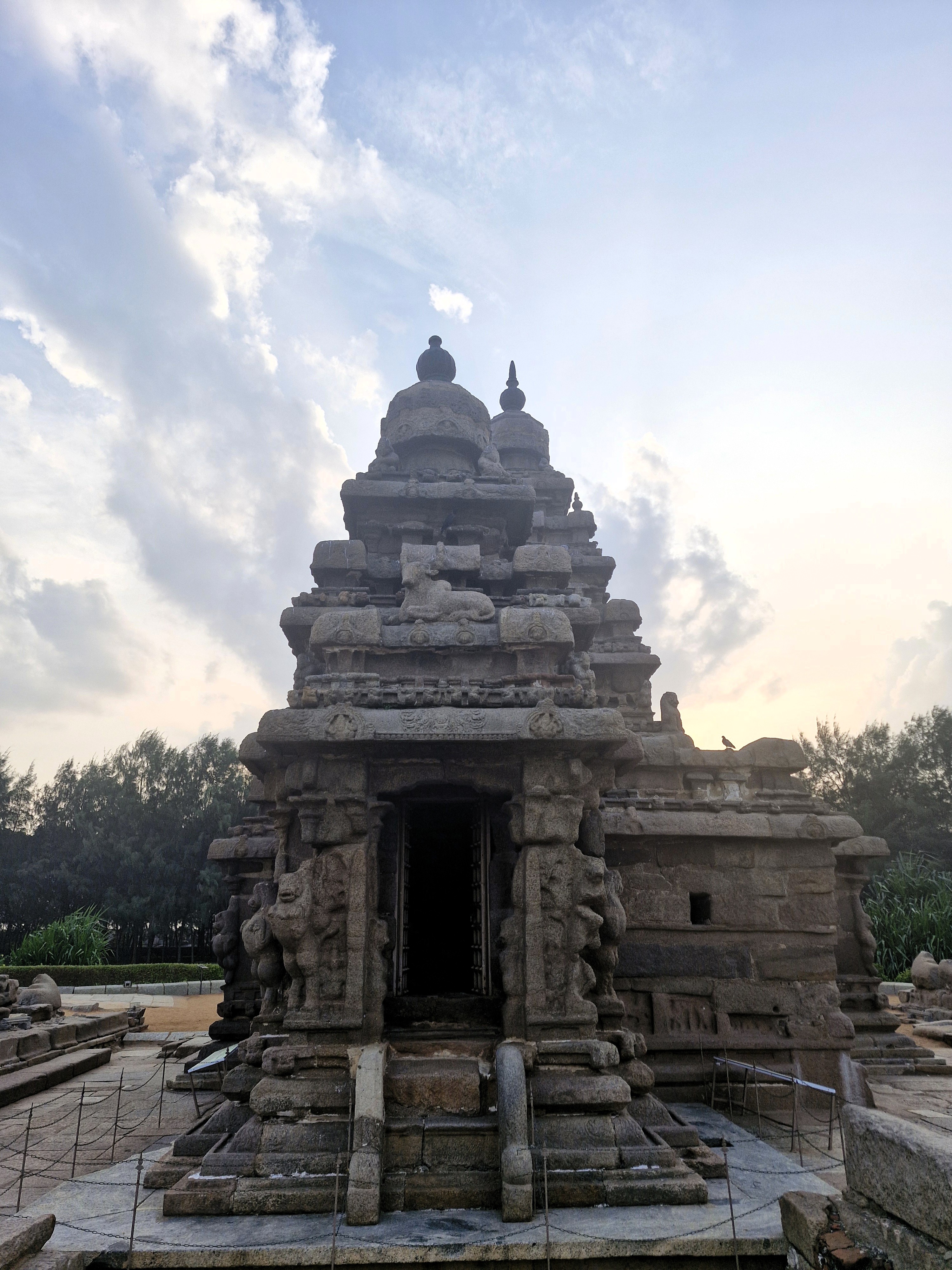
The Shore Temple is perched at the edge of a sandy beach on the Bay of Bengal. It is a stone temple constructed in the seventh century. The rock-cut temple is a magnificent structure. It is one of the oldest temples in South India. It is also the first temple in the Dravidian style that is prevalent in Tamil Nadu temple architecture.
The Shore Temple has two carved towers which dazzle against the blue sky. One shrine is dedicated to Shiva. The other is dedicated to Vishnu. Inside one of the temples is a sculpture depicting various deities. A boundary wall topped by rock-cut Nandi statues surrounds the main temple. There is also a lion sculpture near one of the temples.
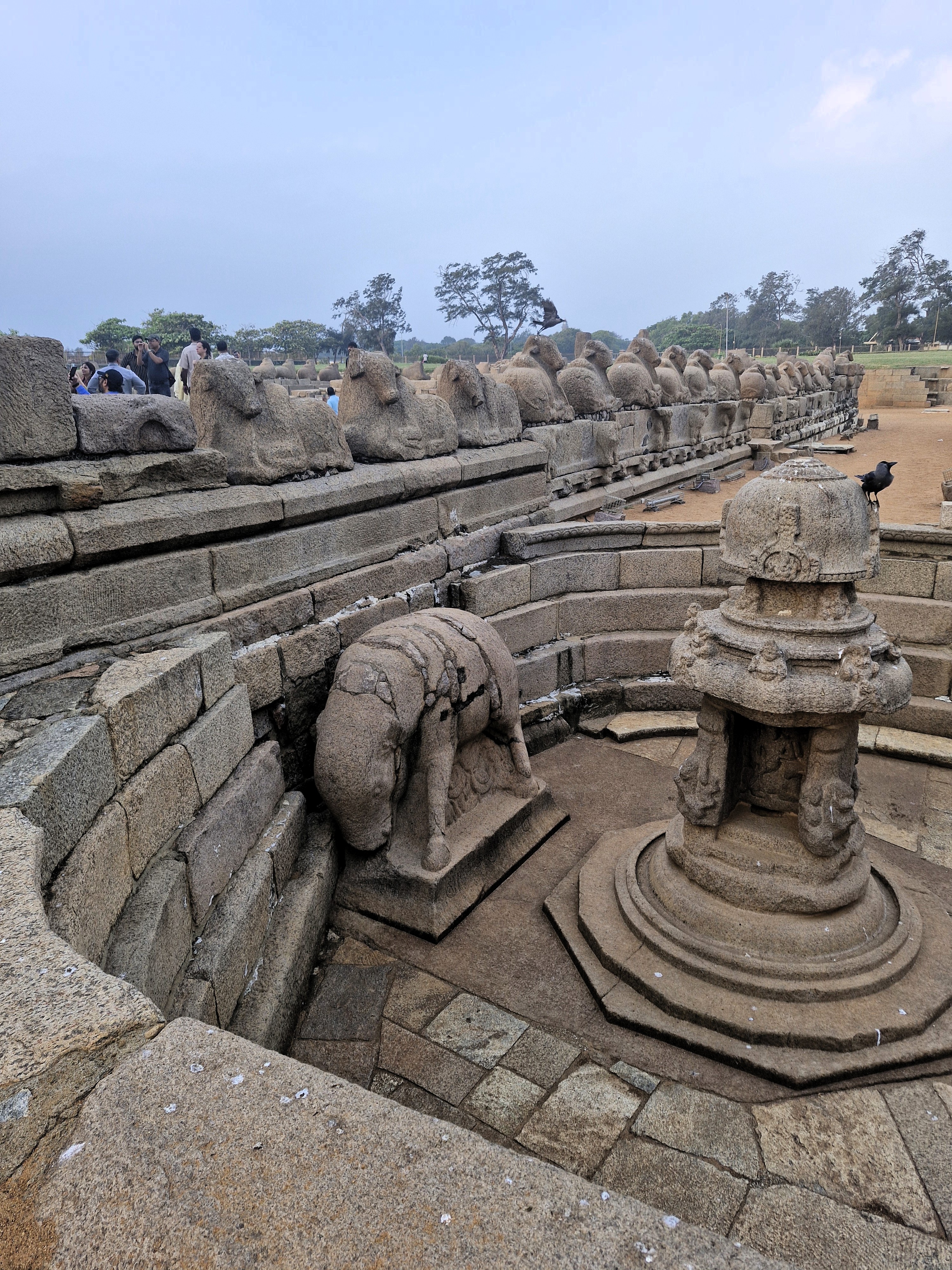
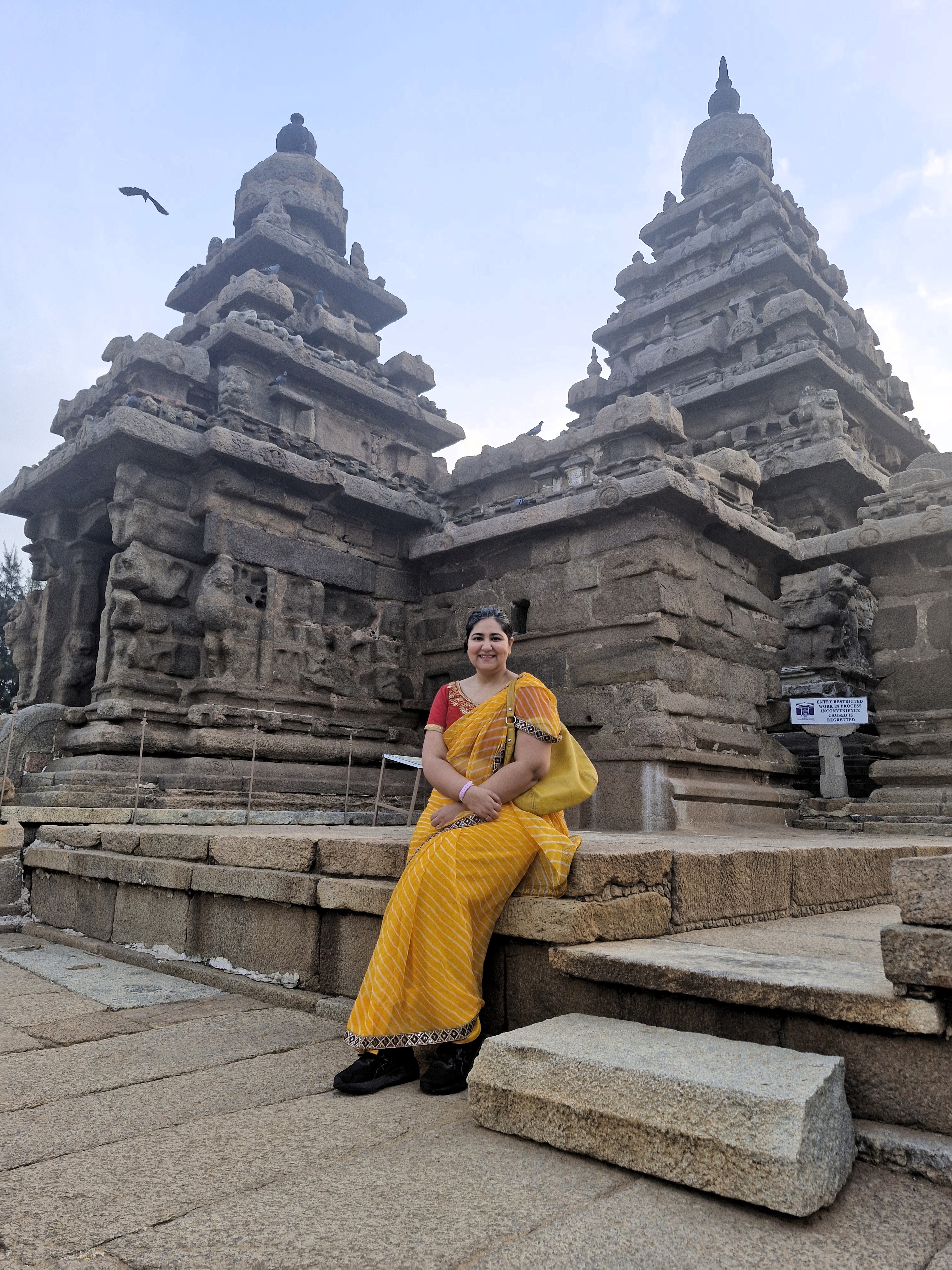
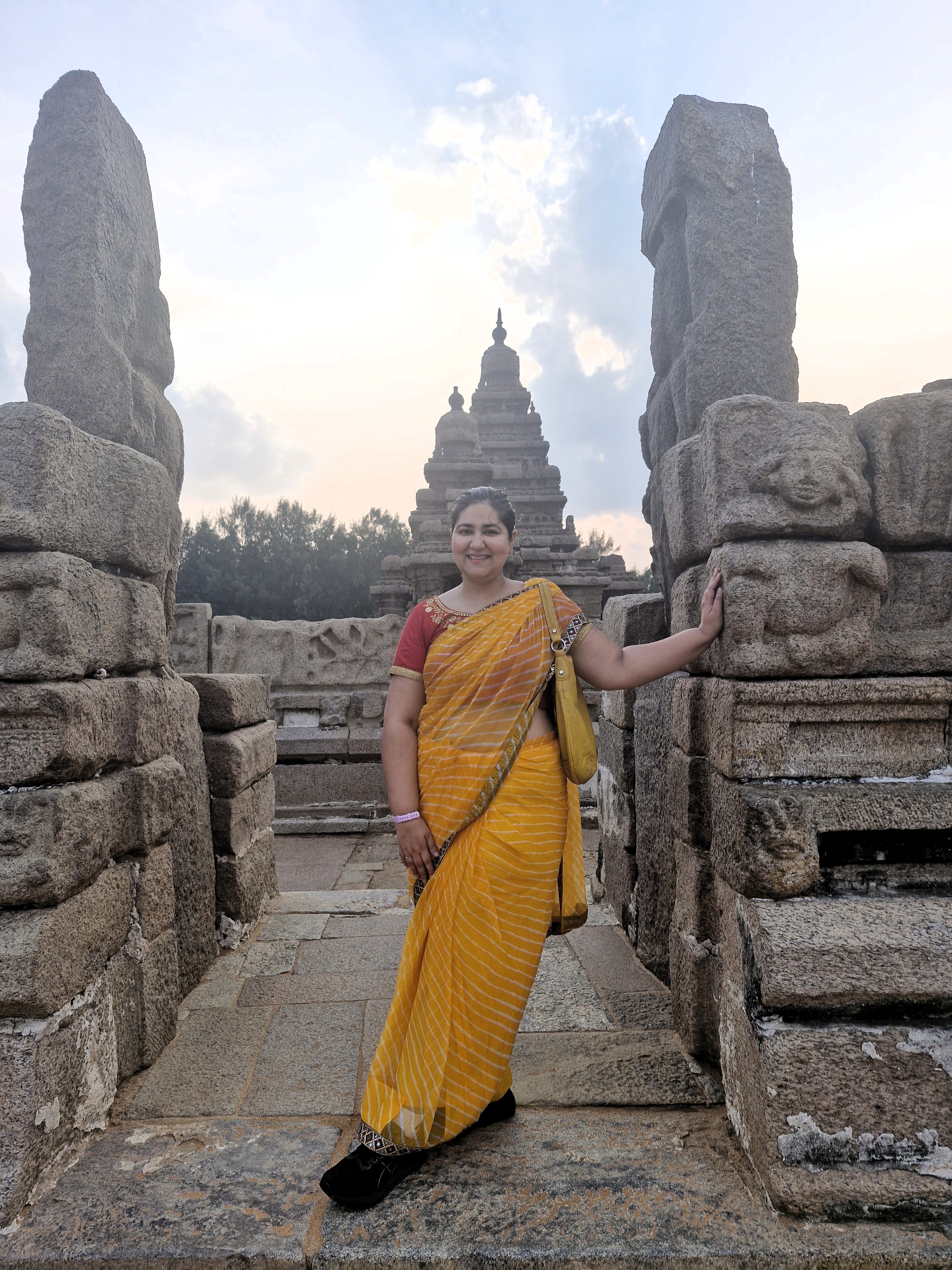
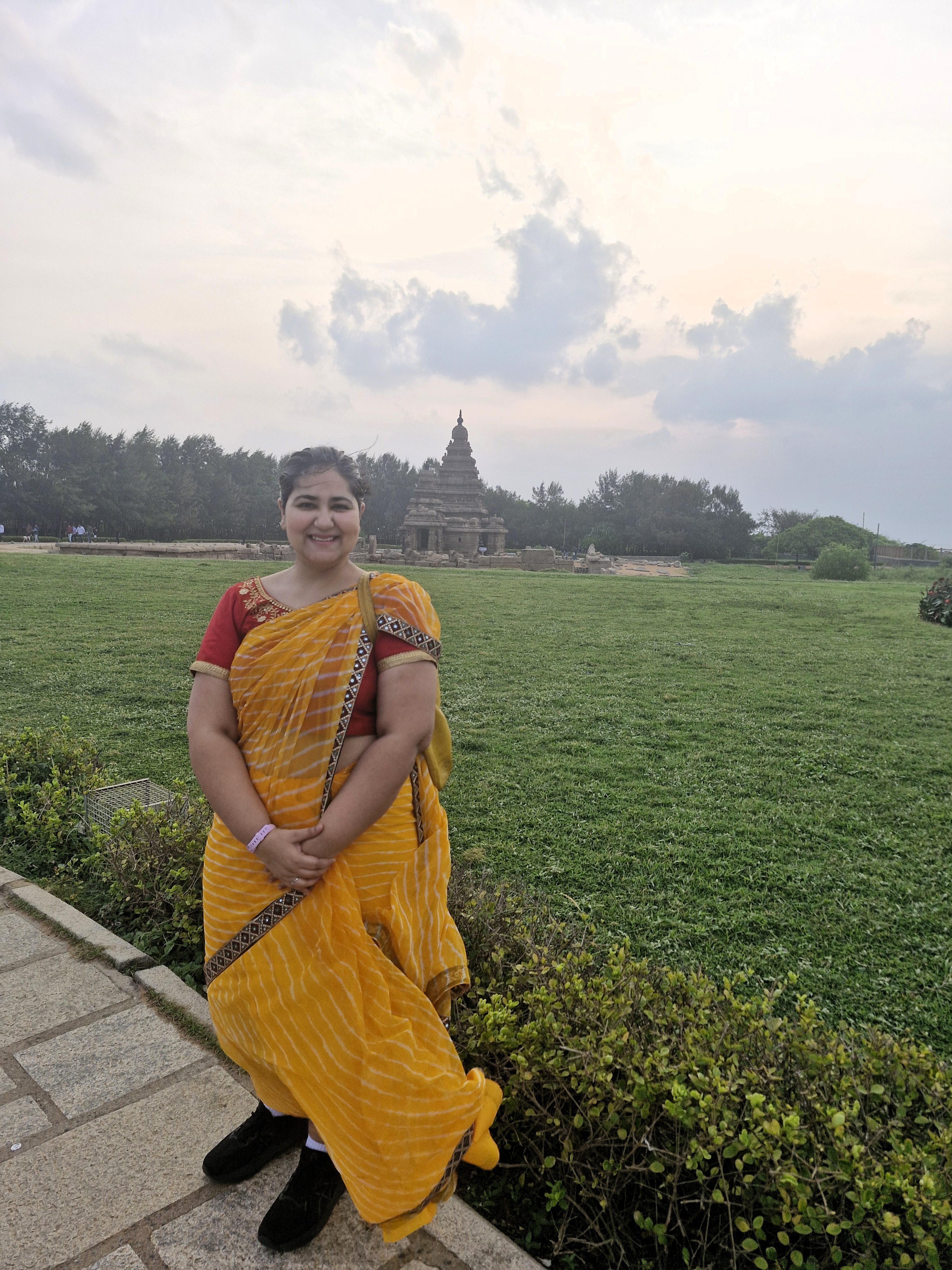
The design of the two carved towers of the Shore Temple was profoundly influential. The influence spread across South India and eventually reached Southeast Asia. It is an ode to the Pallavas’ architectural brilliance.
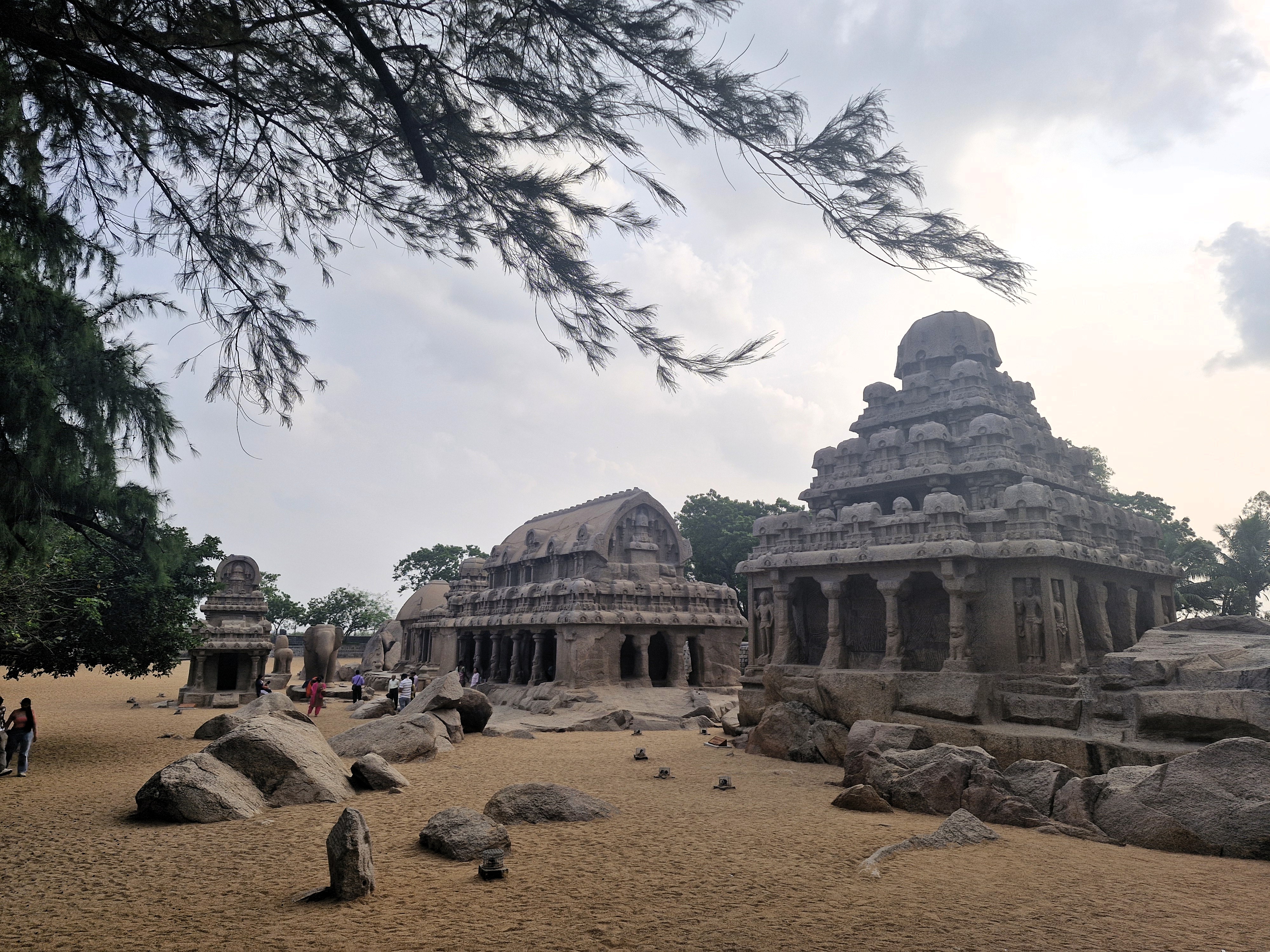
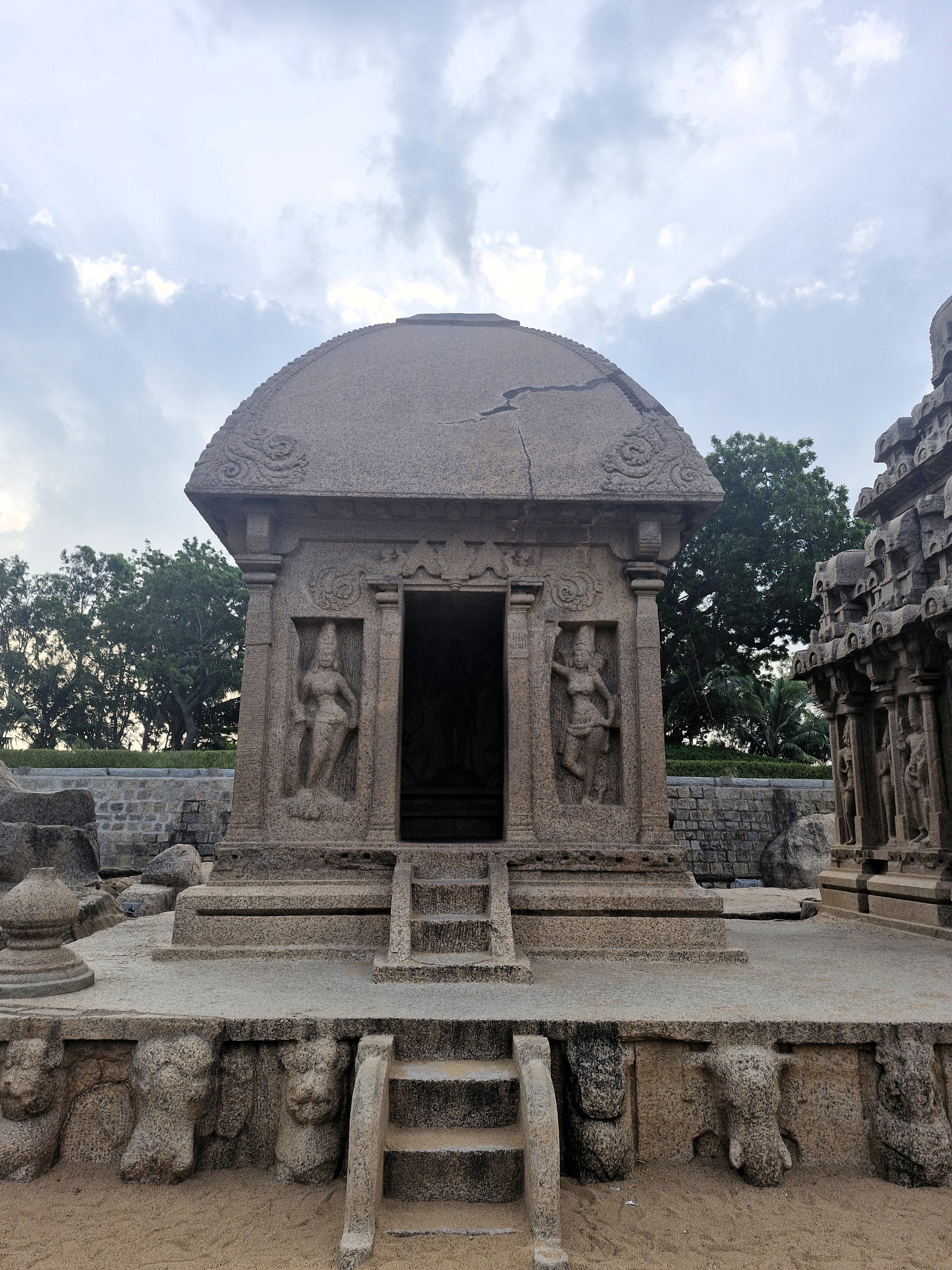
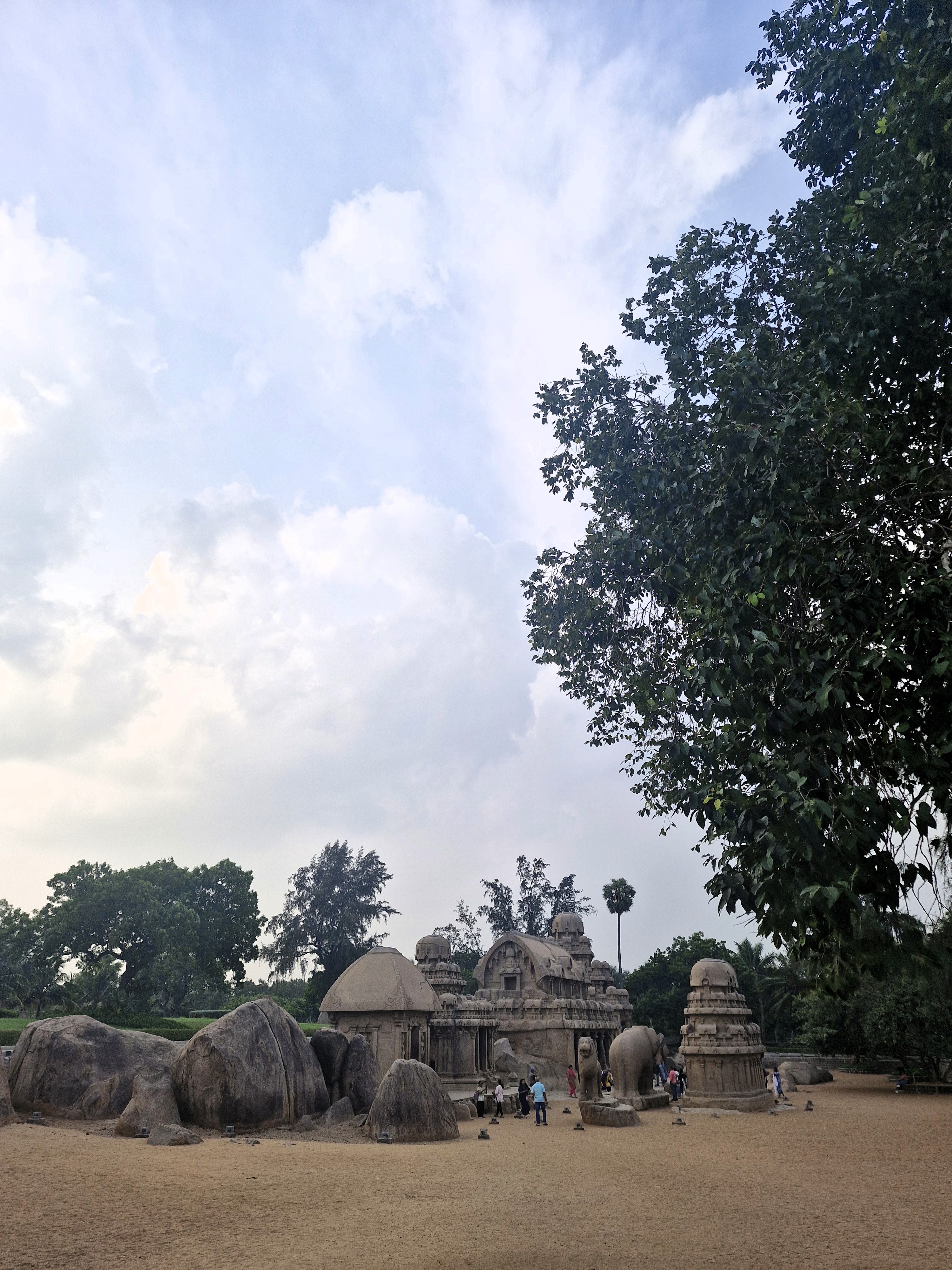
Panch Rathas (Five Chariots)
I was floored by the first sight of these five monolithic stone shrines. The structures are incomplete, according to Balu G. The rathas are named after the Mahabharata heroes and their wife and resemble temple chariots. The complex is some distance away from the other monuments; the ancient sculpting techniques are astonishing.
The rathas were carved out of single rock pieces from the top down.
Mahishasuramardini Cave
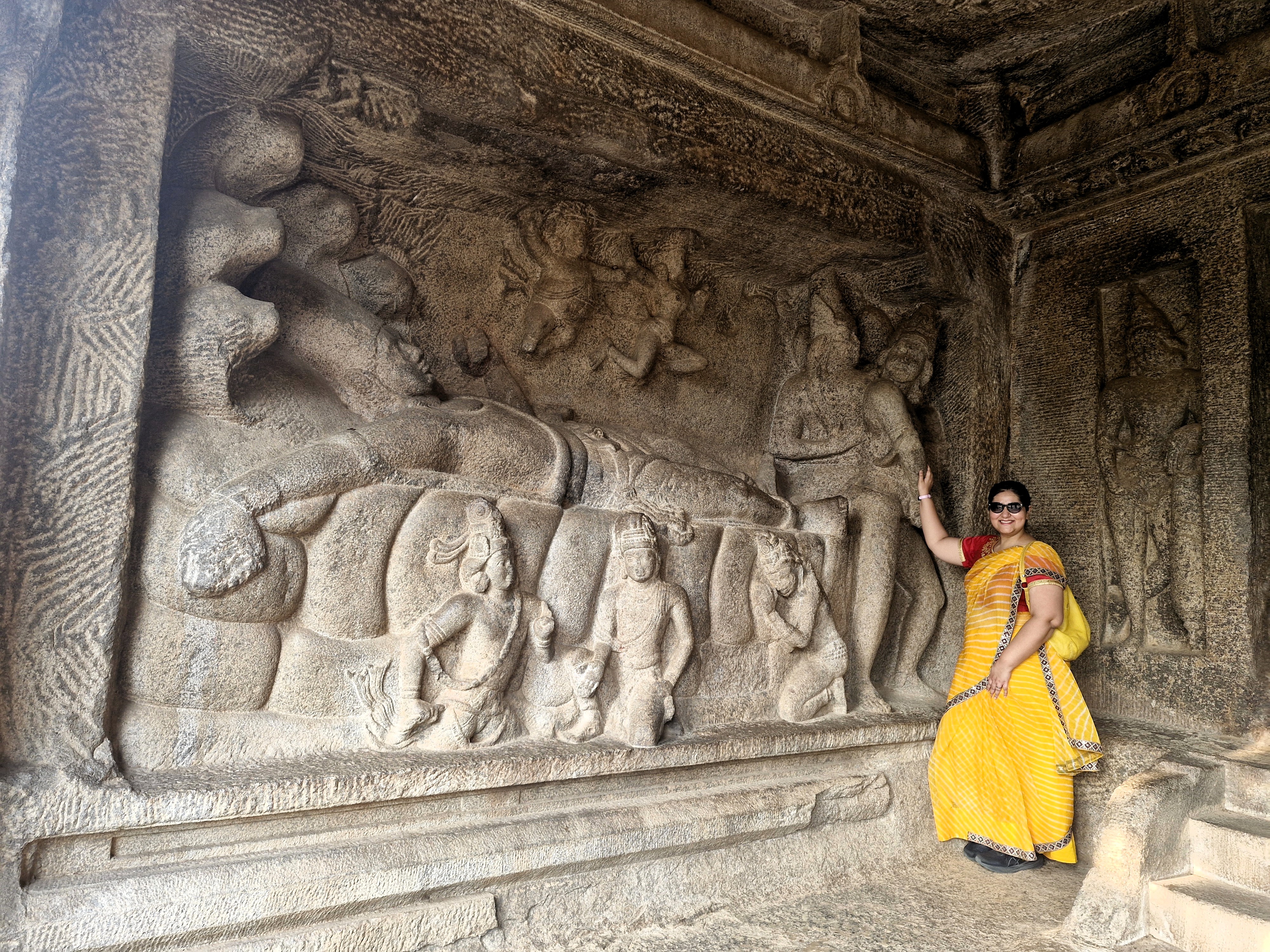
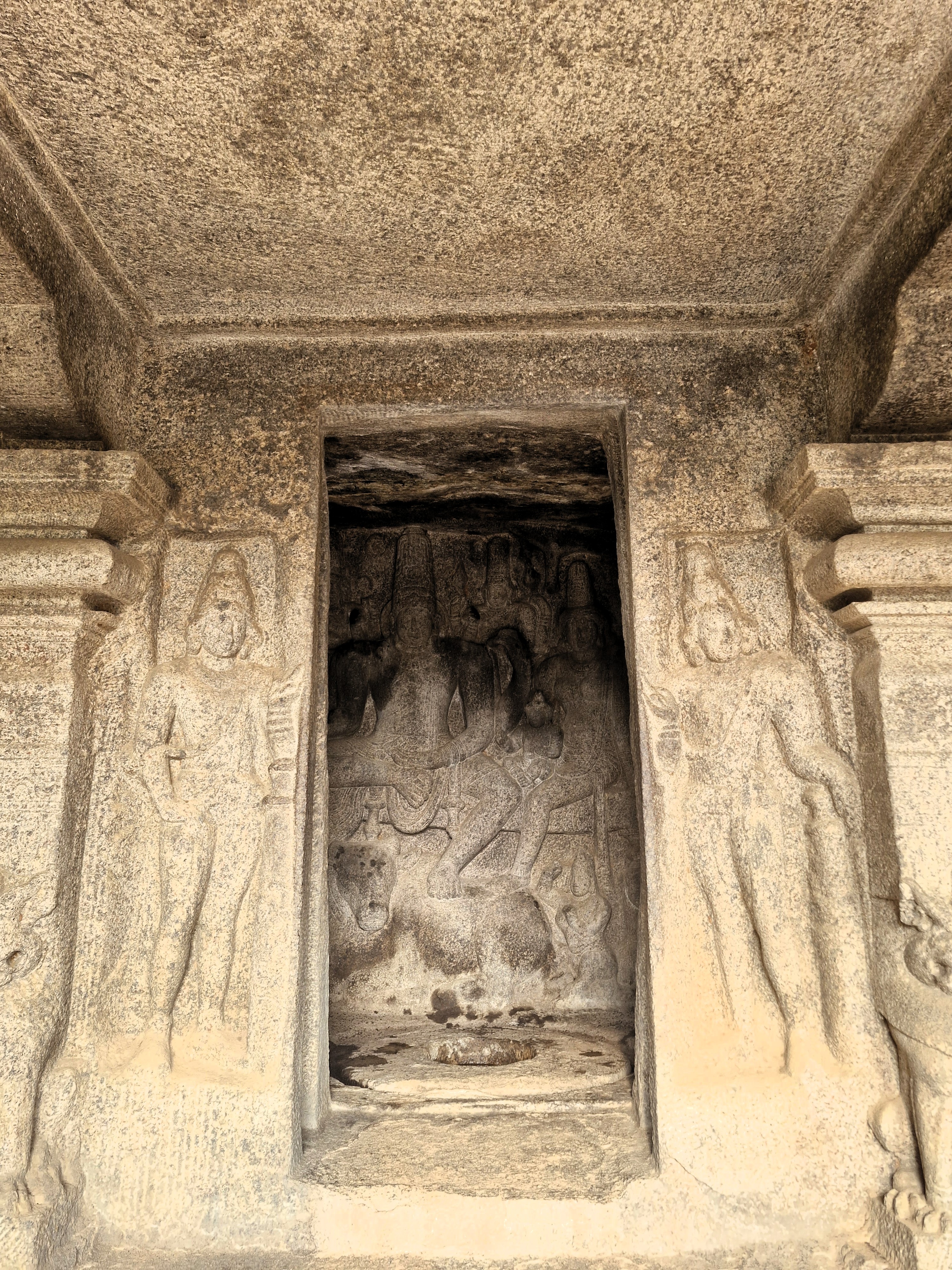
Mahishasuramardini Cave is remarkable for the two sculpted decorations at each end of its long veranda. In the panel to the right, Durga is seated riding a lion and wielding weapons. The carved panel shows the eight-armed goddess Durga as Mahishasuramardini, destroying the buffalo headed demon Mahishasura.
At the opposite end of the veranda, Vishnu is depicted sleeping on His serpent bed, surrounded by the gods.
Lighthouse
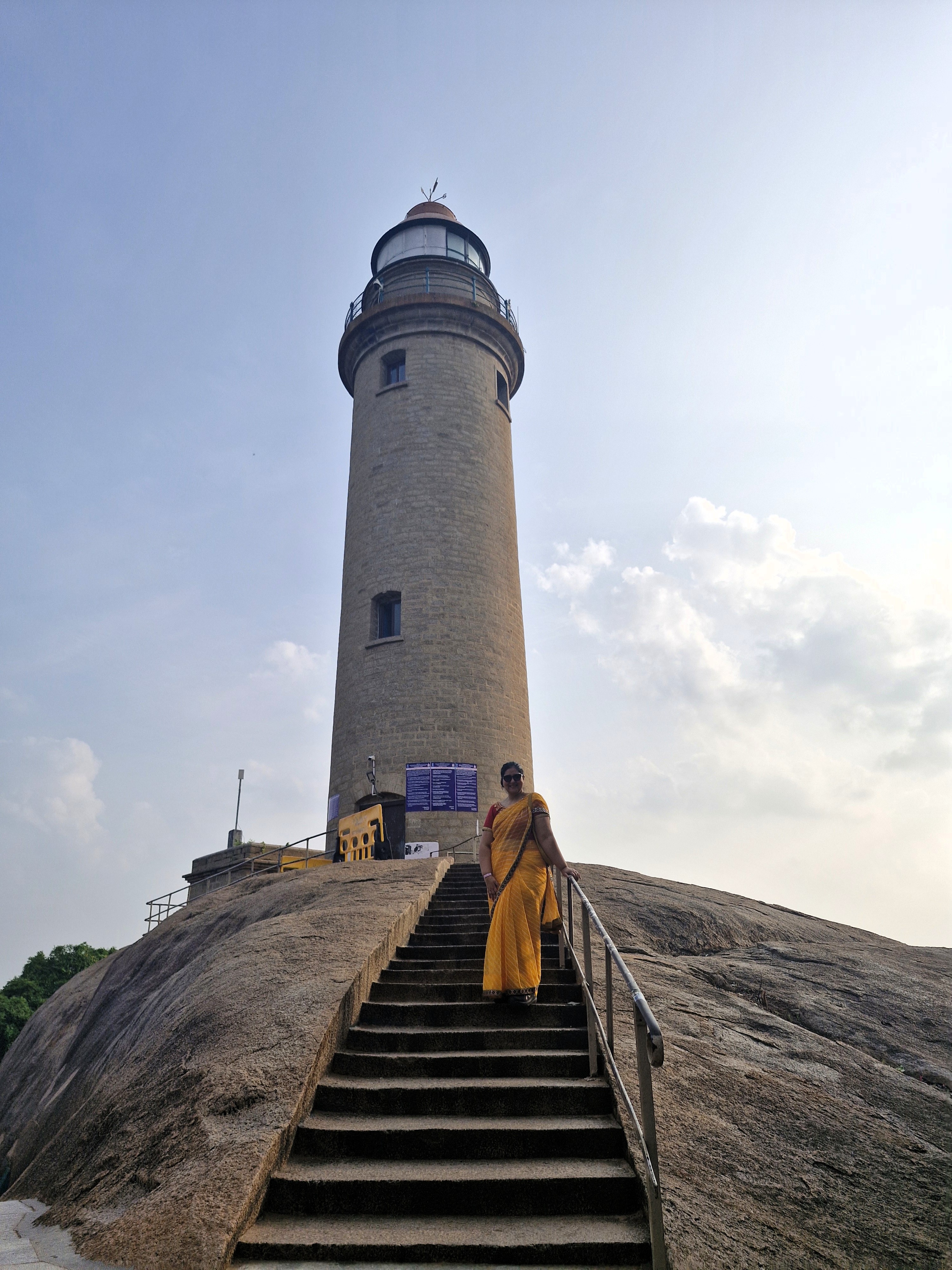
The Lighthouse is situated near the Mahishasuramardini Cave. The first time a light was lit here was in the 1880s. It was closed in 2001 after a threat from LTTE. But it is open to visitors now though the timings are highly odd. As a consequence, I did not bother to go up the Lighthouse.
Roya Gopuram
The Roya Gopuram remained incomplete, its construction having been started by Krishnadevaraya of the Vijayanagara kingdom. The pillars were meant for the gateway, along with the perimeter wall. One of the pillars has a Dashavatar carving, with Balram replacing Buddha. This plan was abandoned because the Vijayanagar kingdom dwindled.
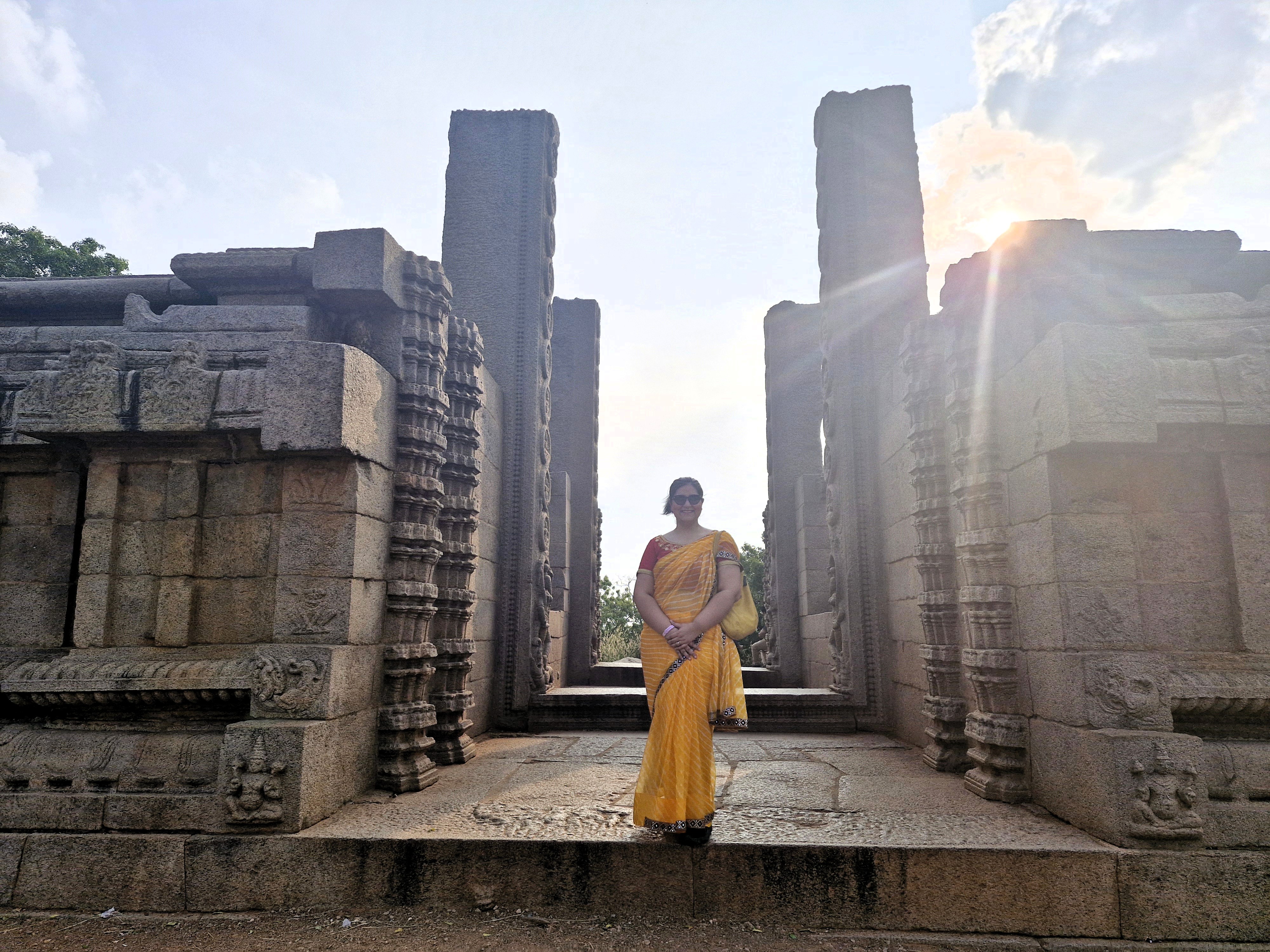
But, even today, standing alone on a ridge, the Roya Gopuram certainly commands an unparallelled majesty.
Varaha Mandapam
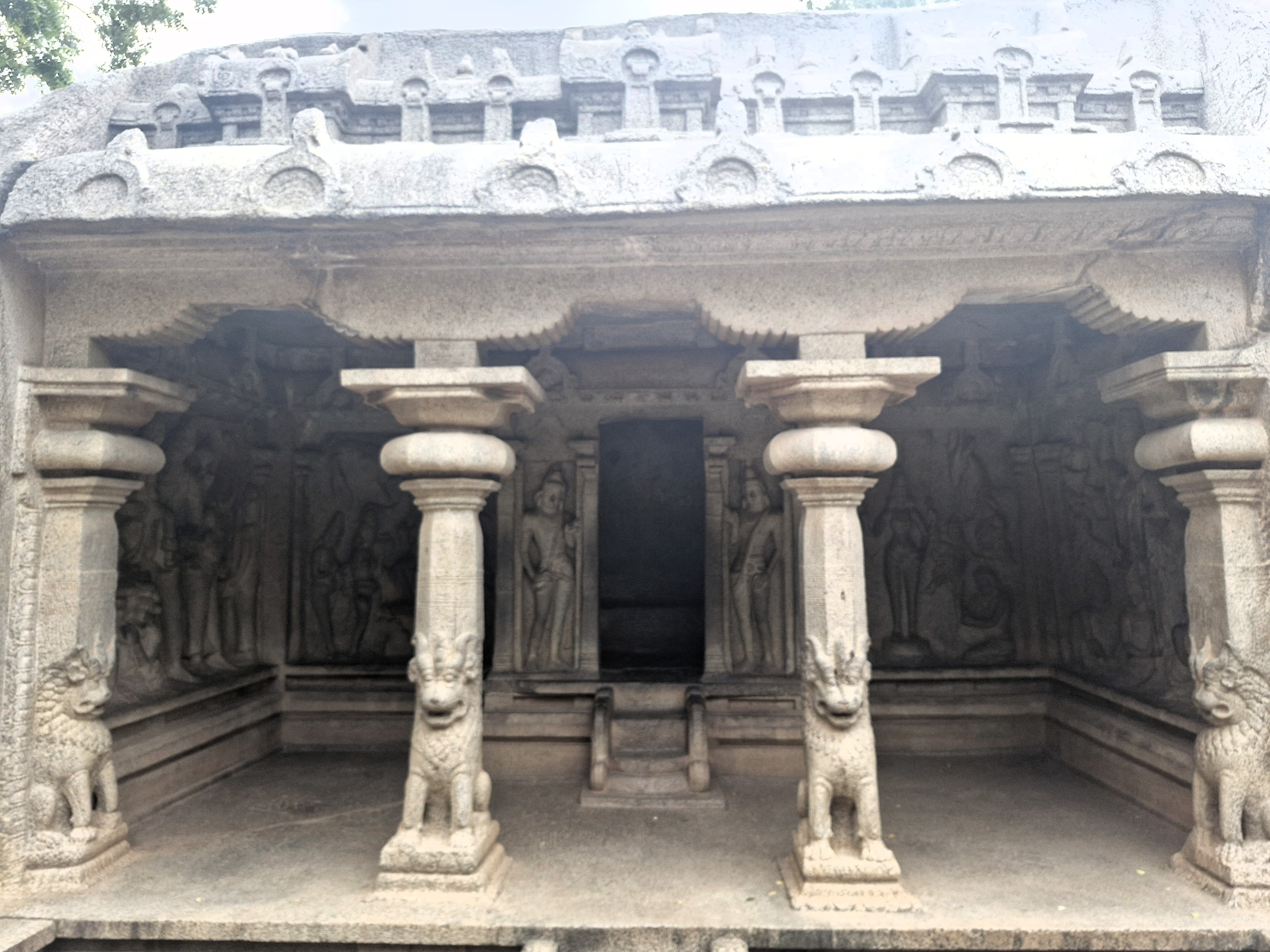
The Varaha Mandapam entrance hall has two pillars with lion-bases; the entrance is flanked by two dwarpalas (guardians). One of the four panels shows the boar-incarnation of Vishnu (Varaha) standing. He has one foot resting on the Naga snake king. Vishnu lifts Bhudevi, the earth goddess, from the ocean.
Another panel is of Gajalakshmi; the goddess Lakshmi seated on a lotus and being bathed by a pair of elephants. A third panel showcases a four-armed Durga.
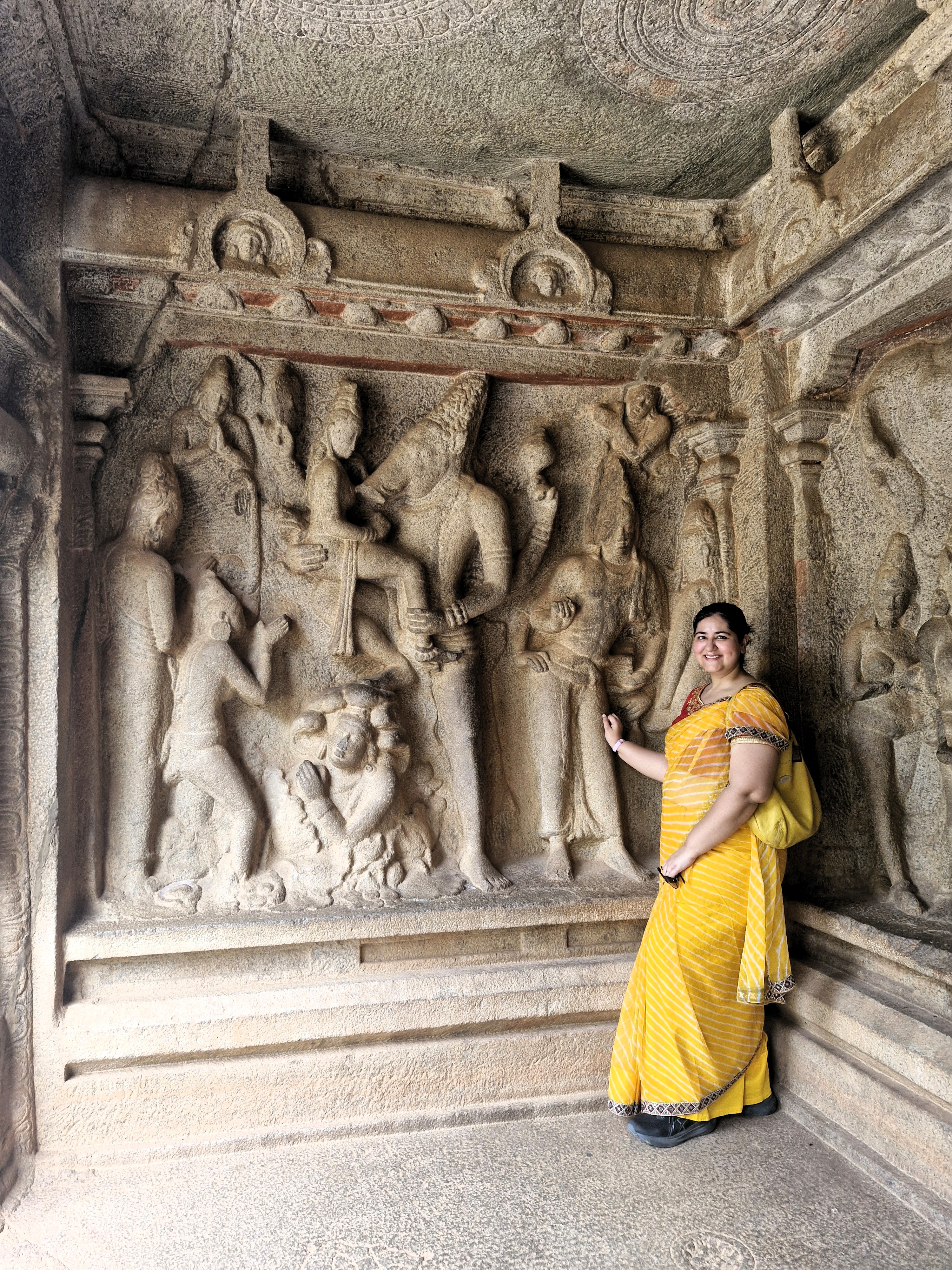
Ganesh Ratha
The Ganesh Ratha is a small, active temple. It has a Lord Ganesha statue inside it. The temple structure from the outside is beautiful and looks like a ship.
Krishna’s Butterball
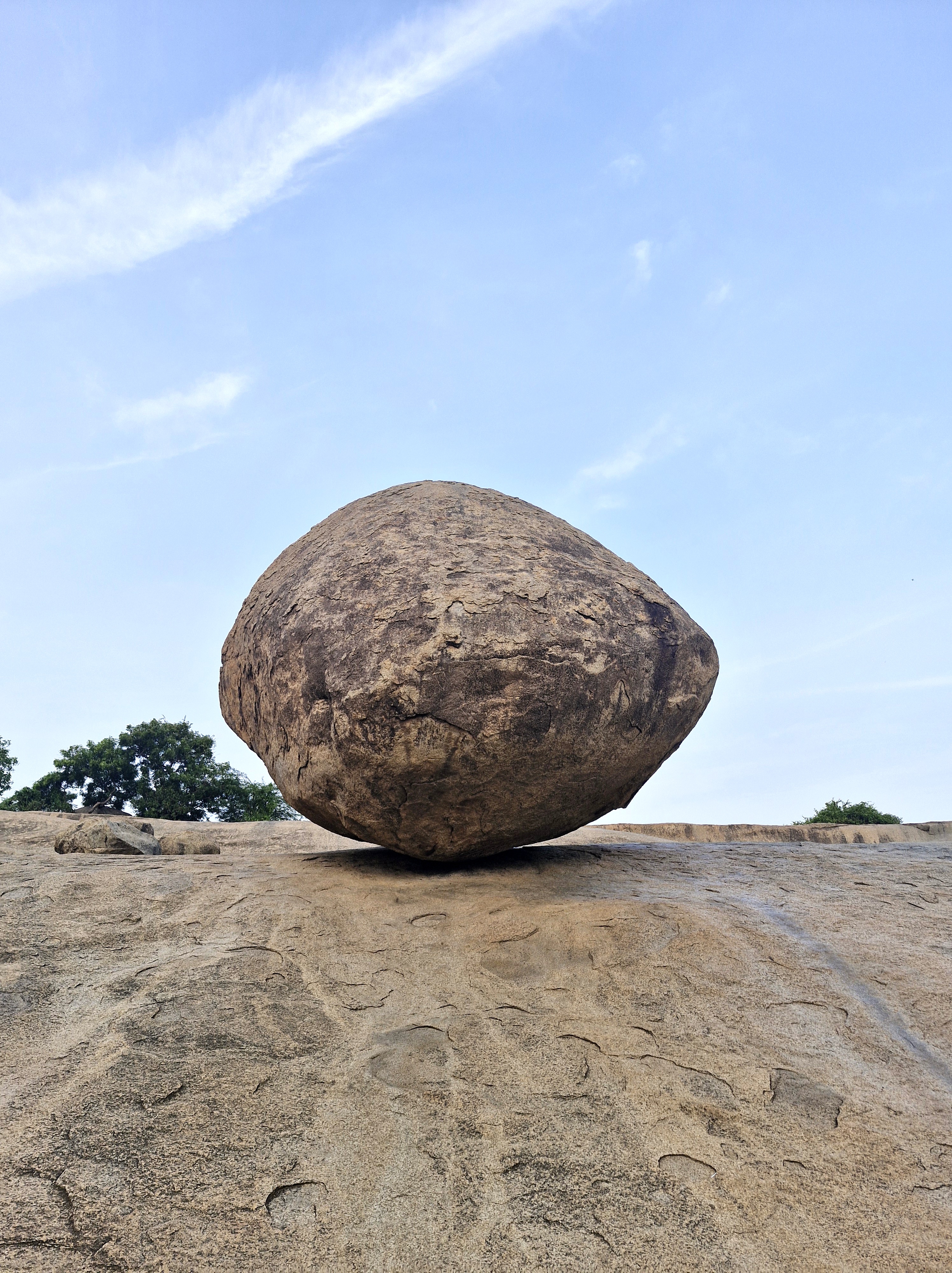
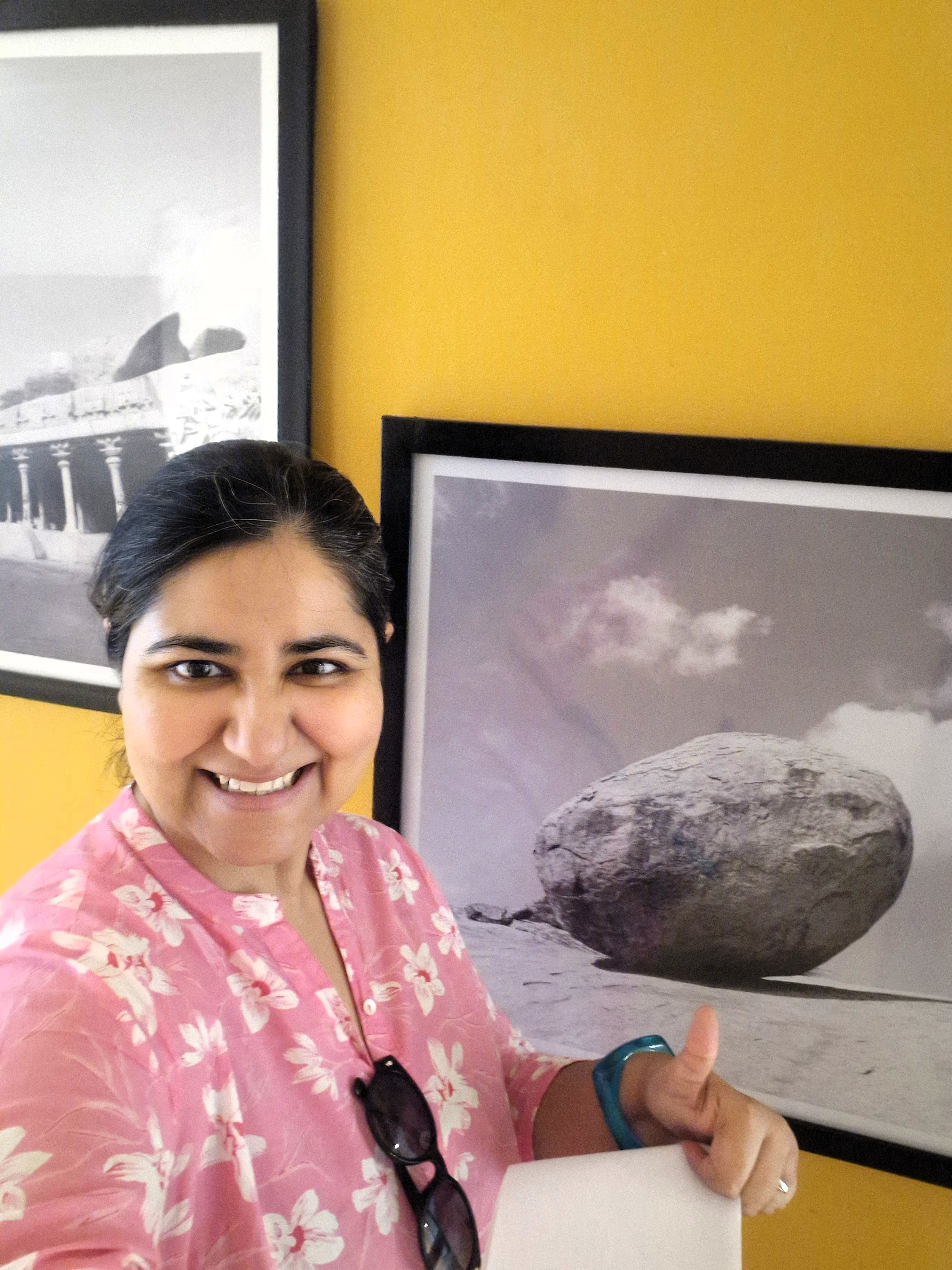
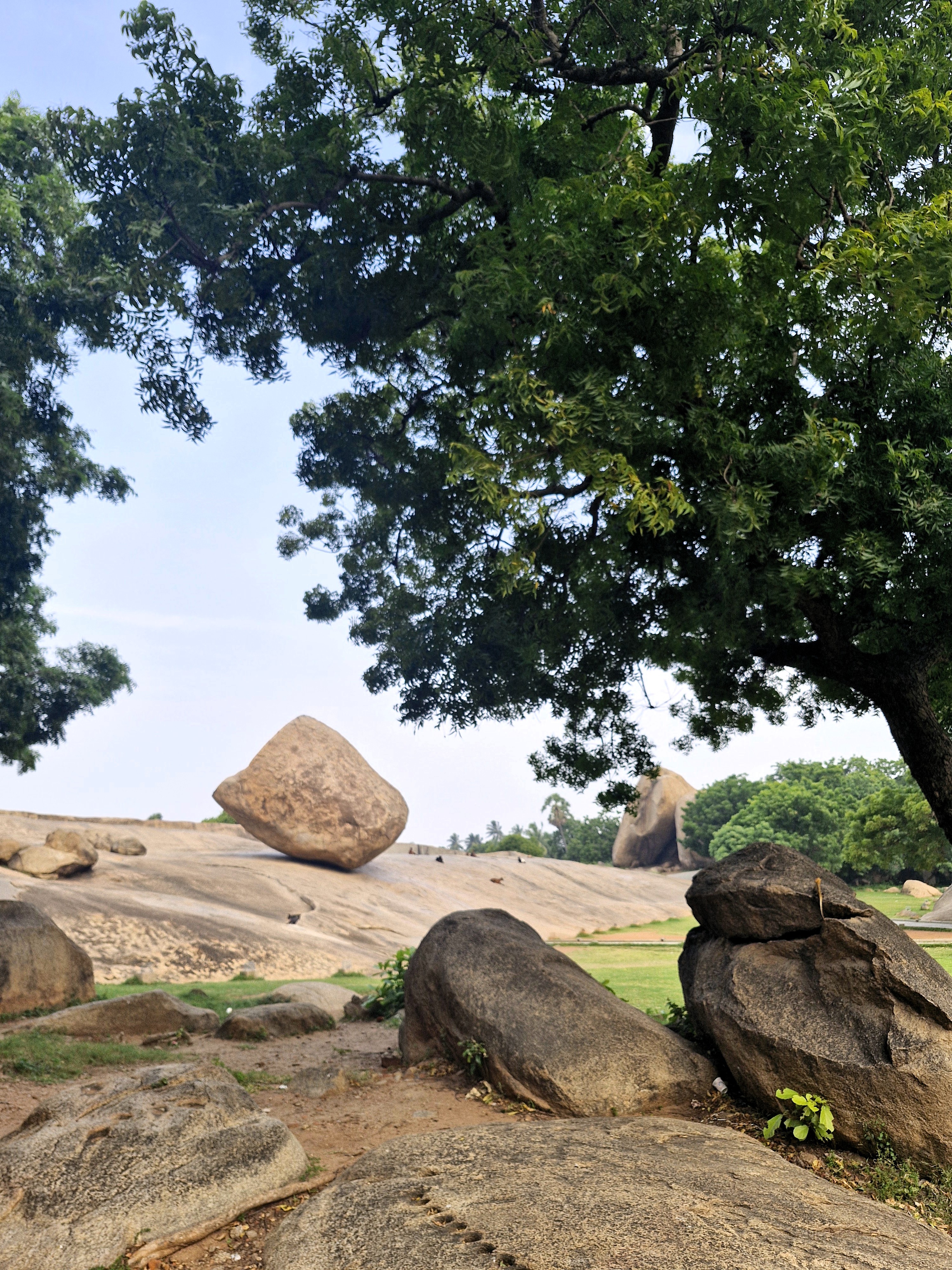
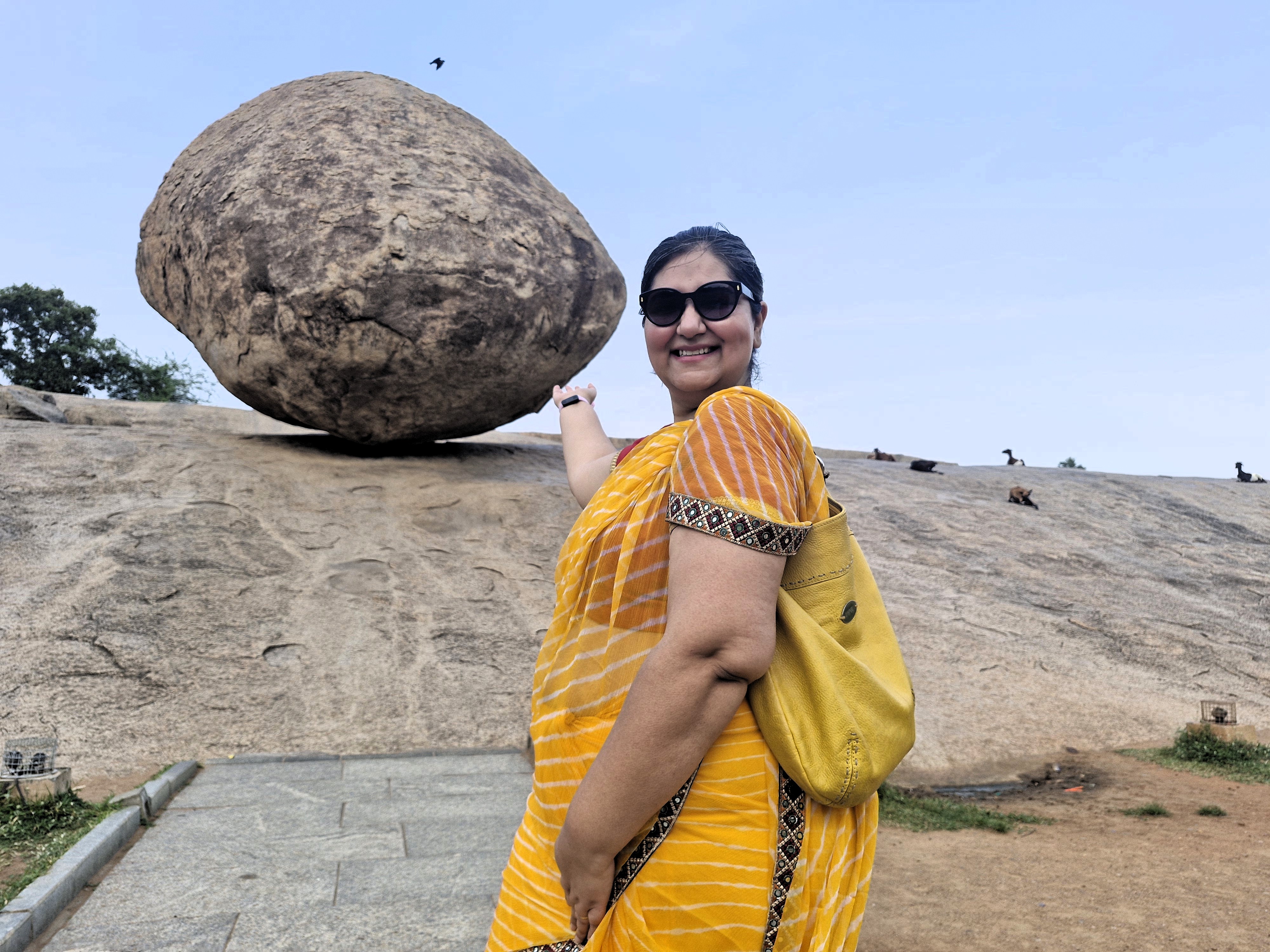
Krishna’s Butterball is a huge spherical boulder, balancing on a hillside. It is the favourite place for tourists to get their photographs clicked! I was fascinated too, NGL. You can read my independent blog post on it here.
Bhagirath’s Penance
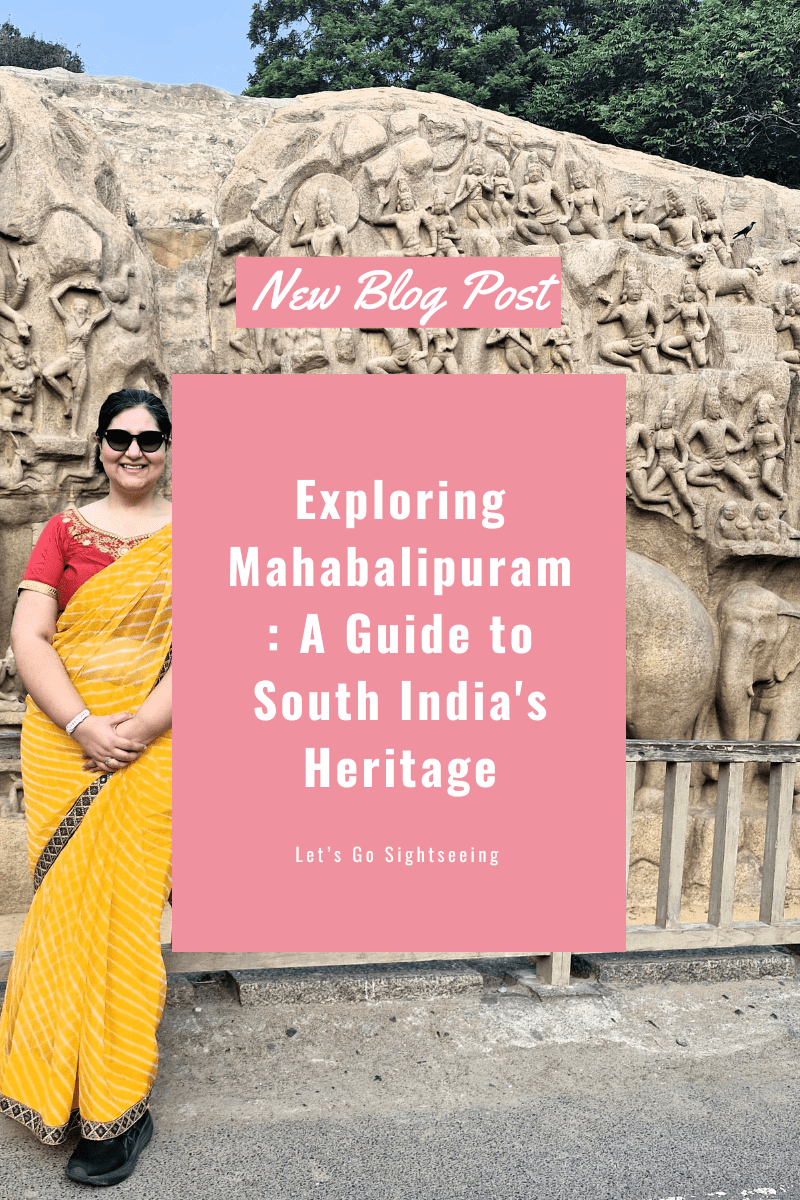
It is believed to be the world’s largest bas-relief. It is more popularly known as Arjuna’s Penance. It is also called the ‘Descent of the Ganges.’ Bas reliefs are structures protruding from the rock base. It is visible on the road itself and is a photo-op. Balu G informed that the main figure, in a ‘Tapasya’ (penance) mode, is Bhagirath (an ancient Indian king).
Due to Bhagirath’s penance, Ganga came tumbling down the Himalayas. The Naga king, queen, and child entered the holy river. Airavat and other elephants congregated to drink water. Soon, other animals joined. As a result, there are gods’, elephants’, monkeys’ and other creatures’ depictions on the bas-relief.
A cleft down the rock shows Ganga. On the left-hand side, Bhagirath is shown standing on one leg.
The Legend of Bhagirath Prayatna (Bhagirath’s Penance)
Bhagirath’s countrymen had been killed by the demonic gaze of the sage Kapil; without purifying waters flowing on earth, their souls were trapped, wandering aimlessly, unable to attain moksha (salvation). He appealed to Brahma for help who consented but asked the former to demonstrate intense devotion.
Bhagirath, thus, spent 1,000 years in prayer and penance. Pleased, Brahma released Ganga in her liquid form, ordering her to descend to earth.
Balu G mentioned why it is also called Arjuna’s Penance. It is because Shiva has been carved with His favourite weapon, the pashupatashastra. According to legend, Arjuna performed penance on the banks of Ganga and was handed the pashupatashastra by Shiva.
You call it Bhagirath’s Penance. Some call it Arjuna’s Penance. Others know it as the Descent of the Ganga. It does not matter. Its beauty remains supreme!
Panch Pandava Cave
Here, you can experience the architecture of a monolithic rock-cut temple carved out of a single granite block. It features stone columns. There are also miniature shrines with deities. The temple includes exquisite carvings depicting stories from Indian mythology.
Krishna Mandapam
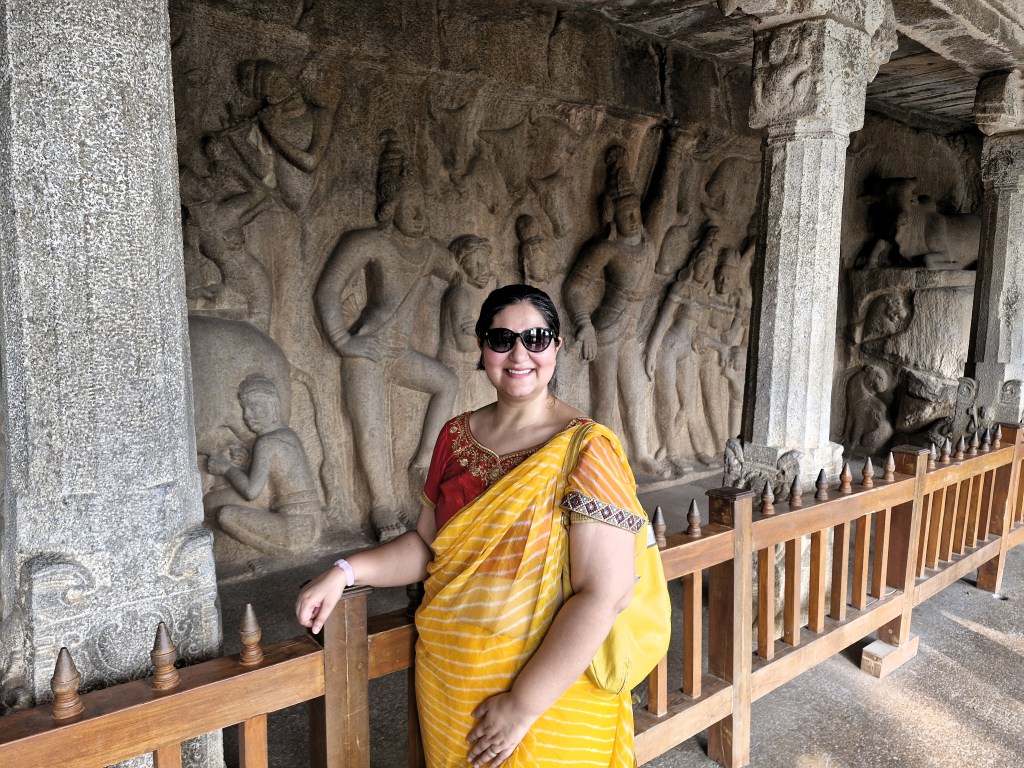
A short walk away, to the left of Arjuna’s Penance, is Krishna Mandapam. It is also a bas-relief, and was carved in the seventh century. The carvings depict Krishna using His strength to lift the Govardhan Parvat (Govardhan mountain) to protect people from imminent floods.
Arulmigu Sri Sthala Sayana Perumal Temple
On the opposite side of Arjuna’s Penance is the Sthala Sayana Perumal Temple. Although not as old as the other Mahabalipuram attractions, it is definitely worth a visit.

The Madras Crocodile Bank Trust and Centre for Herpetology
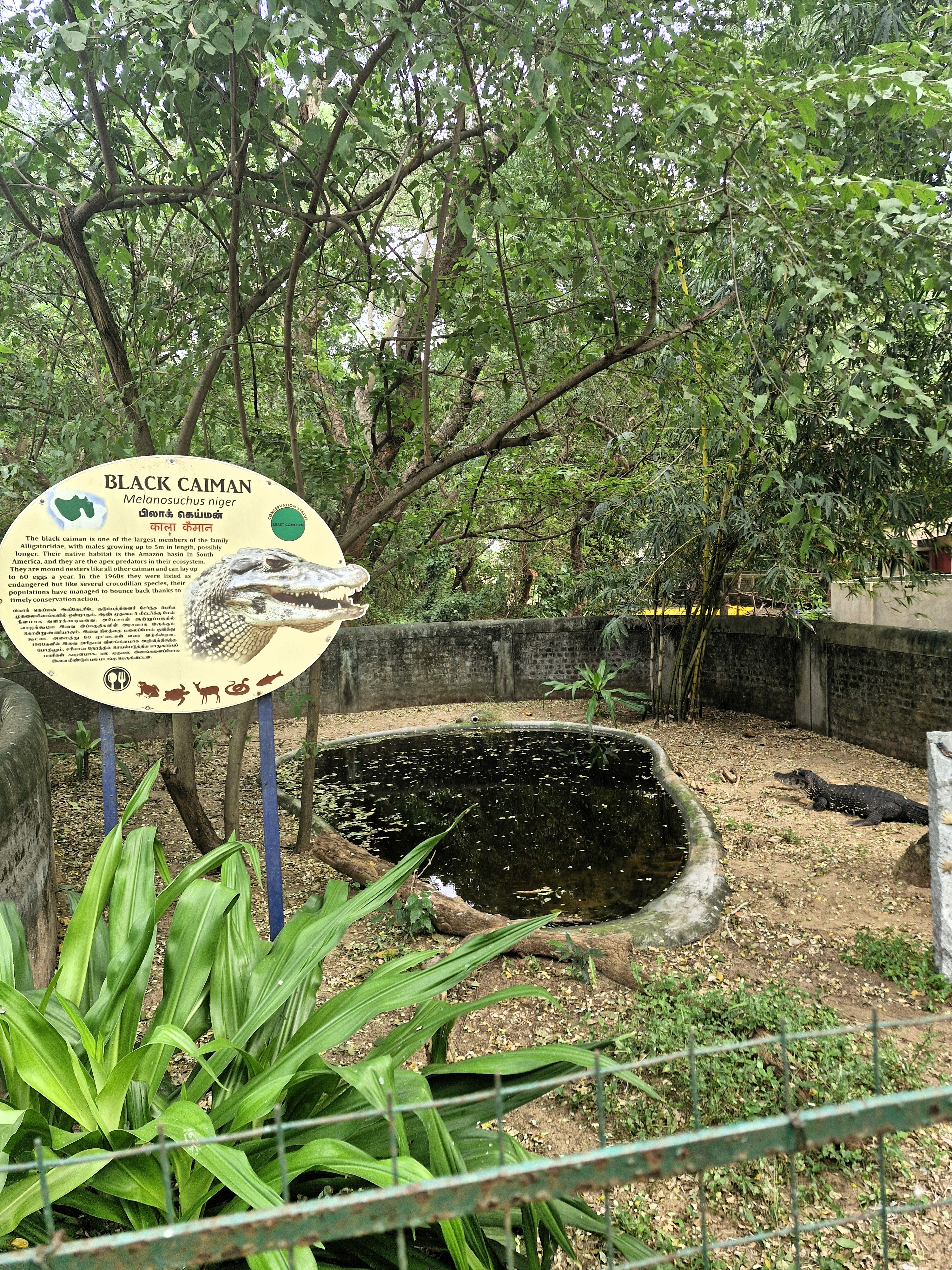
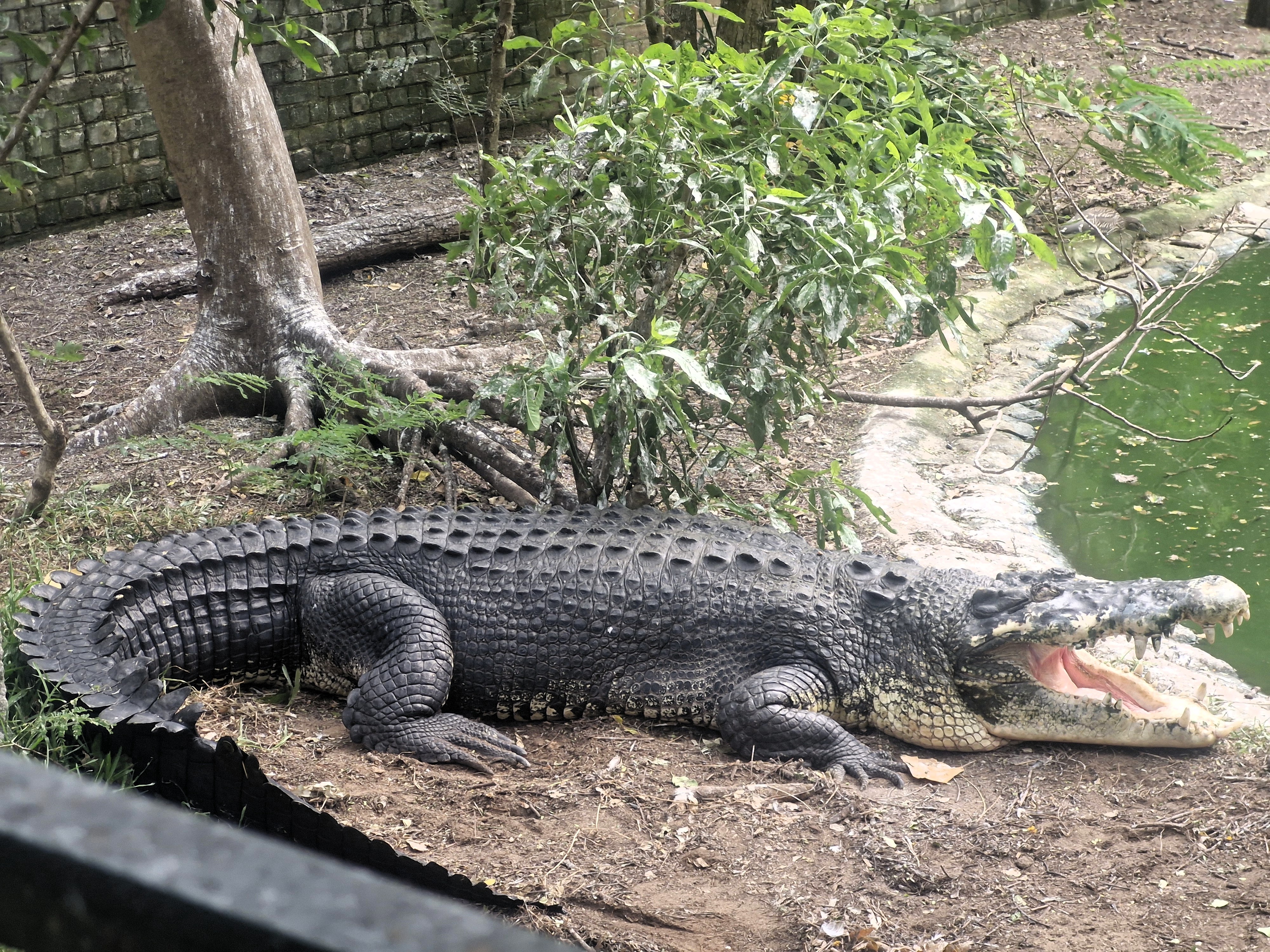
By the mid-20th century, India’s crocodile population was exploited to almost extinction. This situation prompted the government to declare the three Indian crocodile species protected under the Wildlife Act. Towards this end, Rom and Zai Whittaker established The Madras Crocodile Bank Trust and Centre for Herpetology.
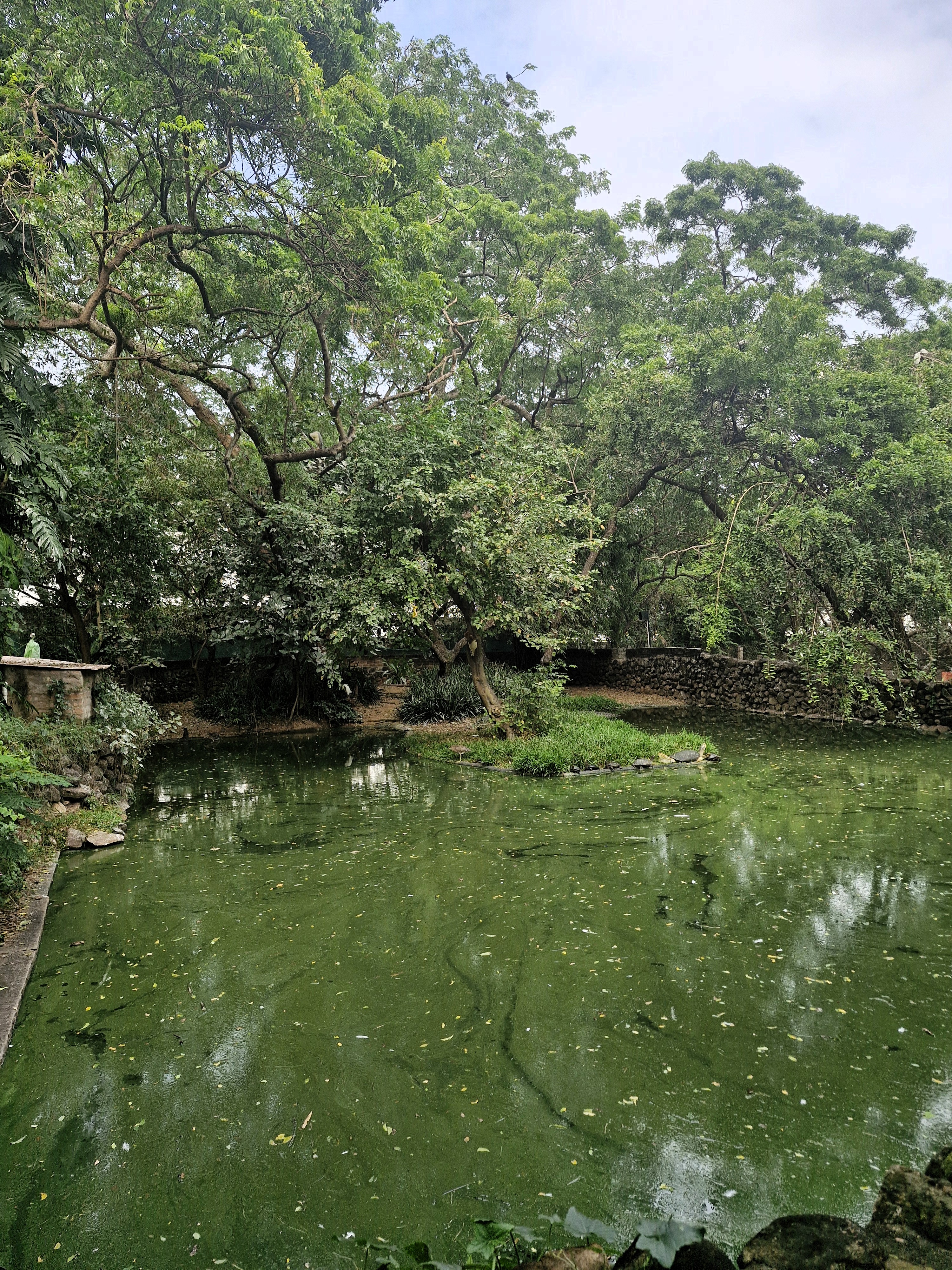
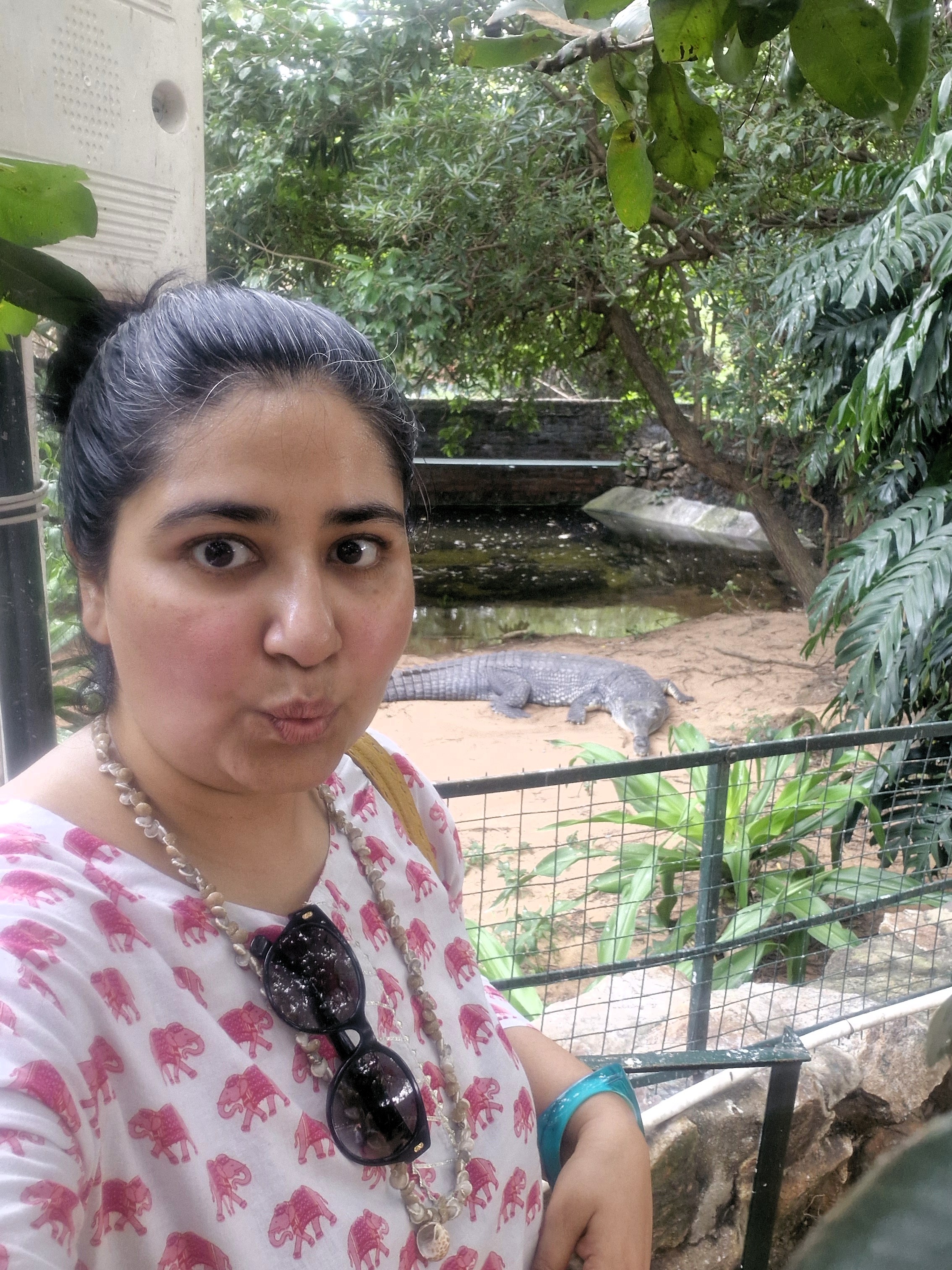
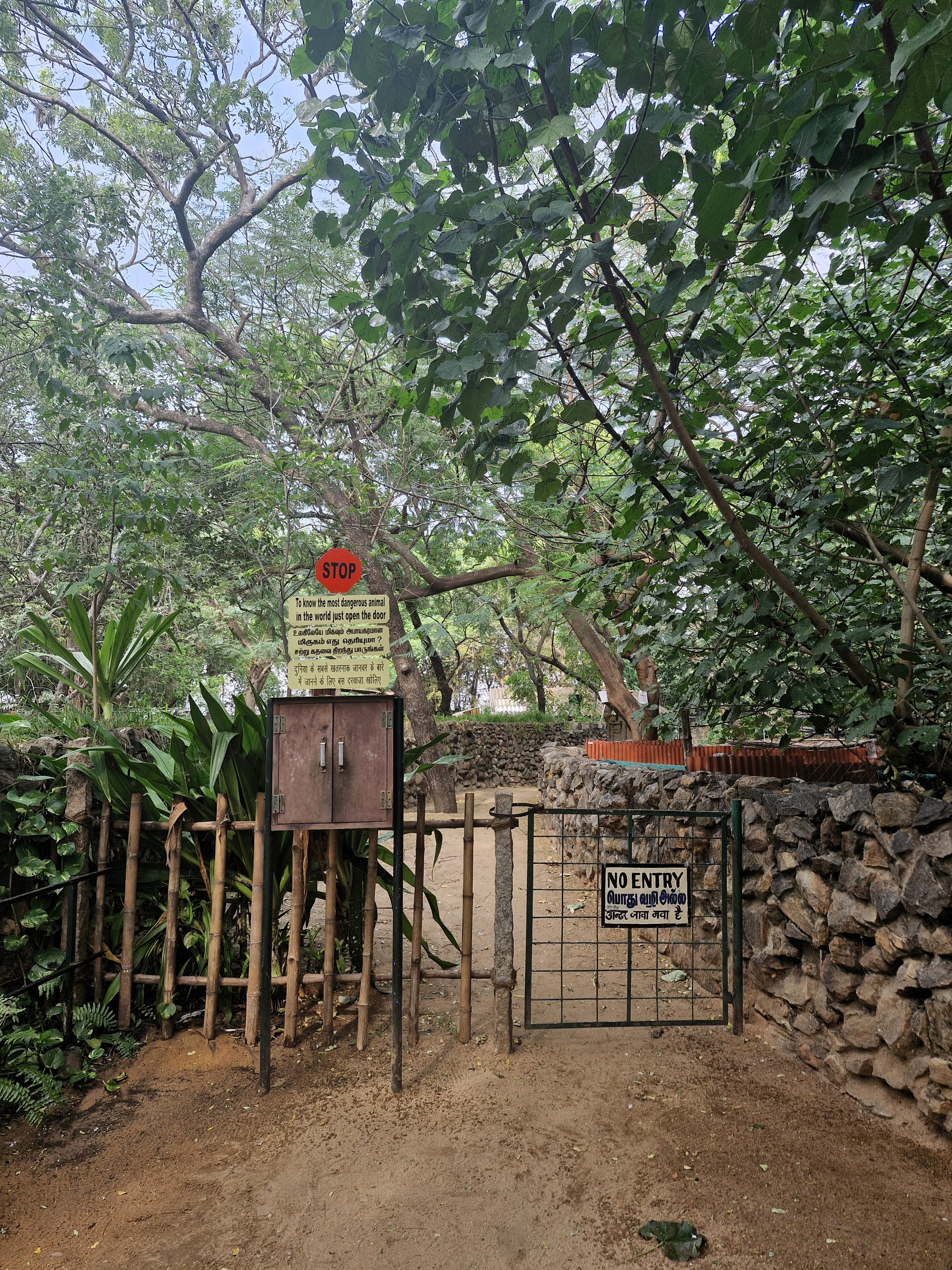
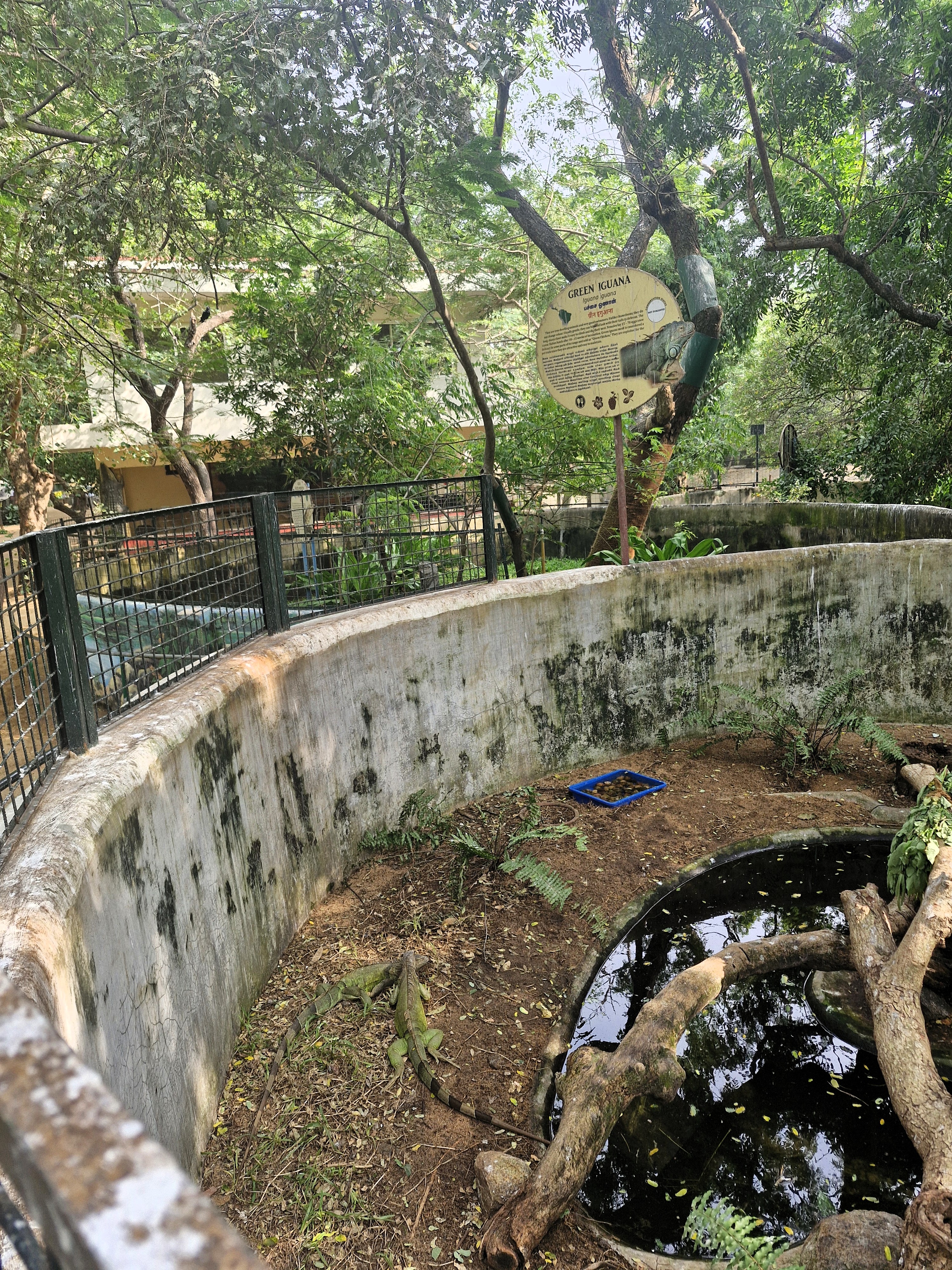
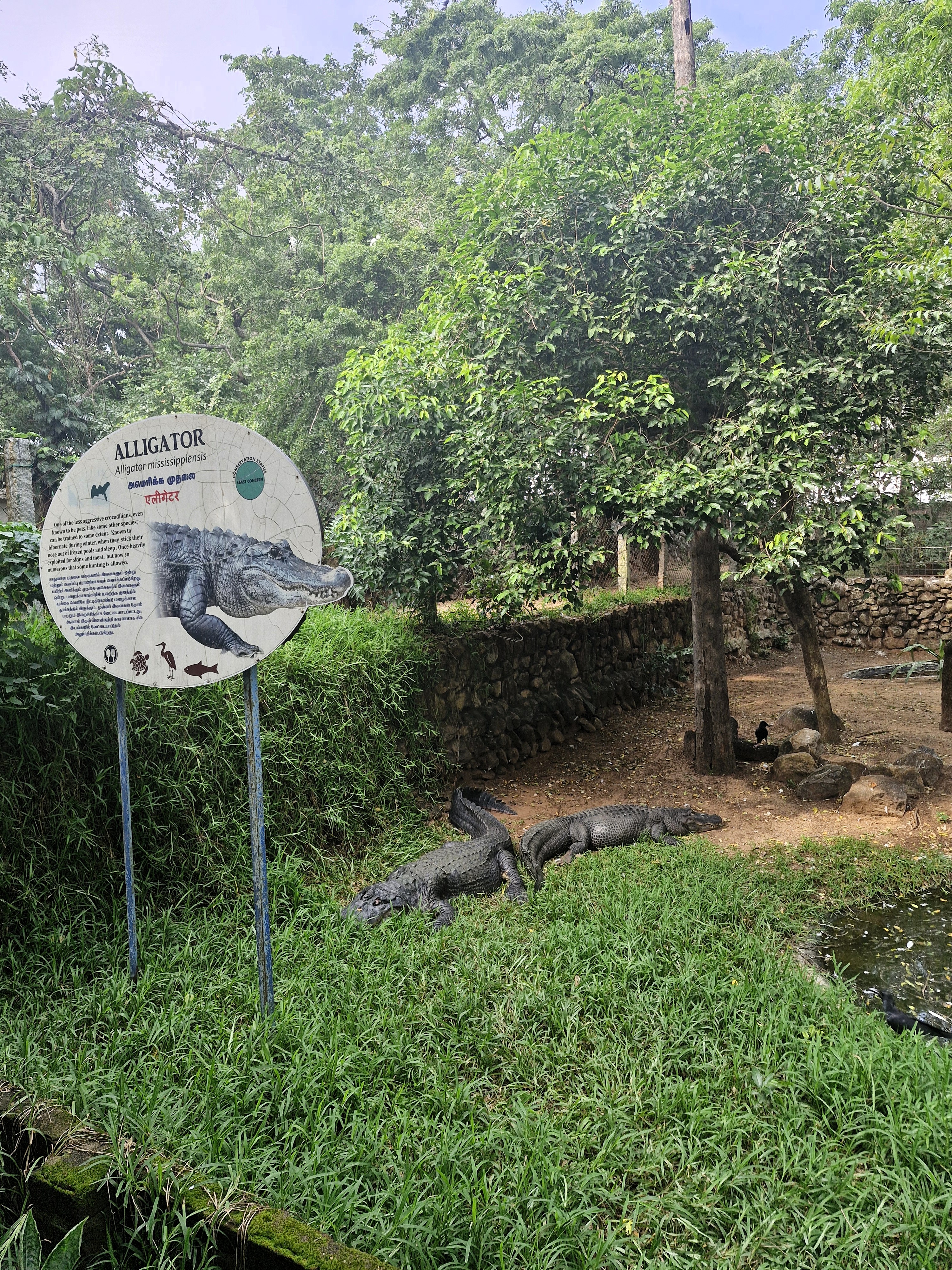
The need for reptile conservation grew. In response, the Madras Crocodile Bank Trust took up the preservation of turtles, lizards, and snakes. It has bred thousands of crocodiles and alligators including endangered Indian crocodile species along with several threatened turtle species. I spotted many of these rare reptilian species in their natural habitats.
I also spotted several avian species. Yet, I missed the chance to see the gharial at its best. It was meandering among fishes and freshwater turtles in the aquarium. The Crocodile Bank is covered with coastal dune forest. It is home to a wide range of fauna. It is an instant hit among nature enthusiasts. Please note that it is located about 15 kilometers from the town center.
Visit the local stone carvers and buy statues and miniatures locally made in the Mahabalipuram streets.
A Legend Linked with Mahabalipuram
The Shore Temple was submerged underwater for many years. According to Balu G, it came into view when the British excavated the area. I was quite amazed when he mentioned that six temples are still submerged in the Bay of Bengal. But they are not intact anymore. This occurred after a massive tsunami in the 17th century.
Mahabalipuram is the remains of a once thriving city, submerged below the sea when the shoreline changed. India’s Atlantis, maybe?
I recommend Four Points by Sheraton as a place to stay. There are activities on offer, along with a complimentary shuttle to and from the Group of Monuments. It also offers Abhyanga treatment. It is an apt place to spend the weekend.
