Before I headed to Sri Lanka, I had a lot of anxiety about it due to its history of civil war and the more recent economic collapse. Blame it on the media. And there’s no better way to overcome apprehension than by travelling.
Once I had been to Sri Lanka, all my concern departed. A few folks contacted me to ask about my trip. I realized then that I was not alone in the consternation. Everyone who reached out to me wanted to know if it was safe and easy to visit.
It was almost déjà vu for me, for I had been equally clueless. After helping a few folks with a better picture of how safe Sri Lanka is, I thought I should just put it down in a blog post.
First Up…
Sri Lanka is a country in South Asia. It is an island. Beaches & tea are just two of the many things it is known for. Out of the 20+ cities that this nation has, the largest is Colombo.
Sri Lanka is the 25th biggest island in the world. Yet, it has such a name in the travel world. It is a great way to remind ourselves that we must not underestimate anybody/ anything!
Sri Lanka is divided into provinces. Each province has a capital.
| Province | Capital |
| Central | Kandy |
| Eastern | Trincomalee |
| North Central | Anuradhapura |
| Northern | Jaffna |
| Northwestern | Kurunegala |
| Sabaragamuwa | Ratnapura |
| Southern | Galle |
| Uva | Badulla |
| Western | Colombo |
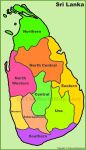
Interestingly, every Sri Lankan province has its fair share of tourism. The peripheral provinces are where the beaches are, along with the nightlife. As you travel inland, the forests and highlands start emerging.
Let’s take it one at a time.
Western
The Western Province is where the capital of Sri Lanka is located. It can easily be called the country’s gateway due to it having the Bandaranaike International Airport. It is the most densely populated province.
The Western Province is home to the Gangaramaya Buddhist Temple, the Mount Lavinia Beach, the Galle Face Green, the Colombo National Museum, and the Negombo Fish Market.
Northwestern
Let’s begin to move clockwise from the Western Province. You arrive at the Northwestern Province. It is famous for its kitesurfing, mangroves, sand dunes, scuba diving, wild beaches, long sand strips, and dolphin & whales watching.
The Northwestern Province is home to the Ridi Viharaya, the Munneshwaram Hindu Temple, the Yapahuwa Rock Fortress, the Arankelle Ancient Monastery, and the world’s tallest granite Samadhi Buddha statue.
Northern
Going circular again, you come to the Northern Province. The 30-year-old war happened here. It, unfortunately, dragged this province backwards as the LTTE terrorists destroyed lives and livelihoods until the war ended in 2009.
But the Northern Province is peaceful now. It is attempting to make up for the lost time and to reach at par with the rest of Sri Lanka. It is home to many kovils (temples), the Neduntheevu, the Nagadipa Purana Vihara, the Jaffna Fort, and the Casuarina Beach.
Eastern
Going round again, we reach the other side of Sri Lanka. The Eastern Province has untouched National and Safari Parks. Sightseers can be alone with nature and wildlife here.
The Eastern Province has been a top surf spot around the world for 50+ years now. It is home to the Koneswaram Temple, the Arugam Bay, many beaches, the Trincomalee War Cemetery, the Pigeon Island National Park, and the Kudumbigala Monastery.
Southern
Moving helically again, we arrive at the Southern Province. It is the seventh largest by area and the third most populated. Its official flower is the Heen Bovitiya (Osbeckia Octandra).
The Veherahena Temple is well-known for its huge Buddha statue & tunnels filled with paintings. The Southern Province is home to the Galle Fort, many beaches, the Old Town of Galle, the Sea Turtle Farm, and the Sinharaja Forest Reserve.
Sabaragamuwa
Let’s travel inland in the same spiral pattern. We have come to the Sabaragamuwa Province. This landlocked province is famous for its gems. Explorers here are rewarded with wildlife and beautiful waterfalls.
The Sabaragamuwa Province is home to many elephant projects, the Adam’s Peak, the Bopath Ella, the Maha Saman Dewalaya, the Belilena Cave, and the Maduwanwela Walawwa.
North Central
Going right-handed again, we are now at the heart of Sri Lanka. The North Central Province is where you will find Anuradhapura, the ancient capital of this country. This area is popular with wildlife enthusiasts.
The North Central Province is home to the Mihintale, the Polonnaruwa, the Dambulla Cave Temple, many national parks, the Ruwanwelisaya, the Jaya Sri Maha Bodhi, and the Ritigala Forest Monastery.
Uva
Moving from left to right again, to another landlocked province, you will arrive at the Uva Province. Its symbolic mountain – Namunukula – stands tall. It is famous for waterfalls and national parks.
The Uva Province is home to the Little Adam’s Peak Viewpoint, the Nine Arches Bridge, the Lipton’s Seat, the Ella Rock, the Ella Spice Garden, many waterfalls, and the Kataragama Temple.
Central
Moving further inland, we reach the belly of Sri Lanka – the Central Province. It is the sixth largest province. Its official flower is the Rhododendron Arboretum, locally called the Maha Rathmala.
Though three successive European powers invaded the country from the 16th – 19th century, the Central Province maintained its independence until the early 19th C. It is home to the Sigiriya The Ancient Rock Fortress, and many Buddhist temples.
With this, I end my short guide to the way Sri Lanka is structured from a sightseer’s POV. By no means is this list exhaustive.
Safe Sri Lanka
There is absolutely no doubt that Sri Lanka has had a troubled history. Civil unrest for 30 years, terrorism and, more recently, the protests over the economic & political situation are hardly the labels any country wants.
Having said that, please name one country that has NOT had a troubled history. In my travel, I found Sri Lanka to be safe, not just as a traveler but also as a woman traveler. Heck, even as a solo woman traveler!
Like I behave anywhere when I travel, I remained aware of my surroundings. I followed all instructions of authorities. I found myself in a crowded place only at the Sri Dalada Maligawa but there too, I did not feel any threat for any moment.
Sri Lankans were courteous and friendly in their demeanor. Their eyes would light up when they would hear “India” (despite the disastrous role my country played in their Civil War).
A hawker approached me only at the Kandy Viewpoint but even he was not persistent. Sri Lankans sure won me over with their friendliness and hospitality. If I get a chance, I would love to return to this island nation.
Other Sri Lanka Staples…
- Sri Lanka traffic is excellent. I stayed at Kandy & Negombo and chose to spend a day in Colombo. The traffic from the airport to Kandy, within Kandy, from Kandy to Negombo, within Negombo, from Negombo to Colombo, within Colombo, and from Negombo to the airport – all were good.
The road conditions were lovely, and the driving sense was excellent, with all drivers following rules.
- Sri Lanka is economical for Indians. Except for the airline fares, all our expenses were similar or even less than what we would spend in, let’s say, Goa, on a similar kind of holiday.
- Sri Lanka accepts INR but are even happier accepting USD. Also, forex cards work wonderfully almost everywhere.
- A few of the electrical points are the same as India’s. But I also encountered UK ones. So, a good idea to carry an adaptor/ a convertor.
In my next blog post, I will share my favorite Sri Lanka attractions.

6 responses to “Sri Lanka Staples”
[…] can travel be complete without food? Now that you know where to visit in Sri Lanka, & what to see/ do, it’s time for the restaurants I loved. As before, the below eateries are […]
LikeLiked by 1 person
[…] hope Sri Lanka Staples turned out to be helpful to you. Now that you’ve figured out where you want to visit on your Sri […]
LikeLiked by 1 person
Srilanka is full of temples and natural beauty well shared with beautiful photos and description.👍
LikeLiked by 2 people
Absolutely! A marvelous country. Thank you so much for stopping by.
LikeLiked by 2 people
Thank you too ☺️ read my book if possible 😁😁
LikeLiked by 1 person
Read my book if possible 😄
LikeLike