
It was a warm 2021 January morning when we drove to Dausa to see its unknown attractions. By the end of the holiday, we were left wondering. How did this town stay a mystery despite its proximity to NCR?
Dausa is the headquarter of its namesake district. The Chauhans and the Badgurjars ruled it in the 10th Century. It was also the first headquarter of the Kachhawahas. So, it is greatly important archaeologically and historically!
It took us about three and a half hours to reach Umaid Palace, our accommodation. We chose to spend the first evening at the hotel itself, exploring its nooks & crevices. The evening culminated with Fluffy enjoying a run in its mustard farm. For a thorough review of Umaid Palace, click here.
Bhangarh Fort
Remarkable Historical Joys in Dausa
We had two full days in Dausa. On the first day, it had been sunny since morning. So off we went!
Chand Baori
About half an hour from Umaid Palace, the Chand Baori, also called the Abhaneri Stepwell, was our first stop. A Nikumbha Dynasty king, Raja Chanda, built it in the ninth century. The purpose was to conserve water in the extremely arid climate of Rajasthan.
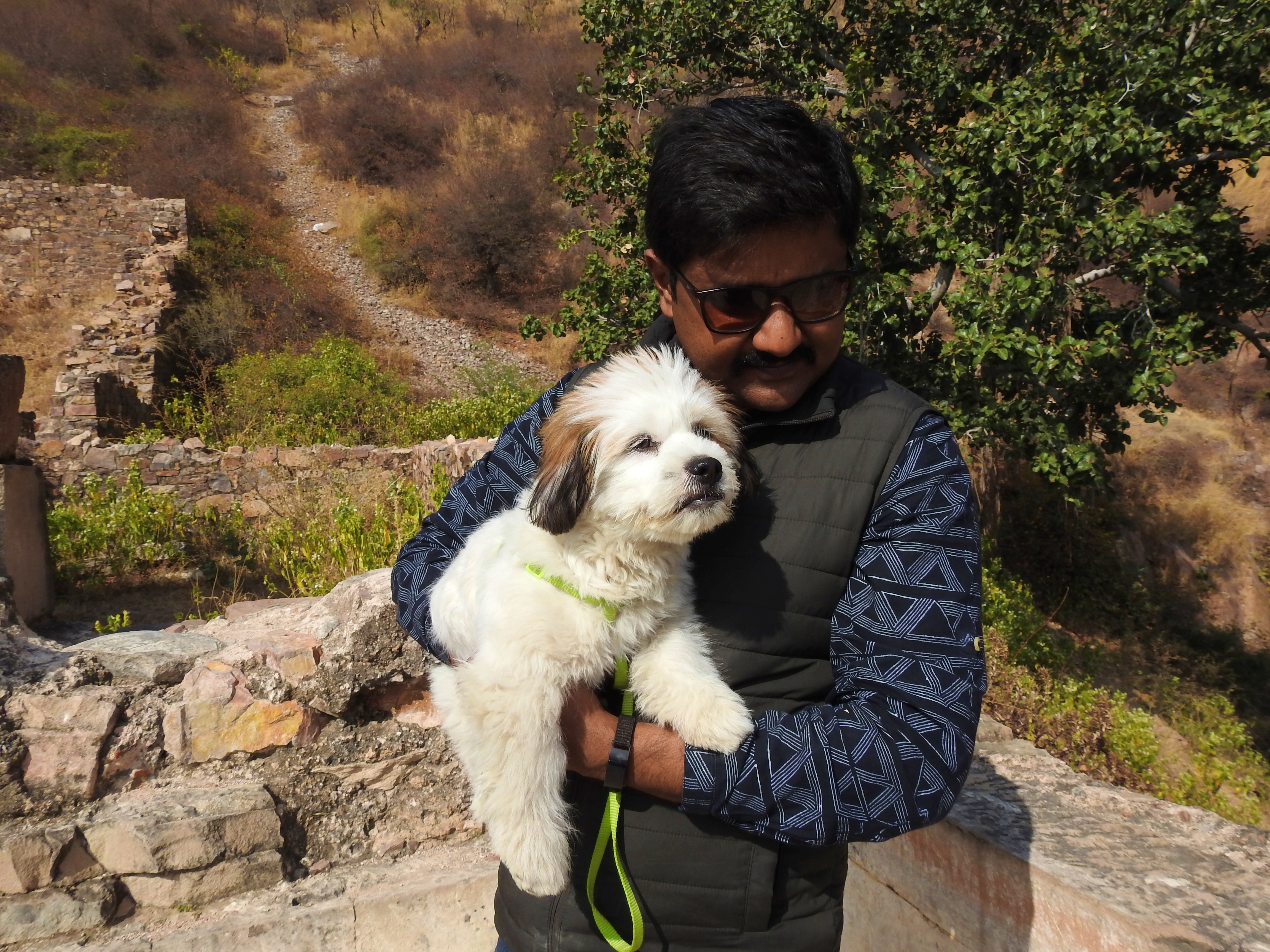
Fluffy, then four months old, scaled the Bhangarh Fort with us!
Because we had Fluffy with us, N and I took turns to go inside. As soon as I stepped inside, I stopped short. Columns adjoined with doorways welcomed me. I loved the flower patterns that were engraved on the columns. The columns and doorways form a gallery that further forms a courtyard. Every corner of the gallery courtyard has octangular rooms leading to the slim roof.
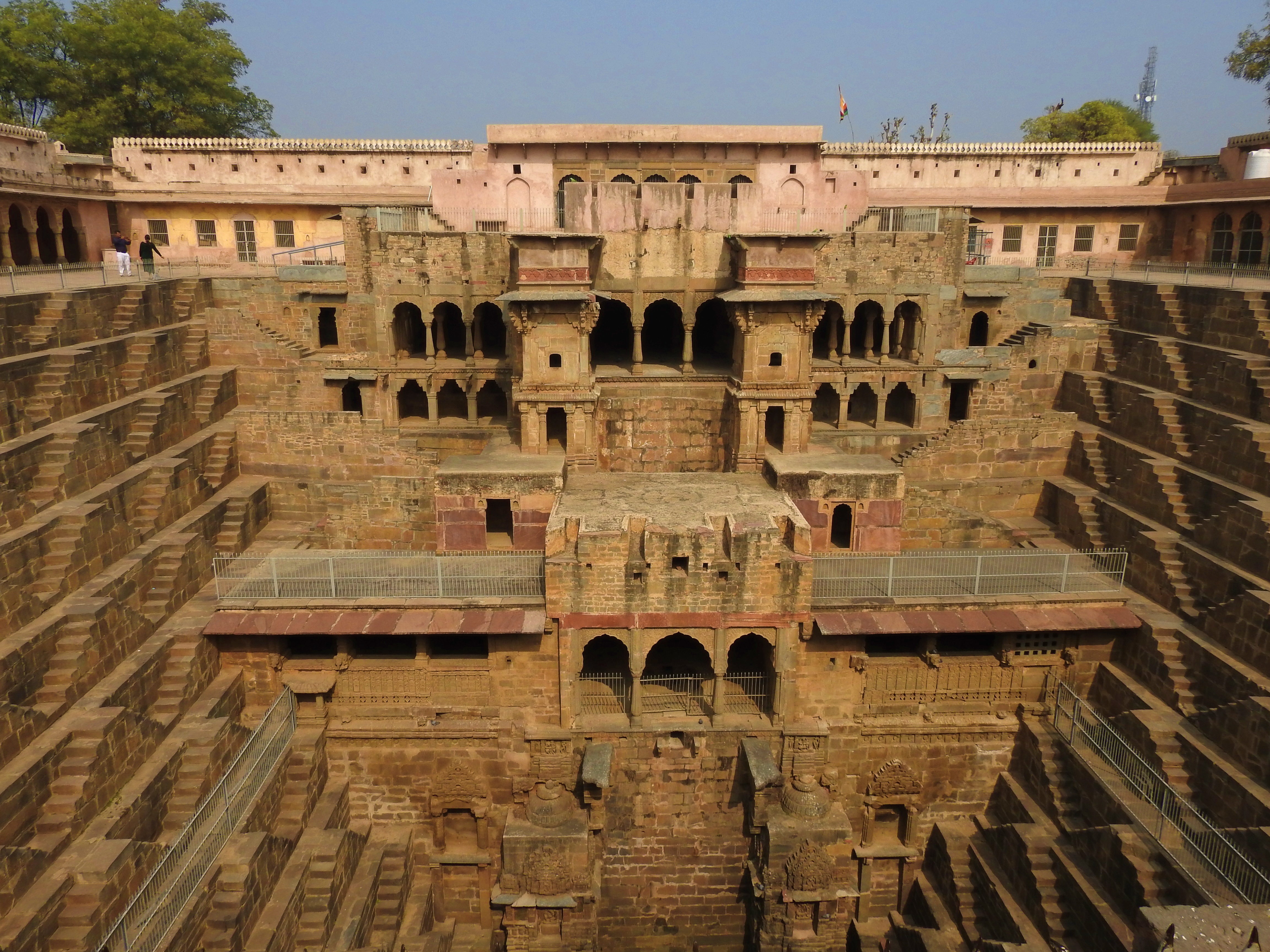
And then, I laid my eyes on the Chand Baori. My jaw dropped seeing this architectural curiosity. Made of red sandstone, the Chand Baori is four-sided and 100 feet deep. It has 3,500 utterly symmetrical, slender steps on three of its sides. A three – storied porch stands on the fourth. The porch has intricately cut jharokhas and balconies where the regal family would sit.
I loved the idols of Lord Ganesha and Goddess Mahishasuramardini lodged within.
When you see the Chand Baori, you will be unable to stop yourself from thinking. You wonder: how did we lose such distinctive ancient Indian buildings? How did modern monstrosities replace them?
Chand Baori
Light and shadow play on the 3,500 symmetrical steps, making it more charming. I share images of the Chand Baori here, but it is best appreciated only by an in-person visit.
I next walked to the Harshat Mata Temple next door.
Harshat Mata Temple
The Harshat Mata Temple is literally a two – minute walk from the Chand Baori. A path, decorated with stone carvings and thorny shrubs, connects the two structures. Keep walking and you come upon the staircase leading to the temple. I entered the Harshat Mata Temple through the iron gate. I noticed the information about the temple on an Archaeological Survey of India board.
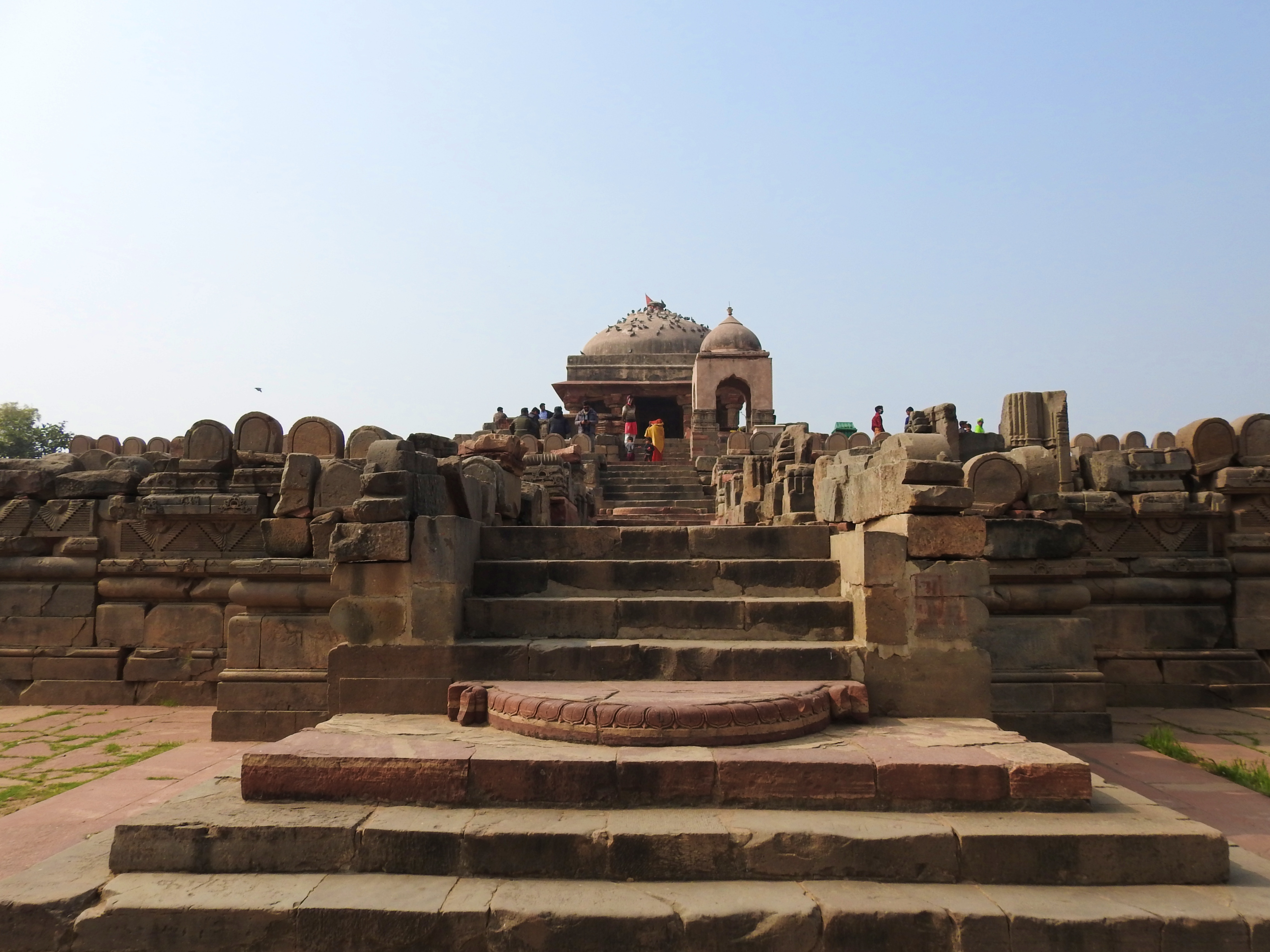
Harshat Mata Temple
I loved the fact that the Harshat Mata Temple is a national protected monument. It is constructed in a double Decker style. Its lower deck is the courtyard where columns, statues etc. are lying around. The engraved pillars, yet again, have excellent art on them. Its upper deck is an open, round platform containing the mandap.
Good religious sculptures depicting life scenes can be seen on the mandap. A path for circumambulation encloses the Garbha Griha (sanctum sanctorum). The Harshat Mata idol is enshrined within. The Goddess is said to bless her devotees with happiness, peace and prosperity. I loved how, even today, the locals have marvelous faith in the resident deity.
This is despite the Harshat Mata Temple being destroyed by Islamic invaders. During my visit, I saw the physical fragments of the temple but the consolidated conviction of the devotees. My last memory of the Temple is also of the sight from the courtyard. I saw new fields and little houses. There were restricted village streets.
The Sun was portraying its mischief.
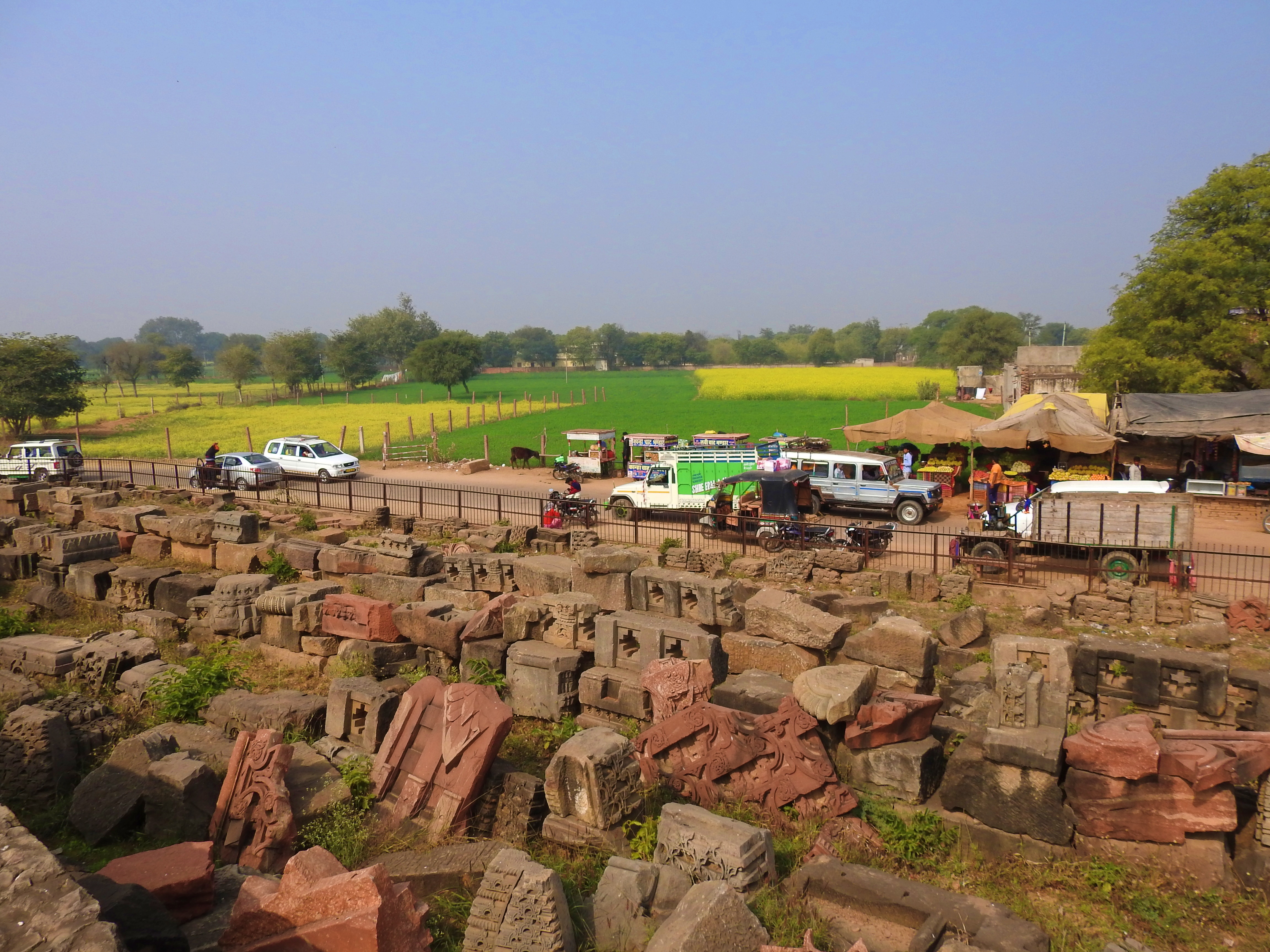
Sight from the Harshat Mata Courtyard

We then headed back to Umaid Palace where an organic lunch awaited us. In the evening, we dressed up to enjoy a bonfire and to click photographs of ourselves under the canopies.
On our second full day, we headed to the Bhangarh Fort.
Bhangarh Fort
About an hour from Umaid Palace, the Bhangarh Fort was our destination for the day. If you’re a lover of all things paranormal, this will leave you elated. If you’re not, you can still enjoy the climb & walk through and listen to the haunted stories.
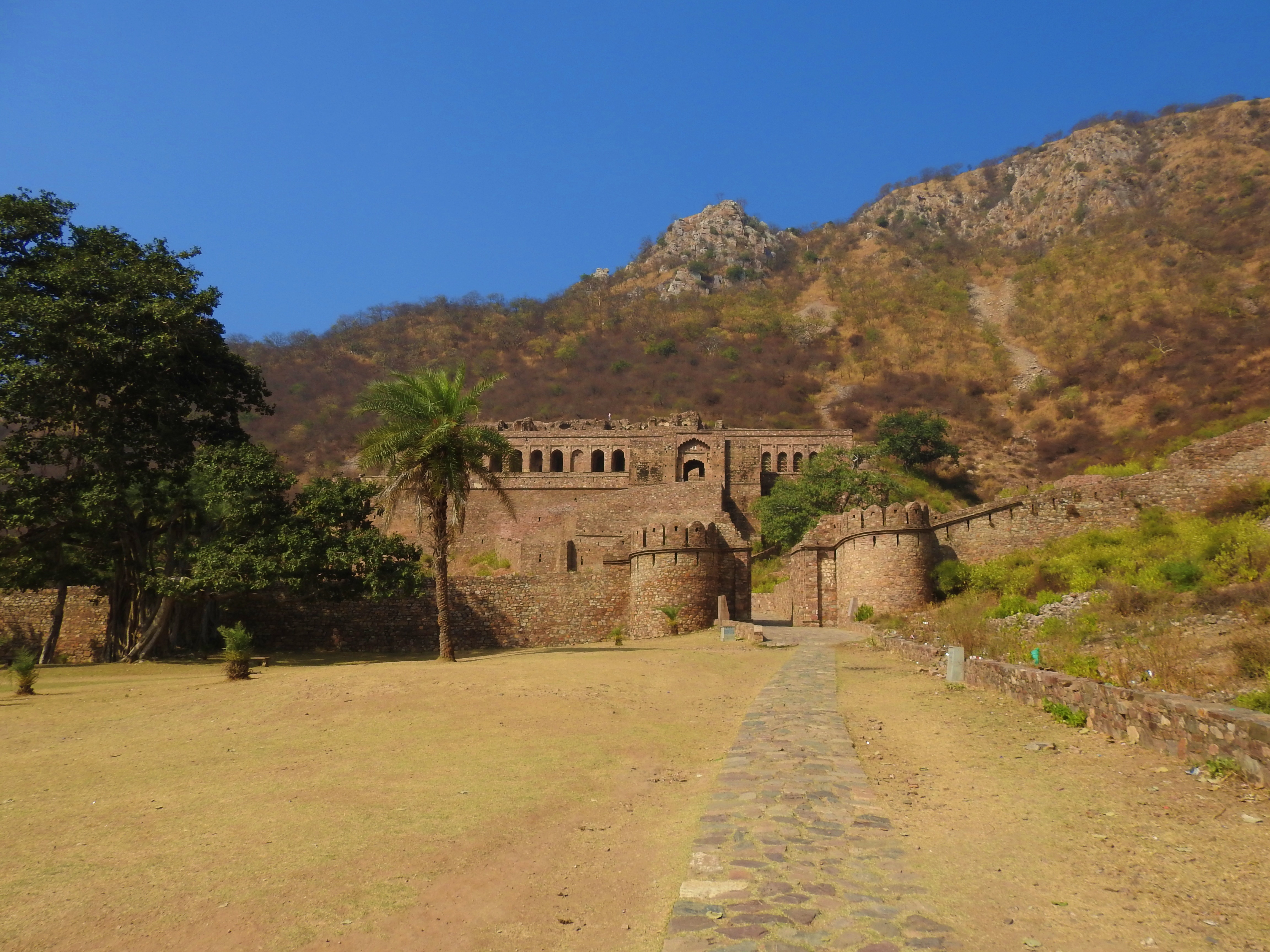
Bhangarh Fort
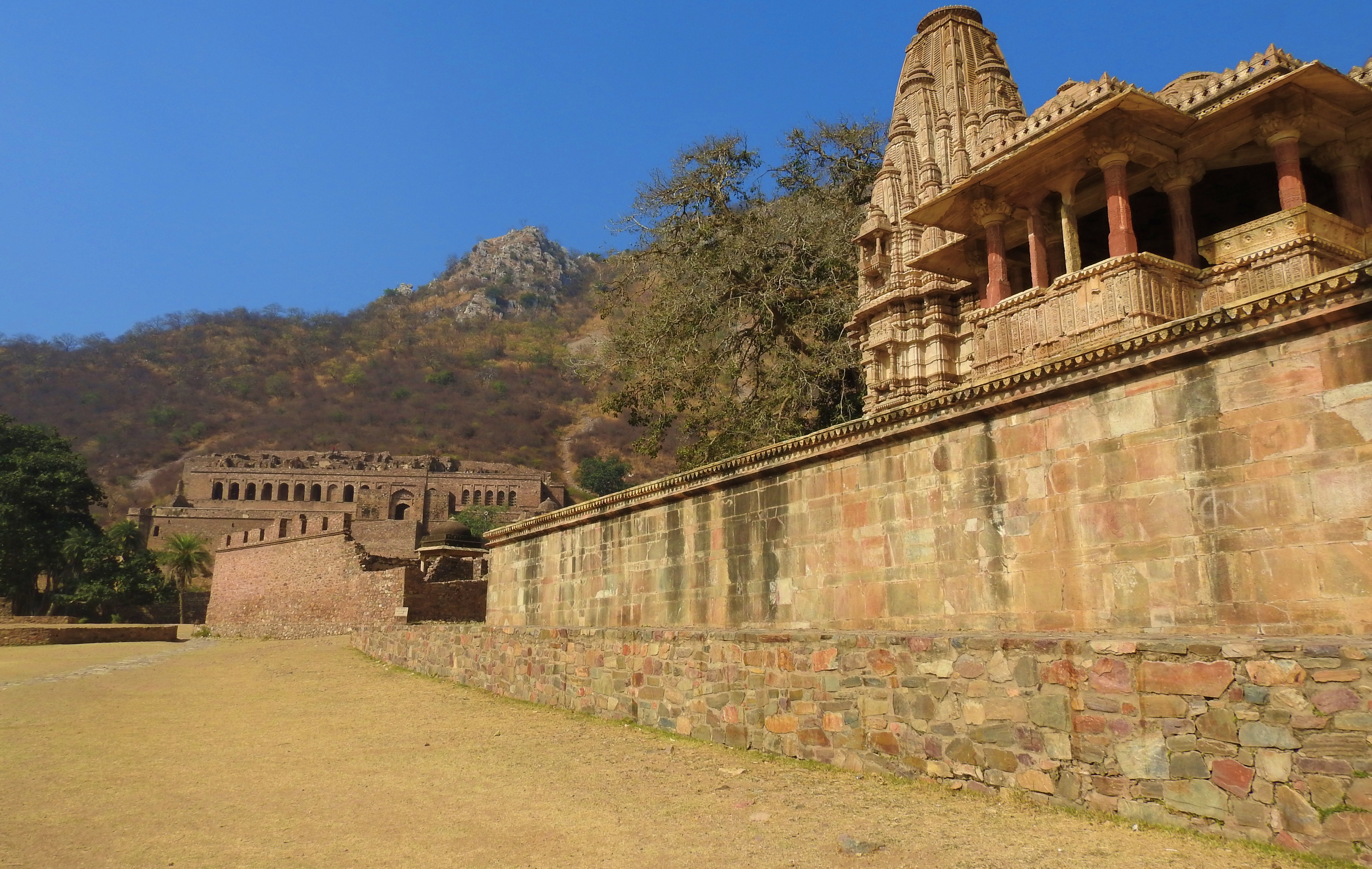
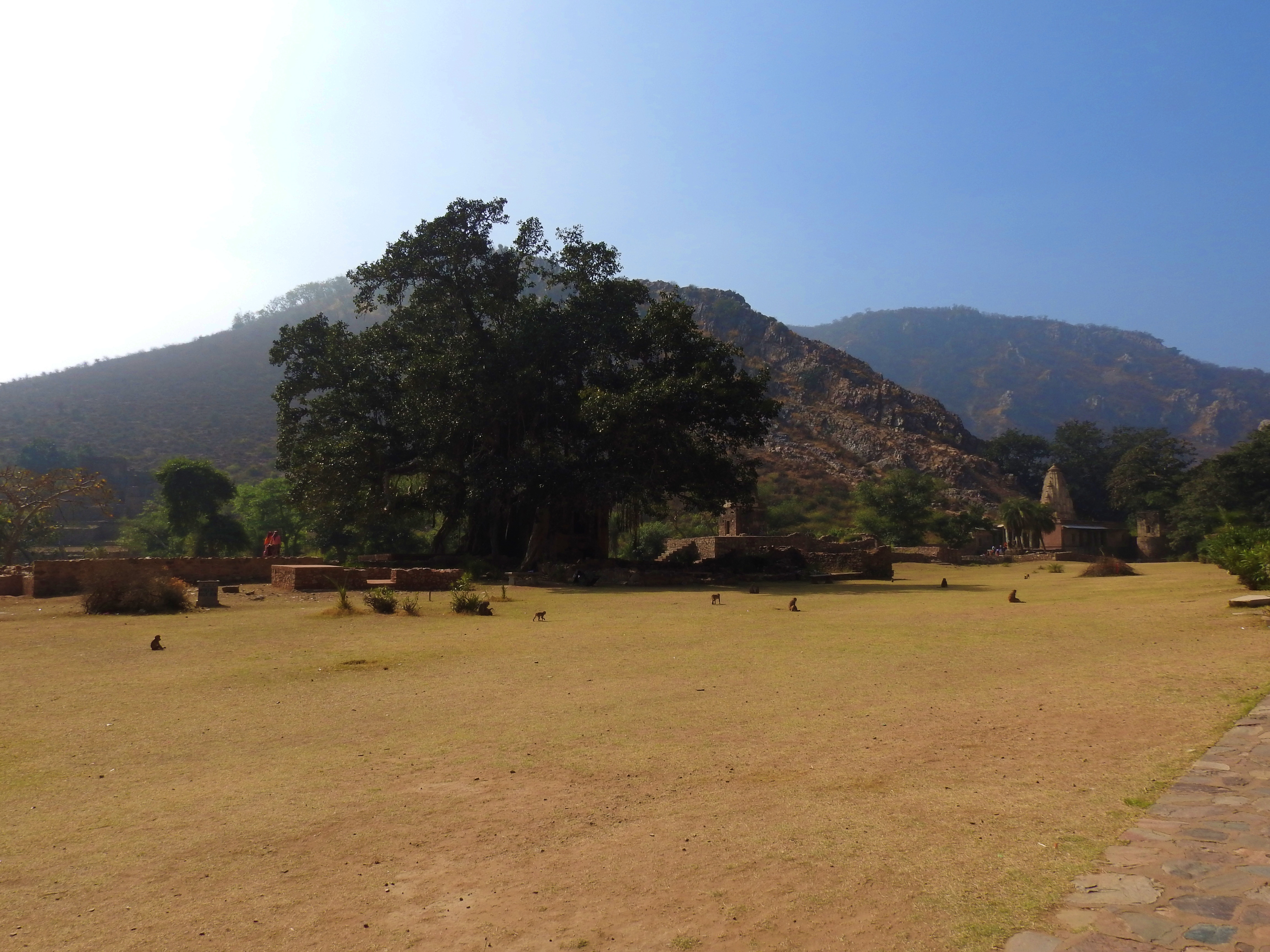
The Bhangarh Fort exemplifies traditional town planning. The bazaar, common residences, temples and the main fort complex – all are well designed. We saw how the ramparts were spread far, even into the neighboring forests. Apart from the main palace, the Bhangarh Fort also holds havelis, temples and a natural water tank.
As we walked towards the entrance, we were flanked by banyan trees. Walking past the bazaar ruins, I couldn’t help thinking how it would have been a bustling market once.
Read Our Earlier Post On The Bhangarh Fort Here!
Right after entering, we came upon the Gopinath Temple. It is the most impressive one amongst all the temples at the Bhangarh Fort. It has fabulous carvings. Within its circular dome, the statuettes have musical instruments in their hands! Wow!!
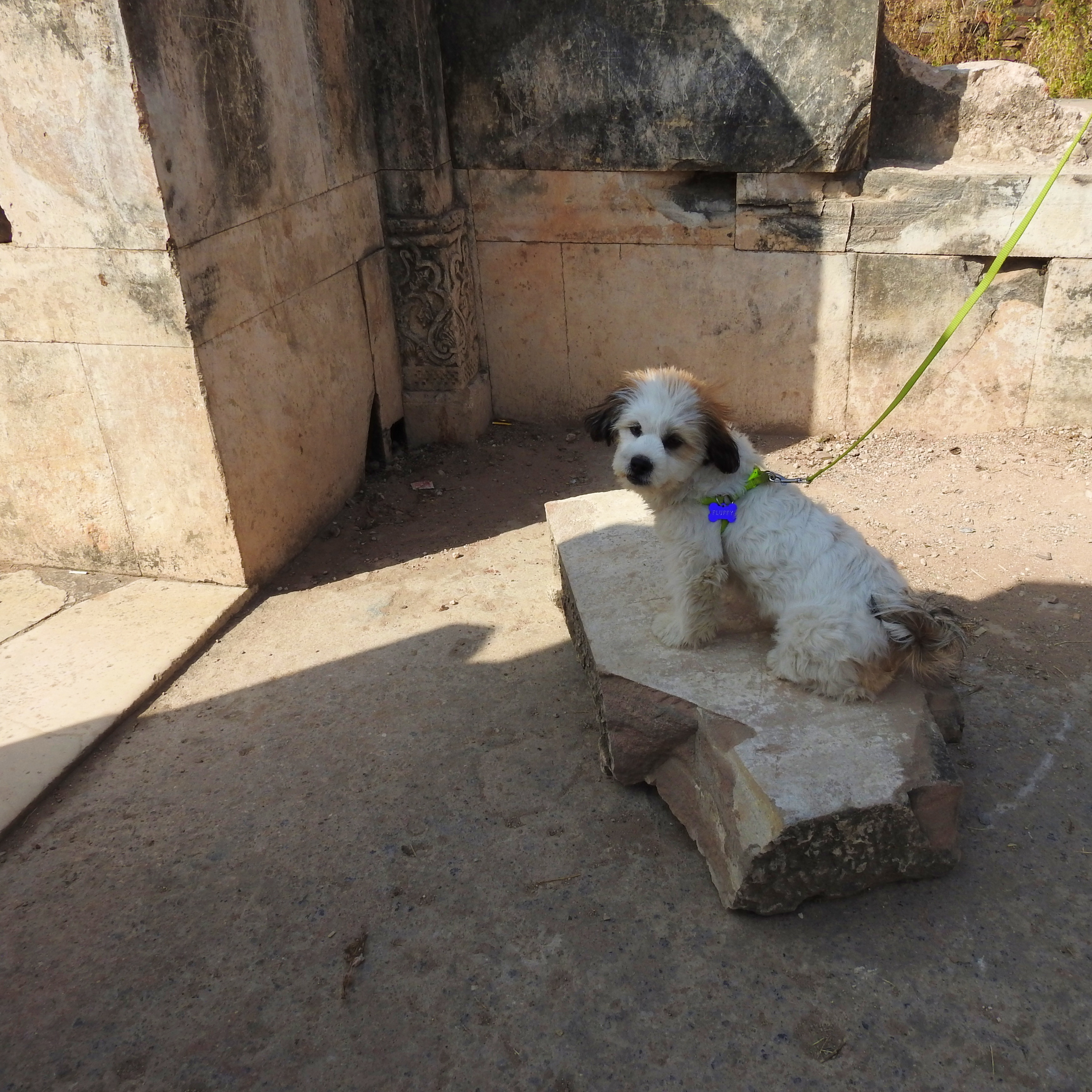
The ticket counter gentleman was kind enough to let us take Fluffy inside the Bhangarh Fort.
The Bhangarh Fort is believed to be haunted. There are countless tales that augment its mystery. One legend goes that the saint approved the fort construction with a condition. The condition was that the shadow of the king’s palace wouldn’t fall on his retreat. But when this was dishonored, by the saint’s anger, Bhangarh transformed into a cursed city.
Another legend attributes it to Princess Ratnavati’s beauty. A sorcerer adopted to entice her with his magic. Still, the Princess saw through his trickery. His magical oil morphed into a rock, rolled towards him & crushed him. Before dying, he cursed the Bhangarh Fort. The curse began to fructify. Strange incidents started occurring.
So, the residents decided to leave it in a single night and settle elsewhere.
On a hill towering above the Bhangarh Fort, we spotted a cenotaph. This is said to be the sorcerer’s chhatri. Over time, the stories have become more solid. Bhangarh features regularly in ‘Haunted Places in India’ lists. There have been stories about people who tried to stay at the Bhangarh Fort after sunset.
Bhangarh – The Cursed City
Unfortunately, these people did not come out alive. Because of this, the Archaeological Survey of India has prohibited entry after dusk. All of this has made the Bhangarh Fort famous. We noticed the stream of tourists. Given the number of visitors roaming around, it seemed more like a picnic destination rather than a haunted place.
But it would be interesting to see what ambiance the Bhangarh Fort takes after sunset! Irrespective of all the fables, do go there to find out for yourself if it is really haunted.
The best time to visit is from November to February. We scaled the Bhangarh Fort on a January afternoon. It was quite warm then. And guarantee you engage a guide; ours claimed to have heard women crying there!
Just writing about this holiday to the Bhangarh Fort has us elated, knowing that we had seen something exceptional!

A Vantage Point at the Bhangarh Fort
While returning from the Bhangarh Fort to the Umaid Palace, we encountered an oil tanker dangerously swerving on the highway. The drive was either asleep or drunk. At any moment, we felt, the tanker would collide with the divider or would drive off the road. We found a gap amidst this zigzagging and managed to escape.
Indian highways bring their own share of stories, don’t they?
Frolic at the Umaid Palace
Our stay at the Umaid Palace was enjoyable. Yet, since then, we have been there twice for lunch. It has underwhelmed us. It seems as if it is continuously in a renovation mode. Also, we have never seen any guests staying there. Having said that, when we had stayed, in 2021, we had had a magnificent time. You can read the full review here.
Umaid Palace
Umaid Palace had all facilities we needed. Food (particularly all the green vegetables) & service were excellent. Fluffy had an enchanting time. We left her leash – free in the garden when the other guests were not around. She ran around in the vegetable patches; even posed for the shutterbugs amidst the mustard fields.
At night, we enjoyed bonfires to ward off the cold. The lighting of the Umaid Palace was quite wonderful. They have a lot of potential; I hope they pull up their socks soon!
